
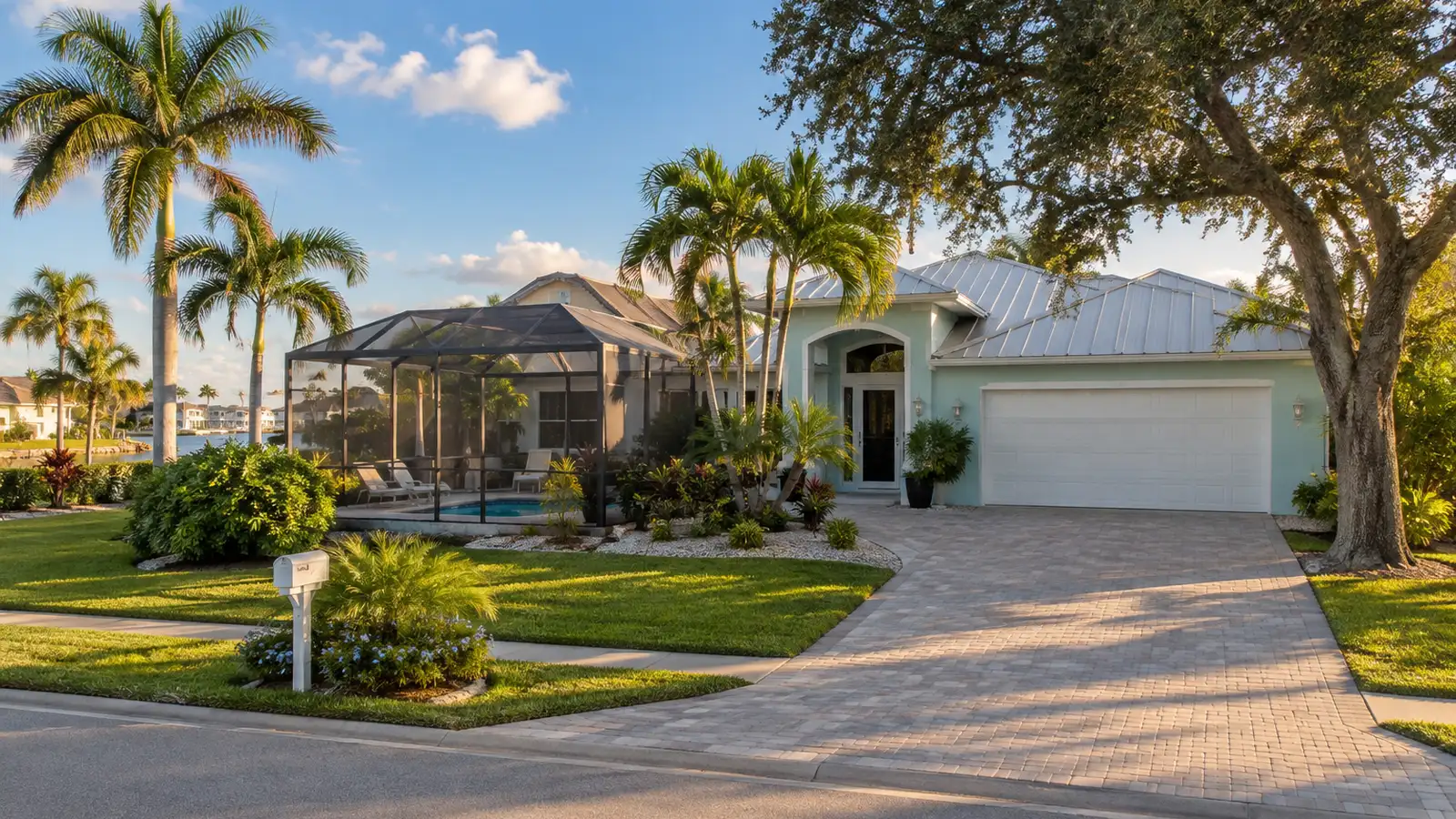
Every whole-home short term rental in Florida needs a state license before the first paying guest checks in. Vacation rentals in Florida are licensed by the state, registered with the county for tourist tax, and in many Florida cities certified again at city hall, and each layer has different rules. The state license comes from the Division of Hotels and Restaurants at the Florida Department of Business and Professional Regulation (DBPR), it is issued online, and for a single house or condo it costs $230 in the first year. What trips up property owners is everything stacked around it: the tourist tax account, the city business tax receipt, the local vacation rental certificate, and a renewal calendar that depends on which of DBPR's seven districts your county sits in. This guide walks through how to get a Florida vacation rental license step by step, in the order you should actually do it, with every fee and deadline taken from the state's own pages, plus the local regulations that sit on top.
Every number below comes from a primary source: the vacation rental definition in Florida Statutes 509.242, the fee and district tables on DBPR's Guide to Vacation Rentals and Timeshare Projects and its lodging fees page, and the Florida Department of Revenue's tax rules. This is the procedural how-to for property owners. For state preemption, the 2011 grandfather clause, HOA rules and the vetoed Senate Bill 280, read our Florida short term rental laws guide; for the tax stack, the Florida rental tax guide.
Quick answers
- Who needs a Florida vacation rental license? Anyone renting an entire house, townhouse, condo or unit in a two- to four-family building more than three times in a calendar year for stays under 30 days, or advertising it as a place regularly rented to guests. Renting a room while you live there does not require one.
- How much does it cost? A new single-unit license is $50 application fee + $10 Hospitality Education Program (HEP) fee + $170 full-year license fee = $230. Renewals are $180 a year ($10 HEP + $170). Apply after your district's half-year date and the license fee drops to $90.
- How long does it take? DBPR says online applications are usually processed in one to two business days, and the digital license is emailed immediately after approval.
- When does it renew? Once a year on your district's fixed date: October 1 (Miami-Dade, Monroe), December 1 (Broward, Palm Beach, Collier, Lee), February 1 (Tampa Bay), April 1 (Orange, Osceola), June 1 (Panhandle, Northeast Florida). Full table below.
- Is the state license enough? No. Licensing requirements for short term rentals in Florida stack: you also need a Florida Department of Revenue sales tax account if you take any direct bookings, a county tourist development tax account in most counties, a local BTR, and in cities like Fort Lauderdale and Panama City Beach a separate local vacation rental certificate with its own inspection.
- What happens if I skip it? DBPR can fine up to $1,000 per offense under FS 509.261, per day for critical violations, and suspend or revoke the rental license. Cities add their own fines, up to $1,000 a day in Fort Lauderdale.
When a DBPR license is required
Florida law does not use the phrase "short term rental" for a rental property. It uses "vacation rental," defined in FS 509.242(1)(c) as "any unit or group of units in a condominium or cooperative or any individually or collectively owned single-family, two-family, three-family, or four-family house or dwelling unit that is also a transient public lodging establishment but that is not a timeshare project." The phrase doing the work there is "transient public lodging establishment." FS 509.013 defines that as a dwelling unit "rented to guests more than three times in a calendar year for periods of less than 30 days or 1 calendar month, whichever is less, or which is advertised or held out to the public as a place regularly rented to guests."
That trigger has two halves and either one is enough:
- Frequency test: more than three rentals in a calendar year, each shorter than 30 days or one calendar month. A fourth short stay in the same year makes the rental property a vacation rental.
- Advertising test: the property is "advertised or held out to the public as a place regularly rented to guests." A live Airbnb or Vrbo listing meets this test on day one, whether or not anyone has booked yet.
DBPR's own guide adds the one exemption that matters: renting a single room or rooms other than the whole unit "is not classified as a public lodging and would not require a license," although the city or county may still regulate it. A homeowner renting a spare bedroom while living in the house is outside DBPR's jurisdiction; an owner listing the whole house on weekends is inside it.
Two other property types fall outside vacation rental license rules. Monthly rentals, meaning every stay is 30 days or one calendar month or longer, are not transient and do not need a vacation rental license, though stays of 180 days or less still owe state and local rental taxes. And buildings with more than four units under one roof are licensed as transient apartments or hotels, not vacation rentals.
Vacation rental license types and the DBPR fee table
DBPR issues vacation rental licenses along two axes: the property type, and who holds the license. Requirements vary slightly by each.
Property classification: condo or dwelling
- Vacation Rental - Condominium: a unit or group of units in a condominium or cooperative.
- Vacation Rental - Dwelling: a single-family house, a townhouse, or a unit or group of units in a duplex, triplex, quadruplex, or other dwelling with four or fewer units.
The two classifications have separate online applications. A townhouse is a dwelling; a unit in a condo association is a condominium, even if it looks like a townhouse.
License holder: single, group or collective
- Single license: one single-family house or townhouse, or a unit or group of units in a single building, owned and operated by the same person or entity. This is the license most individual property owners hold.
- Group license: issued to a licensed agent to cover all units within a building or group of buildings in a single complex, such as a manager running several units in one condo tower.
- Collective license: issued to a licensed agent for houses or units at separate locations, limited to 75 units within one district. This is the license most property managers use to cover multiple units for many property owners under one number.
One point DBPR is careful to make: "licensed agent" does not mean the manager needs a real estate license. It means the owner has authorized the manager, usually through the management agreement, to hold the property out for rent on a transient basis.
Application fee, HEP fee and license fee
Per DBPR's lodging fees page, every vacation rental license has three parts:
- Application fee: $50, charged on new applications and change-of-owner applications only.
- Hospitality Education Program (HEP) fee: $10, charged every year, on the initial application and on every renewal.
- License fee, based on the number of rental units and whether you are inside the full-year or half-year window for your district.
| Single and group licenses | Full-year fee | Half-year fee |
|---|---|---|
| Single rental unit | $170 | $90 |
| 2 to 25 rental units | $180 | $95 |
| 26 to 50 rental units | $195 | $102.50 |
| 51 to 100 rental units | $210 | $110 |
| 101 to 200 rental units | $235 | $122.50 |
| 201 to 300 rental units | $265 | $137.50 |
| 301 to 400 rental units | $295 | $152.50 |
| 401 to 500 rental units | $320 | $165 |
| 501 or more rental units | $350 | $180 |
Collective licenses use a formula instead of a table: $150 basic fee + ($10 x number of rental units) for a full year, and half of that for a half-year application, plus the $10 HEP fee either way.
Worked examples for a short term rental:
- One condo, new application, full-year window: $50 + $10 + $170 = $230. Renewal the next year: $10 + $170 = $180.
- One house, new application, after the half-year date: $50 + $10 + $90 = $150, but you will renew at $180 within six months.
- Property manager with 20 homes on a collective license, full year: $150 + $200 + $10 HEP = $360, or $18 per home, which is why managed properties usually sit on the manager's collective rental license rather than each owner paying $180.
Two timing rules matter more than the amounts. First, "fees are based on the application date and licenses expire on the next renewal date," so DBPR warns you may pay for an initial application and then "in days or weeks" pay again to renew; wait to apply if you will not operate until after the renewal date. Second, all rental locations on one license must be in counties of the same district.
Step-by-step: how to get a Florida vacation rental license
Step 1: confirm zoning, HOA rules and local registration before you spend a dollar
The state license does not override local regulations on zoning or a condo association's rental restrictions. In unincorporated Osceola County, short term rentals are only allowed inside the Short Term Rental Planned Development (STRPD) overlay, and the Osceola checklist starts with "verify your zoning allows short-term rentals" before it mentions DBPR. In the City of Naples, single-family homes are limited to 30-day-or-longer rentals except three times per calendar year. Pull the zoning for the exact parcel, contact the local planning office if the map is unclear, read the HOA or condo documents, then apply. City requirements and county rules often differ for the same street.
Step 2: create a DBPR Online Services account
DBPR requires an Online Services account for vacation rentals. Every rental unit address "must be submitted through the license holder's DBPR Online services account," and DBPR will not accept unit changes by paper or email; everything is submitted online. Create the account in the name of whoever will hold the license: you, your LLC, or your manager if the property will sit on a collective license.
Step 3: choose the right application and enter every rental location address
From the guide page, pick either "Apply Online - Vacation Rental (Condo)" or "Apply Online - Vacation Rental (Dwelling)." The application asks for each rental location address, and DBPR's tip is blunt: "the number of units and number of rental location addresses should match." Later additions or removals are done inside your account under "Update the Number of Units On My License (Add/Remove)."
Step 4: pay the fees
Pay the $50 application fee, the $10 HEP fee and the full-year or half-year license fee. Check the district table first: if your half-year date is a week away, waiting saves $80 on a single unit, and if the renewal date is weeks away with no bookings yet, waiting saves a full renewal cycle.
Step 5: receive and display the license
DBPR states online applications are "usually processed in one to two business days and the digital license is emailed immediately after approval." Print it: state rules require you to "display all current licenses or copies of licenses in a conspicuous place on the premises." You will upload the license to local agencies in later steps, and you can confirm it appears in DBPR's public Vacation Rental Database, which refreshes daily.
Step 6: file a Certificate of Balcony Inspection if the building is three stories or more
For any vacation rental in a building of three stories or more, DBPR requires a Certificate of Balcony Inspection (form DBPR HR-7020) filed with the division every third year, "unless exterior balconies and stairs are 'common elements' of a condominium." Most condo towers qualify for that exemption, but you have to prove it to the division. Bay County's local registration packet asks for the same HR-7020 for rentals over two stories.
Step 7: register with the Florida Department of Revenue (Form DR-1)
Florida charges 6% state sales tax on transient rentals of six months or less, plus a county discretionary sales surtax of 0.5% to 1.5%. Airbnb collects and remits both on its Florida bookings. That does not make the registration optional. The Department of Revenue's registration page is direct: "If your business will sell taxable goods or services, you must register as a sales and use tax dealer to collect, report, and remit sales and use tax before you begin conducting business in Florida." Sign up online through the DOR tax application wizard or file the paper Form DR-1. You need the account if you take a single direct booking, a repeat guest who pays you outside the platform, or a mid-term stay under 180 days, and several local agencies ask for the certificate number on their own forms.
Step 8: open a tourist development tax (TDT) account
Counties levy their own tourist development tax on stays of 180 days or less under FS 125.0104, which covers "every person who rents, leases, or lets for consideration any living quarters or accommodations" in a condominium or other transient property "for a term of 6 months or less." Rates run from 2% to 6%. Who collects it varies: the Department of Revenue's Form DR-15TDT lists each rate and whether the tax is remitted to the state or "directly to the county." The counties Surge operates in all self-administer: Osceola 6%, Broward 6%, Bay 5% and Collier 5%, each listed as "collected by County."
Whether your platform remits that tax depends on whether it has an agreement with that specific jurisdiction. Airbnb's own Florida tax page lists Broward and Collier among the counties where it collects TDT; Osceola and Bay are not on that list as of this writing. Osceola's tax collector spells it out on its TDT application: Osceola "is NOT CONTRACTED with Airbnb, VRBO, Evolve, or any other third-party booking platforms," so the owner or agent remits the 6% tax, with a $5 application fee and monthly filing for the first year. Bay County owners sign up at the county's tourist tax remittance site, which moves from the Clerk of Court to the Tax Collector on October 1, 2026. Even where the platform remits, you still need your own account for direct bookings and for the local paperwork that asks for a TDT number.
Step 9: get your local business tax receipt and local vacation rental certificate
This is the layer most first-time property owners miss. On top of the state and TDT steps, most cities and many counties require a local business tax receipt (BTR), and a growing number of Florida cities have their own short term rental regulations: registration requirements, safety inspections, occupancy limits, parking rules and a 24/7 contact on file. Local requirements differ in each of Surge's four Florida markets; see below.
Step 10: calendar every renewal separately
By the time you are done, you will hold four or five credentials with different renewal dates: DBPR (district date), DOR and TDT (ongoing returns), the local BTR (usually September 30), and the local vacation rental certificate. Put each one in a calendar with a 60-day reminder.
DBPR renewal dates by district
DBPR splits Florida into seven license districts. Your renewal date and the date the half-year fee kicks in depend on where the property sits. All units on one license must be in the same district.
| District | Counties | Annual renewal date | Half-year fee begins |
|---|---|---|---|
| District 1 (Miami) | Miami-Dade, Monroe | October 1 | April 1 |
| District 2 (Fort Lauderdale) | Broward, Martin, Palm Beach | December 1 | June 1 |
| District 3 (Tampa) | Citrus, Hernando, Hillsborough, Pasco, Pinellas, Polk, Sumter | February 1 | August 1 |
| District 4 (Orlando) | Brevard, Indian River, Lake, Orange, Osceola, St. Lucie, Seminole, Volusia | April 1 | October 1 |
| District 5 (Jacksonville) | Alachua, Baker, Bradford, Clay, Columbia, Dixie, Duval, Flagler, Gilchrist, Hamilton, Lafayette, Levy, Marion, Nassau, Putnam, St. Johns, Suwannee, Union | June 1 | December 1 |
| District 6 (Panama City) | Bay, Calhoun, Escambia, Franklin, Gadsden, Gulf, Holmes, Jackson, Jefferson, Leon, Liberty, Madison, Okaloosa, Santa Rosa, Taylor, Wakulla, Walton, Washington | June 1 | December 1 |
| District 7 (Fort Myers) | Charlotte, Collier, DeSoto, Glades, Hardee, Hendry, Highlands, Lee, Manatee, Okeechobee, Sarasota | December 1 | June 1 |
For Surge's Florida markets: Kissimmee (Osceola) renews April 1, while a Davenport home across the line in Polk is District 3 and renews February 1, so two homes a few miles apart need two licenses. Fort Lauderdale and Naples renew December 1; Panama City Beach June 1; Miami Beach October 1. Renewal is the $10 HEP fee plus the full-year license fee, with no half-year rate. Miss the date and you are operating without a DBPR vacation rental license from that day forward.
What DBPR actually checks at short term rental inspections
DBPR does not inspect vacation rentals on a fixed schedule the way it inspects restaurants and hotels. Per the Legislature's own analysis of SB 280, the division "conducts inspections of vacation rentals in response to a consumer complaint," and logged 356 such complaints in fiscal year 2022-23. The published requirements from DBPR's guide are:
- Display all current licenses, or copies, in a conspicuous place on the premises.
- Keep the unit clean, safe and in good physical condition, and free of vermin.
- Bedding: sheets and pillowcases changed between each guest or once a week, whichever comes first; mattresses, comforters and pillows kept clean. Soap in wrapped bars or a dispenser. Cribs must meet Consumer Product Safety Commission standards.
- If dishes and glassware are provided, sanitize them between guests with a three-compartment sink or commercial dish machine, or post DBPR's "Notification of Exception to Sanitization Requirements" notice using the division's exact language.
- Smoke detectors in every living unit; a safe, proper electrical system with no extension cords in use; compliance with NFPA 101, the Life Safety Code.
- Buildings of three stories or more: the Certificate of Balcony Inspection every three years, unless the balconies and stairs are condo common elements.
- If you employ housekeepers or front-desk staff: annual human trafficking awareness training under FS 509.096, provided to new employees within 60 days of hire.
Penalties for operating without a license
The state penalties live in FS 509.261. Any short term rental or other public lodging establishment "operating without a license, or operating with a suspended or revoked license" may be subject to:
- "Fines not to exceed $1,000 per offense."
- Mandatory completion, at your expense, of a remedial education program.
- "The suspension, revocation, or refusal of a license," with suspensions capped at 12 months.
Subsection (2) is the multiplier: "the division may regard as a separate offense each day or portion of a day on which an establishment is operated in violation of a 'critical law or rule.'" Subsection (3) adds a posted closed-for-operation sign, and makes opening without a license, or while suspended, a second-degree misdemeanor.
Local penalties stack on top and are often larger. Fort Lauderdale's Ordinance C-26-39, adopted September 15, 2026, sets a $1,000-per-day penalty for operating or advertising a vacation rental without a city Certificate of Compliance and suspends repeat offenders for 180 days on a third violation and 365 on a fourth. Panama City Beach fines $500 for a first offense and $1,000 for a second, with a one-year certificate revocation on a third within 12 months, under Ordinance 1632. A $230 state license is cheap insurance against any of that.
How the state license interacts with local short term rental regulations
Florida has no statewide ban on short term rental properties and no statewide registry; vacation rentals in Florida are licensed by the state and registered locally. Its preemption statute stops local governments from banning vacation rentals or capping how often you rent, but leaves registration, safety inspections, BTRs, occupancy limits, parking and noise rules to local regulations. So the DBPR license is a prerequisite for the local paperwork, not a replacement for it; every program below asks for proof of the state license first.
| Market | Local registration on top of DBPR | Local fees | Tax stack |
|---|---|---|---|
| Kissimmee / Osceola | Zoning check against the STRPD overlay; Osceola LBTR; City of Kissimmee BTR if inside city limits; TDT account (self-remit) | LBTR $30 a year; TDT application $5 | 6% state + 1.5% surtax + 6% TDT = 13.5% |
| Fort Lauderdale / Broward | City Vacation Rental Certificate of Compliance with inspection; city BTR; TDT account | $880 registration per folio including first inspection; $100 reinspection; renewal $650 (non-owner-occupied) or $200 (homestead); BTR $157.50; $100 late fee | 6% state + 1% surtax + 6% TDT = 13% |
| Panama City Beach (city limits) | City Vacation Rental Certificate under Ordinance 1632 with life-safety inspection; PCB BTR; Bay TDT account | $250 registration; $75 inspection invoice; $150 re-registration; late ladder $25 to $100, new $250 application after 91 days | 6% state + 1% surtax + 5% TDT = 12% |
| Unincorporated Bay County (Laguna Beach, Sunnyside, Inlet Beach) | Ordinance 23-18 registration for one- to four-family structures (high-rise condos exempt); notarized affidavit, fire self-inspection checklist, TDT registration, DBPR license, HR-7020 for rentals over two stories | $250 initial inspection; $50 reinspection; $100 lock-out; $150 renewal | 6% state + 1% surtax + 5% TDT = 12% |
| Naples / Collier | Collier Ordinance 2021-45 registration for unincorporated areas (City of Naples, Marco Island and Everglades City exempt); City of Naples single-family homes limited to 30-day minimums except three times a year | Registration fee not published on the Collier page we verified; confirm with Collier | 6% state + surtax + 5% TDT (per DR-15TDT) |
A few details behind that table. In Osceola County, a business inside Kissimmee or St. Cloud city limits "requires both a municipal license and a County Local Business Tax Receipt," and Kissimmee's BTRs expire September 30 regardless of when you bought them. Fort Lauderdale's renewal deadline is August 1 with certificates expiring September 30; a late renewal is treated as a brand-new $880 application. Panama City Beach requires the DBPR license, proof of Bay TDT registration and a valid PCB BTR number as attachments to the city application, which is why the order of steps above matters: state first, county second, city last.
Other cities follow the same pattern with different rules and fees. Orlando, Miami Beach and Tampa each run their own registration programs with their own fee schedules, and Miami Beach in particular runs some of the strictest zoning and enforcement in the state. We have not verified those fee schedules against the city sites for this guide, so we are not publishing numbers for them; contact the city's short term rental office directly before you buy a rental property there. For the city-by-city management picture, see our guides to Kissimmee, Fort Lauderdale, Panama City Beach, Naples, Miami and West Palm Beach.
What Airbnb and Vrbo require for short term rentals in Florida
The platforms are not licensed by DBPR; the division's own FAQ says that while vacation rentals advertised on a hosting platform are subject to its jurisdiction, "the hosting platforms are not licensed by the division." Airbnb's Florida help page is equally clear on the host's side: "The state of Florida requires that all vacation rentals in the state be licensed through the DBPR,".
Current Florida law does not require a DBPR license number to appear in every online listing. That requirement was part of Senate Bill 280, which passed the Legislature in 2024 and was vetoed by Governor Ron DeSantis on June 27, 2024, and no successor bill has advanced in the 2025 or 2026 sessions as of this writing. Local ordinances are a different matter: Bay County requires its certificate number on any advertising, and Fort Lauderdale fines advertising without a Certificate of Compliance at the same $1,000 a day as operating without one. The safest approach is to put your DBPR license number and any local certificate number in the listing description and in any registration field the platform offers.
On taxes, Airbnb's Florida page confirms it collects and remits the 6% state transient rental tax and the county surtax on every Florida booking, and collects county TDT only in the counties on its published list. Check your other platforms' own Florida tax pages the same way rather than assuming. Osceola states it is not contracted with Airbnb, Vrbo or any other booking platform, and Bay County is not on Airbnb's list either, so owners there file the county tax directly no matter which platform the booking came through.
What property managers handle vs. what stays with the owner
When a professional manager takes over, most compliance work moves with it. A home on a group or collective license is the licensed agent's responsibility: Rule 61C-1.002(4)(a)2.e. of the Florida Administrative Code says "the licensed agent shall be responsible for all violations pursuant to Chapter 509" while the unit is listed under that agent. In practice a full-service manager will:
- Add your home to its collective or group license (or help you file a single license if you prefer to hold your own), and keep the renewal paid.
- Register and file the tourist development tax where the platform does not, and reconcile platform-remitted taxes against payouts.
- Pull the city or county vacation rental certificate, schedule the life-safety inspection, and post the required interior notices and exterior signage.
- Serve as the 24/7 responsible party and local contact that Fort Lauderdale, Panama City Beach and Bay County require on file.
What stays with you as the owner: the zoning and HOA check before purchase, the homestead decision (under FS 196.061, renting all or substantially all of a homesteaded dwelling counts as abandoning the homestead, so talk to your property appraiser before listing a primary residence), insurance, and the management agreement's exit terms. If your home sits on a manager's collective license, get it in writing what happens to licensing, tax accounts and the listing when you leave. Surge handles the full compliance stack for owners across our Florida markets starting at 15% for full service; see the Kissimmee, Fort Lauderdale, Panama City Beach and Naples service pages for how it works in each market, and our management cost guide for what those fees cover.
Key takeaways
- A state DBPR license is required the moment you advertise a whole home for stays under 30 days, or take a fourth short stay in a calendar year. Without the proper license you are operating illegally from day one.
- First-year cost for one unit is $230; renewals are $180; half-year applications pay $90 for the license fee. Collective licenses run $150 + $10 per unit.
- The state license is step one of five: DOR registration, county TDT account, local BTR and local vacation rental certificate follow, in that order.
- Unlicensed operation costs up to $1,000 per offense at the state level, per day for critical violations, plus $500 to $1,000 a day locally.
Deciding where to buy? Our data posts rank the best places to buy an Airbnb in Florida and the most profitable Airbnb cities in Florida using revenue, ADR and occupancy figures pulled by Surge in September 2026.
Frequently asked questions
Do I need a Florida vacation rental license for an Airbnb?
Yes, if you rent the entire home, whether it is a single family home or a condo. A whole unit rented more than three times a year for stays under 30 days, or advertised as regularly rented to guests, is a vacation rental that must be licensed, and a live listing meets the advertising test. Renting a single room while you live in the home does not require the state license.
How much is a Florida vacation rental license?
$230 for a new single-unit license in the full-year window: $50 application fee, $10 Hospitality Education Program fee and $170 license fee. Renewals are $180. If you apply after your district's half-year date, the license fee is $90, for a $150 total. Collective licenses held by property managers cost $150 plus $10 per unit plus the $10 HEP fee.
How long does it take to get a DBPR license?
DBPR says online applications are usually processed in one to two business days and the digital license is emailed right after approval. The local certificate is the slow part: Fort Lauderdale quotes 10 to 12 business days in its busy season, and Panama City Beach and Bay County both require an in-person inspection before the certificate issues.
Do I still need to register with the Department of Revenue if Airbnb collects the tax?
You should. Airbnb remits state sales tax and county surtax on its own bookings, but the Department of Revenue requires anyone selling taxable services to register first, and you owe the tax yourself on any direct or off-platform booking. You can sign up through the DOR online application or paper Form DR-1.
Can a city require its own license on top of the DBPR license?
Yes. Local rules vary by city. State preemption stops local governments from banning vacation rentals or limiting rental frequency, but registration, inspections and BTRs are allowed. Fort Lauderdale ($880), Panama City Beach ($250), unincorporated Bay County ($250) and Osceola ($30 LBTR) all require local registration in addition to the state license.
What if I only rent for a month at a time?
Stays of 30 days or a full month or longer are not transient, so a rental property rented only monthly does not need a state license. State sales tax and tourist development tax still apply to any stay of six months or less, so the DOR and TDT accounts are still required.
Get the license handled
The state license itself is a $230, two-day task. The tax accounts, the local certificate, the inspection and the separate renewal dates are where short term rental owners lose weekends and, occasionally, $1,000 a day. Surge manages licensing, registration, tax filing and ongoing compliance with local regulations for property owners across our Florida markets, starting at 15% for full service. Start with our Florida management page, compare fees on our Airbnb management hub, or check the market pages for Orlando, Fort Lauderdale, Panama City Beach and Naples to see where your property fits.

Written by
Humberto MarquezFounder, Surge
Founder of Surge and licensed Texas real estate broker. Manages short-term rentals across 12 U.S. markets and invests in STRs himself. Quoted in Martha Stewart, Yahoo Finance, Realtor.com, Bob Vila.
More about Humberto →See what your property could earn with Surge
Full-service short term rental management across Texas and Florida. Get a free property assessment and revenue estimate, no commitment.