
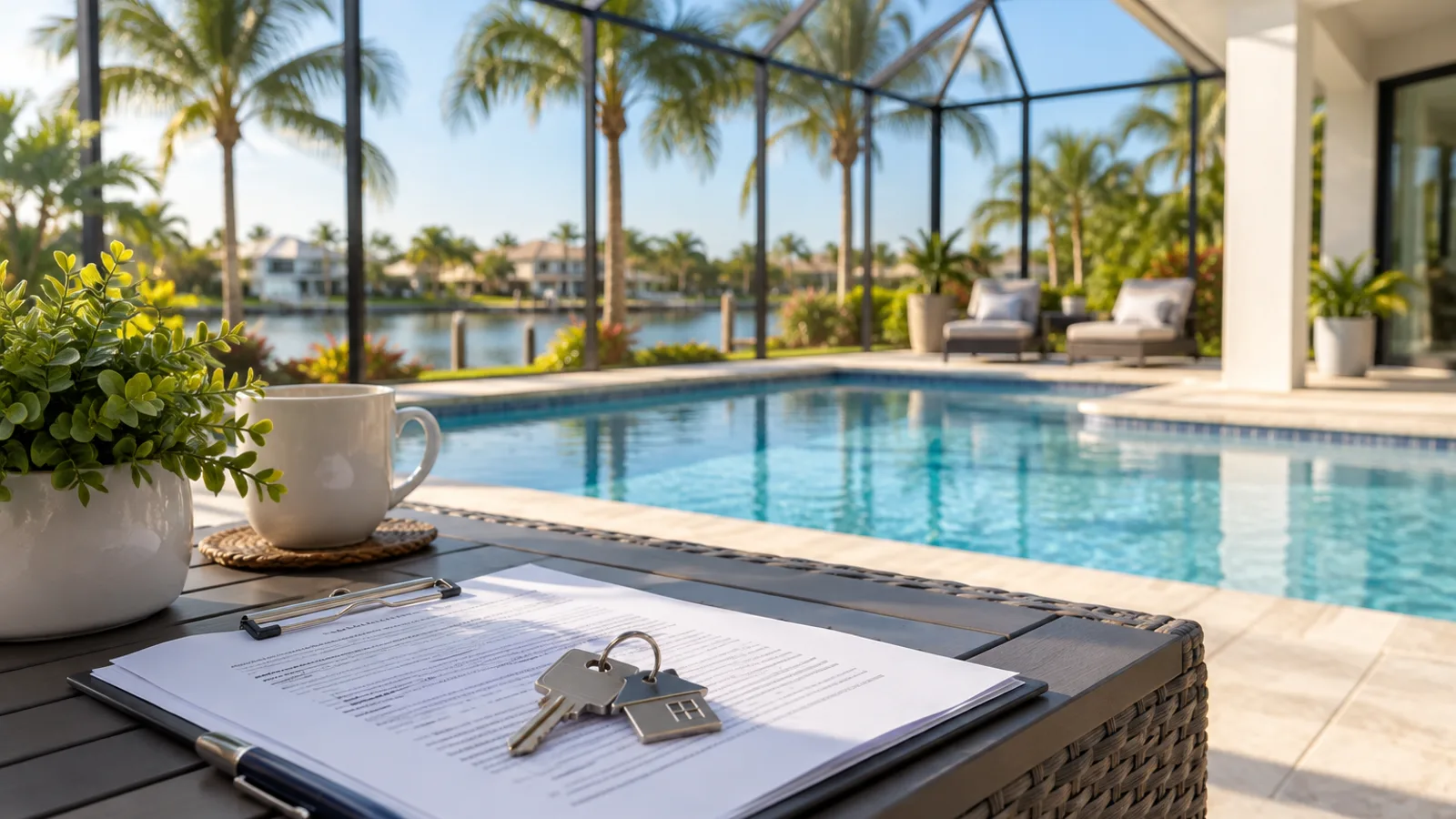
Florida short term rental laws run on a two-layer system: the state sets the floor and caps what cities can do, and cities and counties fill in the rest with registration, safety, and nuisance rules. If you own or manage a vacation rental in Florida, you need to clear both layers, and the local layer looks different in Kissimmee than it does in Fort Lauderdale. This guide breaks down what the state controls, how DBPR licensing actually works, what taxes apply, and what each of Surge's Florida markets requires as of this writing. If you searched "florida short term rental laws" looking for the current, non-hypothetical rules, this is that guide: real statute citations, real fee tables, no pending-bill guesswork treated as settled law.
Every legal and tax fact below was pulled from a primary source: Florida Statutes on flsenate.gov, license fees from myfloridalicense.com, the state sales tax rate from floridarevenue.com, and city-level rules from each city or county's own site. For a deeper walkthrough of the tax stack specifically, see our Florida rental tax guide, and for insurance, see Florida Airbnb insurance requirements.
What the state controls vs. what cities control
Florida defines a "vacation rental" in Florida Statutes 509.242 as a condo, co-op, or single-family through four-family dwelling that also meets the definition of a "transient public lodging establishment." That transient definition, in FS 509.013, is the one that actually decides whether a property is regulated: a unit "rented to guests more than three times in a calendar year for periods of less than 30 days or 1 calendar month, whichever is less, or which is advertised or held out to the public as a place regularly rented to guests." Rent it three times or fewer per year for stays under 30 days, and never advertise it as short term, and it falls outside vacation rental regulation. Advertise it as an Airbnb, and it doesn't matter how many bookings you actually take: you're covered.
The state preempts most of the regulation to itself. FS 509.032(7) is blunt about it: sanitation standards, inspections, and personnel training for public lodging establishments are "preempted to the state." The subsection that matters most for owners is 509.032(7)(b): "A local law, ordinance, or regulation may not prohibit vacation rentals or regulate the duration or frequency of rental of vacation rentals." In plain terms, a city cannot ban Airbnbs outright and cannot set a minimum-stay or annual-rental-count rule for a single-family home, unless that rule predates June 1, 2011, in which case it's grandfathered in and stays enforceable. That grandfather clause is why the City of Naples can still hold single-family homes to a 30-day minimum: its ordinance predates the cutoff.
What's left for local governments: registration and licensing programs, safety and fire inspections tied to the building and fire code, and ordinary nuisance rules on noise, parking, trash, and occupancy limits. None of that is a ban and none of it touches minimum stay or rental frequency, so it survives preemption. That's the split you'll see repeated in every one of Surge's Florida markets below: no city can tell you that you can't rent short term, but every city can make you register, pay a fee, and pass an inspection first. State law sets the ceiling on how far local laws and local ordinances can go; it does not erase local authorities entirely.
Where a statewide overhaul stands right now
The Legislature has tried to rewrite this framework almost every year for a decade. The most serious recent attempt, SB 280, would have given the state more control over local vacation rental rules and added statewide registration and advertising requirements. It passed the Legislature in 2024 and Governor DeSantis vetoed it on June 27, 2024. No lawmaker picked the bill back up for the 2025 session, and as of this writing there is no equivalent statewide preemption or registration bill advancing in the 2026 session; the closest 2026 bill touching vacation rentals (SB 658/608) deals with pool water-safety features, not licensing or preemption. Bottom line for owners: the current 509.032/509.013/509.242 framework, unchanged since the last amendment, is what governs your property today. Don't build a compliance plan around a bill that hasn't passed.
DBPR licensing, step by step
Every Florida vacation rental needs a license from the Division of Hotels and Restaurants at the Department of Business and Professional Regulation (DBPR) before it accepts a paying guest. There is no way around this for a property that meets the FS 509.013 definition.
1. Pick your license type
- Single license: one owner, one unit.
- Group license: one owner, multiple units in the same license district.
- Collective license: a licensed agent (property manager) holding units for multiple owners under one license, common for management companies.
2. Pay the fees
Per the DBPR's own fee guide, every new application carries a flat $50 application fee plus a $10 Hospitality Education Program (HEP) fee, on top of the license fee itself:
| Capacity | Full-year fee | Half-year fee |
|---|---|---|
| Single rental unit | $170 | $90 |
| 2 to 25 units | $180 | $95 |
| 26 to 50 units | $195 | $102.50 |
| 51 to 100 units | $210 | $110 |
| 101 to 200 units | $235 | $122.50 |
Collective licenses use a different formula: a $150 basic fee plus $10 per rental unit, full year (half that for a half-year application).
Your renewal date and the point where you switch from full-year to half-year pricing depend on which of DBPR's seven license districts your county sits in. Fort Lauderdale, Martin, and Palm Beach are District 2 (annual renewal December 1, half-year rate starts June 1). Orlando's district, District 4, covers Osceola and renews April 1 (half-year starts October 1). Bay County (Panama City Beach) is District 6, renewing June 1. Collier County (Naples) is District 7, renewing December 1.
3. Meet the safety requirements
DBPR does not routinely inspect vacation rentals the way it inspects hotels. Per the Legislature's own analysis of SB 280, "the division conducts inspections of vacation rentals in response to a consumer complaint," and it logged 356 such complaints in fiscal year 2022-23 alone. That's complaint-driven enforcement, not a scheduled visit, which means the burden is on the owner to actually meet the rules rather than wait to get caught. The baseline requirements: smoke detectors in every living unit, no extension cords substituting for real wiring, and compliance with NFPA 101 (the Life Safety Code). Any vacation rental in a building of three stories or more must file a Certificate of Balcony Inspection with the division every three years unless the balconies and stairs are condo common elements. Vacation rental condominiums in buildings of three stories or more with interior egress, or over 75 feet tall, need automatic fire sprinklers under NFPA 13.
4. Renew every year
Licenses are not evergreen. Miss your district's renewal date and you're operating unlicensed, which triggers the penalties covered below.
Taxes: a quick map (full detail in our tax guide)
Florida stacks three tax layers on a short term rental, and none of them are optional:
| Tax | Rate | Who collects it |
|---|---|---|
| State sales tax | 6% | Platforms (Airbnb, Vrbo) collect and remit statewide |
| County discretionary surtax | Varies by county | Platforms collect and remit alongside state tax |
| County Tourist Development Tax (TDT) | 2% to 6%, county-set | Depends on the county: some are self-administered and collect it directly from the owner or agent, others have a voluntary agreement with the platform (Florida DOR's DR-15TDT lists which counties self-administer) |
Florida's general state sales tax rate is 6%, confirmed on the Florida Department of Revenue's own page. The trap owners fall into is assuming a platform handles everything: platforms reliably collect the state 6% and the county surtax on every booking, but the county Tourist Development Tax is a separate arrangement county by county. In Broward County, for example, the combined rate on a short term rental runs 13% (6% state, 1% Broward surtax, 6% Broward TDT), and the TDT portion is collected by the county, not the platform. Don't assume your county works the same way; check your own county tax collector before you set a nightly rate. For the full breakdown by tax type and who owes what, read our Florida rental tax guide.
Local rules in Surge's Florida markets
Every one of these rules sits on top of the state license, not instead of it. Registering with a city or county does not exempt you from DBPR.
Kissimmee / Osceola County
Osceola County zones short term rentals through a dedicated Short Term Rental Planned Development (STRPD) overlay. Before you do anything else, the county's own guidance is direct: "Verify your zoning allows short term rentals" using the county's short term rental overlay map. Osceola also runs its own Tourist Development Tax program, charged on "any short term rental (less than 180 days)" per the county tax collector, and the county is not contracted with Airbnb, Vrbo, or Evolve to collect it for you: the owner or agent has to register and remit the 6% Tourist Tax directly. Kissimmee sits in DBPR District 4 with Orlando, so your state license renews April 1. See our Kissimmee management guide and the Kissimmee service page.
Fort Lauderdale / Broward County
Fort Lauderdale runs one of the more expensive and unforgiving registration programs in the state. Registration is $880 per folio (which includes the first inspection), with a $100 fee for any inspection, reinspection, or missed appointment, and a $50 agent-transfer fee. Renewal runs $650 for a non-owner-occupied property or $200 for a homestead property, plus a $157.50 city business tax receipt. Certificates expire September 30 and renewal is due by August 1; miss it and you're filing a brand-new $880 application. Under Ordinance C-26-39, operating or advertising without a valid Certificate of Compliance carries a $1,000-per-day penalty, an expired certificate escalates from a $250 fine to $1,000 a day, and repeat violations trigger a 180-day suspension on the third offense and a 365-day suspension on the fourth. The combined tax rate here is 13%: 6% state, 1% Broward surtax, 6% Broward TDT, with the TDT collected by the county. See our Fort Lauderdale management guide and the Fort Lauderdale service page.
Panama City Beach / Bay County
Panama City Beach requires a Vacation Rental Certificate under city Ordinance 1632: "It is unlawful to rent or allow occupancy without one." Unincorporated Bay County runs a parallel program under Ordinance 23-18 (effective August 1, 2023), requiring annual registration, a notarized affidavit, a fire-safety self-inspection checklist, and Tourist Development Tax registration; the county notes that "in many cases, the ordinance simply solidifies the rules ... under which short term rentals were already operating." High-rise condos and apartment complexes are exempt from the county ordinance; only one- to four-family structures are covered. Bay County is DBPR District 6, renewing June 1. See our Panama City Beach management guide and the Panama City Beach service page.
Naples / Collier County
This market has two different rulebooks depending on the address. Unincorporated Collier County requires registration under Ordinance 2021-45 (effective January 3, 2022) for any property "rented to guests, in increments of less than 30 consecutive days or less than 1 full calendar month, more than 3 times" a year. The City of Naples, City of Marco Island, and Everglades City are explicitly carved out of that county ordinance and set their own rules. In the City of Naples specifically, single-family homes face a 30-day minimum stay, with a narrow exception: "3 times per calendar year, a property may be rented for less than 30 days," and the property "may not be advertised as available for less than 30-day rentals." That 30-day rule predates the state's 2011 grandfather cutoff, which is exactly why it survives preemption. Collier County is DBPR District 7, renewing December 1. See our Naples management guide and the Naples service page.
Miami Beach and Orlando: a short note
Miami Beach runs among the state's strictest zoning and enforcement regimes for short term rentals, with fines that can run into the thousands per violation in restricted residential zones; check current zoning before you buy. Orlando limits home-sharing to owner-occupied properties in residential zones and treats investment-property short term rentals differently by zoning district. Both markets deserve their own deep dive: read our dedicated guides at Miami short term rental laws and Orlando short term rental laws.
Checking a market outside Surge's four cities?
If you're weighing a property in Miami-Dade County, Orange County, Pinellas County, or Key West, run the same three checks: confirm your zoning districts allow short term rental properties, register with the local government before you take a booking, and separately confirm your DBPR license district and Tourist Development Tax registration. Local rules on off street parking space counts, maximum occupancy, and garage apartment or accessory-unit eligibility vary by county, so pull the local ordinance directly rather than relying on a neighbor's setup or a listing agent's description of what's allowed.
HOA and condo rules can override everything above
State preemption stops cities from banning vacation rentals. It does not stop your homeowners association or condo board. Florida Statute 718.110(13) is specific about how a condo association can restrict rentals: an amendment "prohibiting unit owners from renting their units or altering the duration of the rental term or specifying or limiting the number of times unit owners are entitled to rent their units during a specified period applies only to unit owners who consent to the amendment and unit owners who acquire title to their units after the effective date of that amendment." Translation: if you already own and never consented, a new rental ban usually can't be forced on you retroactively, but any buyer who closes after the amendment passes is bound by it automatically. Before you buy a condo for short term rental use, read the current declaration and any pending amendments, not just what the listing agent tells you the rules are today.
Penalties for skipping the license
DBPR has real teeth under FS 509.261: fines up to $1,000 per offense, mandatory remedial training at the operator's own expense, and license suspension or revocation, with each day of unlicensed operation countable as a separate offense. Local governments layer their own penalties on top; Fort Lauderdale's $1,000-per-day ordinance fine (Ordinance C-26-39) is a good example of how steep the local layer alone can get. Run the math before you decide registration paperwork isn't worth the hassle: a two-week delay in Fort Lauderdale alone could theoretically reach $14,000 in local fines before DBPR even gets involved.
Compliance checklist
- Confirm your property crosses the FS 509.013 rental-frequency threshold: more than three rentals a year under 30 days, or advertised as short term. This is the state law test that decides whether every other item on this list applies to you.
- Apply for the correct DBPR license type (single, group, or collective) and pay the $50 application fee, $10 HEP fee, and the applicable license fee. Florida requires this before your first guest checks in, not after.
- Install smoke detectors in every unit, meet the general safety rules and safety inspections tied to NFPA 101, and file a Certificate of Balcony Inspection every three years if you're in a building of three stories or more.
- Register with your local government's short term rental program (Osceola's STRPD overlay, Fort Lauderdale's Certificate of Compliance, Bay County's Ordinance 23-18 packet, or Collier's Ordinance 2021-45, depending on your market) and keep proof of that registration and any re inspection fee receipts on file.
- Register for Florida sales tax with the Department of Revenue and confirm whether your county self-administers its Tourist Development Tax or relies on a platform agreement. Do not assume tax collection is fully automatic just because a platform handles bookings.
- Read your HOA or condo association's governing documents for rental restrictions under FS 718.110(13) before you close on a property, not after.
- Calendar your DBPR renewal date by license district and your local certificate's renewal deadline separately; they are rarely the same date, and letting either lapse restarts the clock on local permits and local taxes alike.
- If your rental property sits inside a zoning overlay or a residential zone with maximum occupancy limits, confirm those limits in writing from the local government, not from a rental agreement template.
Terms every Florida short term rental owner should know
State law, local ordinances, and your own HOA use overlapping vocabulary that means different things depending on who wrote it. A quick glossary, since getting these terms wrong is how property owners end up out of compliance without realizing it:
- Vacation rental: the state's legal term for a short term rental property, defined in FS 509.242. Most local ordinances borrow this exact definition rather than writing their own.
- Local governments / local authorities: cities and counties. They can pass local ordinances covering registration, zoning districts, occupancy limits, and parking rules, but under state preemption they cannot pass local laws that function as a ban or set minimum lease terms.
- Business and Professional Regulation: the Florida Department of Business and Professional Regulation (DBPR), the state agency that licenses every short term rental business, including single-property owners.
- Tourist Development Taxes: county-level bed taxes, separate from state sales tax, collected by the county or, in some counties, by the platform under a voluntary agreement.
- Responsible party: whoever is legally on the hook for tax collection, safety inspections, and code compliance. For a self-managed rental property, that's the owner. For a managed property, it is usually the licensed agent named on a collective license.
- Dwelling unit: the state's catch-all for the physical structure being rented, whether that's a single-family home, a garage apartment, a condo, or a unit inside a larger complex.
- Discretionary sales surtax: a county-added percentage on top of the 6% state sales tax, separate again from the Tourist Development Tax.
- Transient accommodations: another phrase you'll see in county tax code for the same thing state law calls a vacation rental; treat it as a synonym, not a separate category.
- Primary residence: some local ordinances (not Florida's state preemption statute) carve out owner-occupied, primary-residence home-sharing from the stricter rules that apply to pure investment properties; Orlando is the clearest example among Surge's markets.
Owners evaluating properties in Miami-Dade County, Orange County, or anywhere else in the state should treat this glossary the same way: read the local ordinance's own definitions section first, because "vacation rental," "transient rental," and "short term rental" are used inconsistently across Florida's 67 counties even though state law only recognizes one legal definition.
Quick answers
- Do I need a state license to run an Airbnb in Florida? Yes, if the property meets the FS 509.013 transient rental definition: rented more than three times a year for under 30 days, or advertised as available short term.
- Can a Florida city ban short term rentals outright? Not if the ban was adopted after June 1, 2011. Pre-2011 ordinances are grandfathered and can still prohibit or restrict duration and frequency.
- What can cities still regulate? Registration, safety and fire inspections tied to building code, and nuisance rules on noise, parking, trash, and occupancy.
- How much is the DBPR license? $50 application fee plus $10 HEP fee, plus $170 (single unit, full year) or $90 (half year), scaling up for group and collective licenses.
- What's the tax rate on a Florida vacation rental? 6% state sales tax plus a county discretionary surtax plus a county Tourist Development Tax of 2% to 6%; the combined rate in Broward County is 13%.
- Who collects the Tourist Development Tax? It depends on the county. Some counties have platform agreements, others (like Osceola) are not contracted with any platform and require the owner or agent to remit it directly.
- Can my HOA stop me from short term renting? Yes, under FS 718.110(13), but a rental restriction amendment only binds owners who consented to it or who bought after it passed.
- Did SB 280 pass and change the rules? No. It passed the Legislature in 2024 and was vetoed by Governor DeSantis on June 27, 2024. As of this writing, no replacement bill has advanced.
Frequently asked questions
Is Airbnb legal in Florida?
Yes, statewide, subject to a DBPR license and whatever local registration and safety rules apply in your specific city or county. No Florida city can ban vacation rentals outright unless its ban predates June 1, 2011.
What is the 3-times-a-year rule in Florida short term rental law?
It's the trigger in FS 509.013 that decides whether a dwelling counts as regulated lodging: a property rented more than three times in a calendar year for stays under 30 days is regulated as a vacation rental, and needs a DBPR license, regardless of how the owner personally thinks of it.
Does Florida require a business license for short term rentals?
You need the state DBPR license at minimum. Most cities also require a local business tax receipt or short term rental certificate on top of it; Fort Lauderdale's $157.50 city business tax receipt is one example.
How often does DBPR inspect vacation rentals?
Not on a routine schedule. Per the Legislature's own bill analysis, DBPR inspects vacation rentals in response to consumer complaints, not a fixed calendar, so owners carry the responsibility for staying compliant between inspections.
Can my condo association ban Airbnb even though the state doesn't?
Yes. State preemption under FS 509.032 only limits what local governments can do. It has no bearing on private HOA or condo association rules, which are governed separately by FS 718.110(13).
What happens if I operate without a DBPR license?
Fines up to $1,000 per offense under FS 509.261, with each day of unlicensed operation potentially counted separately, plus license suspension or revocation and mandatory remedial training. Local governments add their own fines on top.
Is the Tourist Development Tax the same as sales tax?
No. The 6% state rate on rental income is separate from the county Tourist Development Tax (2% to 6%, set by each county) and any county discretionary surtax. All three can apply to the same booking.
Will a new statewide law change all of this soon?
Possibly, but not yet. SB 280 would have added statewide registration and advertising rules; it was vetoed in June 2024 and no successor has advanced through the 2025 or 2026 sessions as of this writing. Treat the current statute, not a pending bill, as the rule that applies to your property today.
Let Surge handle the paperwork
Florida's licensing and registration rules change by county, and the fines for getting it wrong start at $1,000 per day in some cities. Surge handles licensing, registration, and ongoing compliance for owners across our Florida markets, starting at 15% for full service. See what that looks like on our Florida state page, or if you're mapping out a new property's local rules yourself, our Airbnb map maker can help you scope the neighborhood before you commit. Ready to talk specifics? book a call with Surge.

Written by
Humberto MarquezFounder, Surge
Founder of Surge and licensed Texas real estate broker. Manages short-term rentals across 12 U.S. markets and invests in STRs himself. Quoted in Martha Stewart, Yahoo Finance, Realtor.com, Bob Vila.
More about Humberto →See what your property could earn with Surge
Full-service short term rental management across 12 markets. Get a free property assessment and revenue estimate, no commitment.