
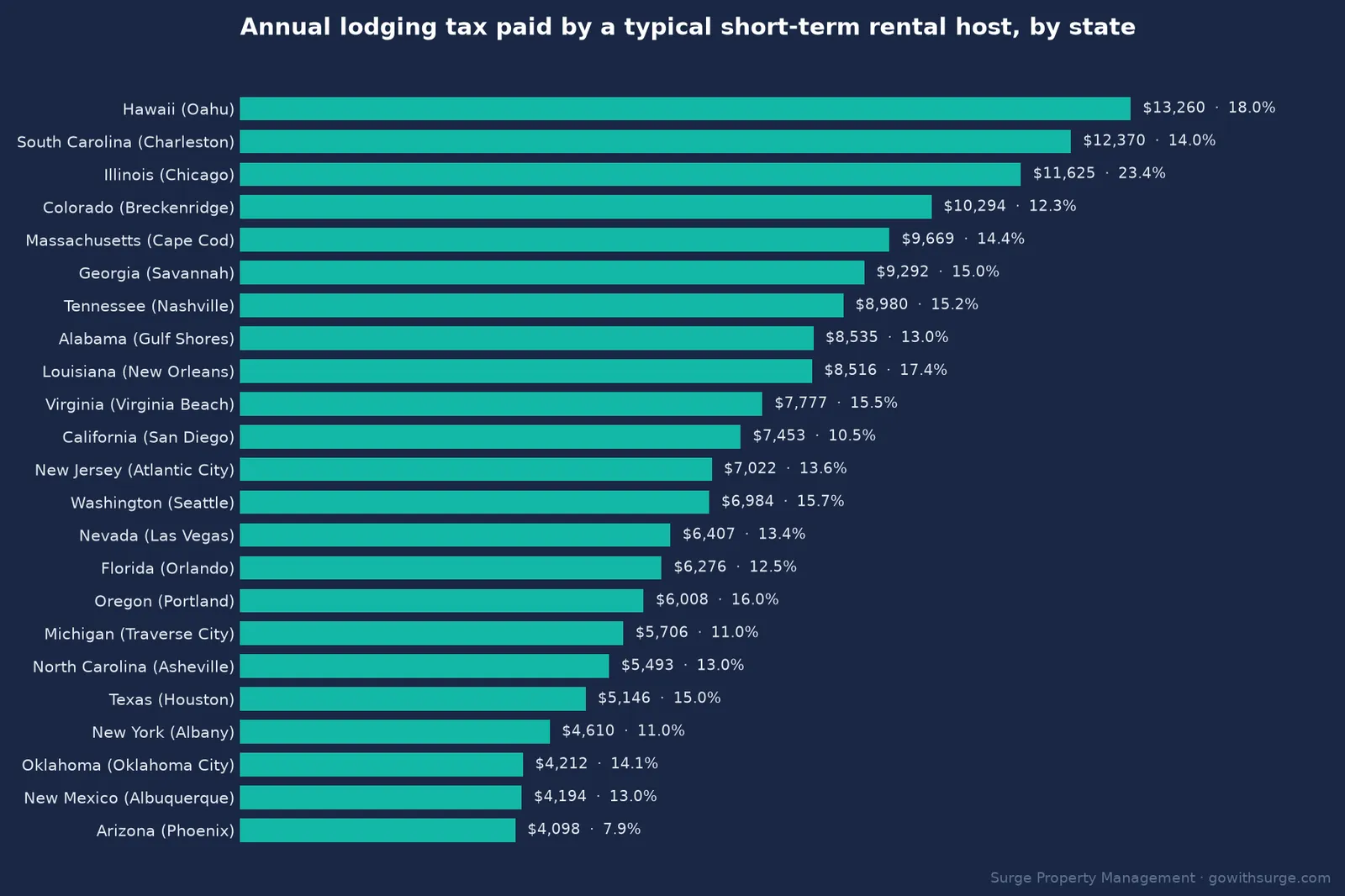
Every short-term rental host knows lodging taxes exist. Almost none of them know what they actually cost per year, because the number is never printed anywhere: it is a stack of a state rate, a county rate, a city rate, and sometimes a special-district fee, applied to whatever the property happens to earn.
So we calculated it. We combined AirDNA median annual revenue for a typical entire-home listing with the full combined lodging tax stack in each state's flagship short-term rental market, across 23 states. The result is the first ranking we are aware of that answers the question hosts actually ask: in real dollars, how much lodging tax does a short term rental owner in my state hand over every year?
The spread is enormous. A host in Oahu pays roughly $13,260 a year in lodging and occupancy taxes. A host in Phoenix pays about $4,098 — $9,162 less, on comparable revenue. That difference is not a rounding error in a pro forma. It is the entire annual profit of a mediocre rental property.
Key findings
- Hawaii hosts pay the most lodging tax in America — about $13,260 per year on a typical Oahu entire-home listing, driven by a 17.96% combined rate on $73,821 of median revenue.
- Chicago has the highest lodging tax rate in the country at roughly 23.4%, yet Illinois ranks only third in dollars, because revenue per listing there is far lower than in resort markets.
- Charleston, South Carolina ranks second at about $12,370 per year on a moderate 14% rate — purely because Charleston has the highest median revenue per listing in the study at $88,356.
- Arizona is the cheapest major short term rental state: 7.9% in Phoenix, about $4,098 a year, less than a third of Hawaii's burden.
- Nine of the 23 states studied stack to 15% or more once county and city taxes are layered on. The average combined rate across the study is 14.13%, and the average annual tax bill is $7,562.
- Rate and burden are only loosely related. Phoenix listings out-earn Chicago listings and still pay $7,527 less in tax per year.
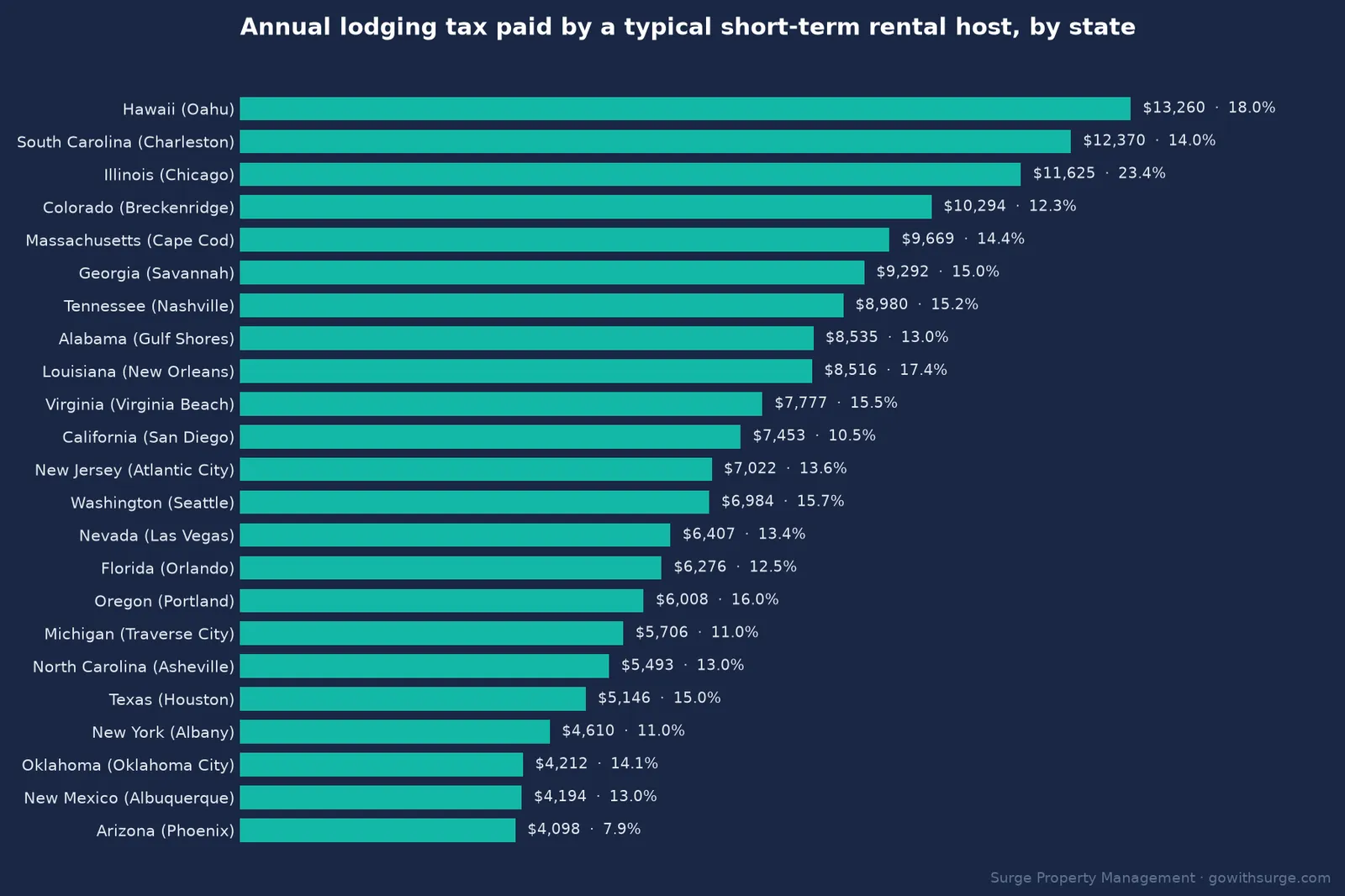
The full ranking: short term rental tax by state, in dollars
Each row shows the state's flagship short-term rental market, the AirDNA median annual revenue for an entire-place listing in that market over the trailing twelve months, the combined statutory lodging tax rate that applies to short term rentals there, and the resulting annual tax. Each state name links to our full state guide, where every component of the rate is documented.
| Rank | State | Market | Median annual revenue | Combined tax rate | Est. annual tax |
|---|---|---|---|---|---|
| 1 | Hawaii | Oahu | $73,821 | 17.96% | $13,260 |
| 2 | South Carolina | Charleston | $88,356 | 14.00% | $12,370 |
| 3 | Illinois | Chicago | $49,681 | 23.40% | $11,625 |
| 4 | Colorado | Breckenridge | $83,865 | 12.28% | $10,294 |
| 5 | Massachusetts | Cape Cod | $66,911 | 14.45% | $9,669 |
| 6 | Georgia | Savannah | $61,946 | 15.00% | $9,292 |
| 7 | Tennessee | Nashville | $58,885 | 15.25% | $8,980 |
| 8 | Alabama | Gulf Shores / Mobile | $65,653 | 13.00% | $8,535 |
| 9 | Louisiana | New Orleans | $48,804 | 17.45% | $8,516 |
| 10 | Virginia | Virginia Beach | $50,176 | 15.50% | $7,777 |
| 11 | California | San Diego | $70,984 | 10.50% | $7,453 |
| 12 | New Jersey | Atlantic City / Ocean City | $51,540 | 13.62% | $7,022 |
| 13 | Washington | Seattle | $44,483 | 15.70% | $6,984 |
| 14 | Nevada | Las Vegas | $47,882 | 13.38% | $6,407 |
| 15 | Florida | Orlando | $50,209 | 12.50% | $6,276 |
| 16 | Oregon | Portland | $37,553 | 16.00% | $6,008 |
| 17 | Michigan | Traverse City | $51,872 | 11.00% | $5,706 |
| 18 | North Carolina | Asheville | $42,251 | 13.00% | $5,493 |
| 19 | Texas | Houston | $34,310 | 15.00% | $5,146 |
| 20 | New York | Albany / Saratoga Springs | $41,913 | 11.00% | $4,610 |
| 21 | Oklahoma | Oklahoma City | $29,818 | 14.12% | $4,212 |
| 22 | New Mexico | Albuquerque | $32,259 | 13.00% | $4,194 |
| 23 | Arizona | Phoenix / Scottsdale | $51,877 | 7.90% | $4,098 |
A note on New York: New York City would rank far higher than Albany, with a combined rate near 14.75% plus flat fees, but Local Law 18 has made entire-home short term rentals largely illegal in the five boroughs. We used the state's largest legal short term rental market instead, which is the honest comparison. The same logic applies anywhere a market's headline rate is attached to a listing type that cannot legally operate.
Rate versus revenue: two completely different games
The most useful thing in this data is that the highest rate and the highest bill are almost never the same place.
Chicago charges roughly 23.4% — the highest lodging tax stack of any major American city, built from the state hotel operators' occupancy tax, the city hotel accommodations tax, the home-share surcharge, and several regional add-ons. But median revenue per listing in Chicago is $49,681, so the annual bill lands at $11,625. Phoenix charges 7.9%, less than a third of Chicago's rate, on higher median revenue of $51,877 — and the host pays $4,098. The Phoenix host keeps $7,527 more every year for owning a property that earns slightly more money.
Run the comparison the other way and the pattern holds. San Diego's transient occupancy tax is 10.5% with no state lodging tax on top, one of the gentler rates in the study, but $70,984 of revenue still produces a $7,453 bill — higher in dollars than Nevada, Florida, Oregon, Michigan, North Carolina, Texas, New York, Oklahoma, New Mexico and Arizona, all of which have higher rates.
For an investor comparing markets, this means the tax rate on its own is close to useless as a screening metric. What matters is the rate multiplied by realistic revenue, and then measured against the price of the asset. High-rate, low-revenue markets are the genuinely punitive ones, because the tax scales with a revenue line that is not big enough to absorb it.
Resort and beach markets tax hard, but they can afford to
Six of the top eight positions belong to vacation destinations: Oahu, Charleston, Breckenridge, Cape Cod, Savannah and Gulf Shores. These markets have learned that visitors will pay a lodging premium, and they have built the tax stack accordingly — Cape Cod even layers a 2.75% Water Protection Fund fee on top of the state room occupancy excise and the local option excise.
What makes those bills tolerable is the revenue underneath them. Charleston's $88,356 median and Breckenridge's $83,865 are roughly two and a half times what a typical Houston listing earns. A five-figure tax bill on five-figure gross revenue is a cost of doing business. The same absolute bill in a market earning $30,000 would end the business.
The 15% club
Nine of the 23 states in the study cross 15% combined once every local layer is counted: Illinois, Hawaii, Louisiana, Oregon, Washington, Virginia, Tennessee, Georgia and Texas. That matters because of how hosts budget. Most owners we talk to know their state rate and stop there. A Texas host who has read that the state hotel occupancy tax is 6% is planning for less than half of the roughly 15% that Houston actually collects once the city and county venue portions are added. A Washington host who budgets the state sales tax is missing Seattle's special lodging and convention-center pieces that push the stack near 15.7%.
In a typical underestimate of that size, the host is short several thousand dollars a year — a shortfall that only shows up when the first filing is due or, worse, when an audit letter arrives.
Platform collection is not the same thing as compliance
The most common and most expensive misunderstanding in this whole subject: Airbnb and Vrbo collect and remit lodging taxes in most of the markets above, and hosts conclude they are done.
They are not. Platform collection almost never covers the whole obligation:
- Direct bookings are entirely yours. Every reservation that comes through your own site, a repeat guest, or a phone call carries the full tax, and you file and remit it yourself.
- Registration is separate from remittance. Most of these states and cities require the operator to register the property and hold a permit or license regardless of who collects the tax. Hawaii requires GET and TAT registration; Massachusetts requires registration with the Department of Revenue plus $1M in liability insurance; Savannah, Nashville and New Orleans all require a local permit.
- Some layers are never collected by platforms. Local option and special-district taxes are frequently outside platform agreements, so the host has to remit those directly even on platform bookings.
- Zero-dollar returns are still returns. In several states you must file even when the platform remitted every dollar, and the penalty for not filing applies whether or not tax was owed.
- Flat per-night fees sit outside the percentage. Georgia's $5 per night state fee, Tennessee's $2.50, and Virginia Beach's $2 are charged per night regardless of rate, and are excluded from the percentages in our table.
That is why the effective burden in the table is the floor, not the ceiling. Fees, permits, and the administrative cost of monthly filings sit on top of it.
What this means if you are choosing a market
Three practical takeaways from the numbers:
Underwrite tax as a revenue haircut, not a line item. The average combined rate in this study is 14.13%. If you model a new acquisition on gross revenue without subtracting roughly a seventh of it, your cash-on-cash return is wrong by more than most deals' entire margin.
Compare rates only within similar revenue bands. A 15% market earning $80,000 is a far better business than a 12% market earning $35,000, even though the second one looks cheaper on the tax line.
Price the compliance work, not just the tax. Registration, monthly or quarterly filings across state and city portals, and direct-booking remittance are real recurring labor. In markets with three or four separate taxing authorities, hosts routinely spend several hours a month on it or pay someone to.
What the tax actually covers, and who is responsible
Before the ranking is useful you need to know what is being taxed. In nearly every state above, the lodging tax applies to the total rent charged to the guest for a short term rental unit — not just the nightly rate. That usually means cleaning fees, pet fees, extra-guest fees and resort fees are taxable sales too. Hosts who remit tax only on the base rent are underpaying on gross sales in most of these markets, and that is one of the most common findings in a state audit.
Responsibility sits with the operator. Every state in this study defines an operator broadly — a person who rents one or more rooms, an apartment, a house, or an entire dwelling to transient guests — and the same definition that captures lodging houses, hotel rooms and bed and breakfast establishments captures a single Airbnb unit. Being small does not exempt you. In most of these states the only meaningful exemption is a duration threshold: rent a property for longer than the local short term threshold, usually 28 to 31 days, and the stay falls outside the lodging tax entirely.
Some states add a second exemption for very limited activity. Massachusetts lets an operator who rents 14 days or fewer in a calendar year file an exemption declaration with the Massachusetts Department of Revenue rather than collecting tax at all, though the registration requirement and the additional community impact fee rules still have to be checked town by town. New Jersey exempts direct bookings by owners with fewer than three units from the state sales tax and occupancy fee. Those are the exceptions, not the rule.
The three obligations behind every rate in the table
Each percentage in the ranking is really three separate jobs, and hosts who only think about the third one are the ones who get penalty notices.
1. Register before the first booking. Nearly every state requires an operator to register the location with the state revenue department and often with the town as well, before collecting anything. Registration creates a tax account and a filing obligation; it is not the same as remitting. Cities layer their own permits on top, and in several markets the permit is capped or zoned, so the registration step is where a property can fail outright. Confirming that the property can legally be a short term rental unit in that location, before purchase, is the single cheapest piece of due diligence in this business.
2. Collect the proper amount on every stay. That means collecting state sales tax where the state treats lodging as a taxable sale, plus the local sales tax and city sales tax layers, plus any dedicated occupancy or lodging tax. Getting the composition wrong is easy: in Texas, short term rentals owe hotel occupancy tax but no sales tax; in Hawaii, GET applies alongside the transient accommodations tax; in Washington, state and local taxes and a special lodging charge all apply to the same room rentals. The rate composition table below lists the exact stack we used for every market so you can see which layers apply where.
3. File returns on time, even at zero. Filing returns is a separate obligation from paying taxes. Once you have an account, the department expects tax returns on its schedule — monthly in most of these states, quarterly for smaller operators — and a period in which a platform collected every dollar still needs a return showing that. Skipping it because you owed nothing is the most common way an otherwise compliant host accumulates penalties. If you overpaid, a refund generally requires an amended return, not a phone call.
Where platforms help and where they stop
Airbnb and Vrbo are registered to collect and remit on their own behalf in most of these states, which genuinely removes work. But the marketplace facilitator agreement in each state defines exactly which taxes the platform collects, and the gaps are consistent:
- Direct and repeat bookings. Any stay booked off-platform is yours end to end: collecting tax, filing, and remitting it. Hosts building a direct-booking business are quietly taking the full compliance burden back on.
- Local layers outside the agreement. City and special-district taxes are frequently not covered, so the host must remit those directly even for platform stays. This is where towns catch people.
- Flat per-night fees. Georgia's $5 per night state fee, Tennessee's $2.50 and Virginia Beach's $2 are charged per night regardless of rate. They are excluded from the percentages in our table and are often the host's responsibility to remit in advance of the filing deadline.
- Registration and permits. No platform registers your property for you, and no platform holds your license.
Treat platform collection as a convenience on one of the three obligations, not as a substitute for a tax account.
How to use the ranking as an owner
If you are comparing two markets, pull the combined rate for each, apply it to a realistic revenue estimate for a comparable short term rental unit rather than a best case, and carry the result into your model as a recurring cost. On the average in this study that is 14.13% of gross revenue — a haircut larger than most management fees and larger than most owners' modelled margin. Then add the administrative reality: in markets with three or four taxing authorities, filing is a monthly task across multiple portals, each with its own account, deadline and definition of taxable rent.
Every state name in the ranking table links to our full guide for that state, with current rates, registration steps, filing frequency and the exemptions that apply. Those 23 guides are the source of the rate composition used here, and they are kept current as local rates change.
Methodology
Revenue. AirDNA median annual revenue per entire-place active listing, trailing twelve months, retrieved August 2026, for each state's largest short-term rental market by listing count.
Tax rates. The combined statutory state, county, city and special-district lodging, occupancy and sales taxes that apply to short term rental gross receipts in that specific market. Rates were compiled from state revenue department publications and municipal codes, and cross-checked against our own published state tax guides, which are linked from each row of the ranking table.
Excluded. Federal and state income tax, flat per-night fees, permit and license fees, cleaning-fee-specific rules, and any tax that applies only to stays longer than the local short-term threshold.
Known limitations. One flagship market cannot represent an entire state: a Texas figure built on Houston understates Austin and overstates rural counties, and a Colorado figure built on Breckenridge is well above the Denver metro. Rates in this category change frequently, particularly local option and special-district add-ons. Where a platform collects part of the stack, the economic incidence is shared with the guest through the displayed price; the rates shown are the full statutory stack on gross revenue.
| State | Market | Rate composition |
|---|---|---|
| Hawaii | Oahu | 4.712% GET (Oahu) + 10.25% state TAT + 3% Oahu county TAT |
| South Carolina | Charleston | 5% state sales + 2% state accommodations + local option + Charleston accommodations ≈ 14% |
| Illinois | Chicago | 6% state hotel + Chicago hotel/home-share stack ≈ 23.4% effective (highest in US) |
| Colorado | Breckenridge | 2.9% state sales + county + Breckenridge 3.4% accommodations = 12.275% combined |
| Massachusetts | Cape Cod | 5.7% state room occupancy + 6% local option + 2.75% Cape Cod & Islands Water Protection Fund |
| Georgia | Savannah | 7% state+local sales + 8% Savannah hotel-motel tax ($5/night state fee extra) |
| Tennessee | Nashville | 7% state + 2.25% local sales + 6% Davidson Co. hotel occupancy (+$2.50/night) |
| Alabama | Gulf Shores / Mobile | 4% state lodging (coastal 5%) + Gulf Shores 9% lodging |
| Louisiana | New Orleans | State + Orleans Parish sales & occupancy stack ≈ 17.45% (+ flat per-night fees) |
| Virginia | Virginia Beach | 5.3-6% sales + ~9.5% VB transient occupancy (+$2/night flat) |
| California | San Diego | No state lodging tax; San Diego TOT 10.5% |
| New Jersey | Atlantic City / Ocean City | 6.625% sales + 5% occupancy fee + up to 2% municipal (varies; direct bookings only) |
| Washington | Seattle | 10.1% combined sales + convention center & special hotel taxes ≈ 15.6-15.7% |
| Nevada | Las Vegas | Clark County/Las Vegas transient lodging tax ~13-13.38% |
| Florida | Orlando | 6% state sales + 0.5% county surtax + 6% Orange County Tourist Development Tax |
| Oregon | Portland | 1.5% state + 5.5% Multnomah + 6% Portland + 2% tourism districts + booking fees ≈ 16% |
| Michigan | Traverse City | 6% use tax + 5% county lodging excise |
| North Carolina | Asheville | 6.75-7% sales + 6% Buncombe occupancy |
| Texas | Houston | 6% state hotel occupancy + Houston 7% + county/venue ≈ 15% (hotel tax only; no sales tax on STR) |
| New York | Albany / Saratoga Springs | 4% state + local sales + county occupancy ≈ 11-12% upstate (NYC ~14.75% + fees) |
| Oklahoma | Oklahoma City | 4.5% state + local sales ≈ 8.625% + 5.5% OKC hotel tax |
| New Mexico | Albuquerque | ~7.6% gross receipts + 5% lodgers' tax + hospitality fee |
| Arizona | Phoenix / Scottsdale | 5.5% state TPT hotel class rate components + Phoenix 2.3%+ city lodging (transaction privilege stack ~7.9% total STR) |
Using this data
Journalists, researchers and operators are welcome to cite this study with a link back to this page. If you need the underlying dataset as a CSV, a state-level breakout for a specific market, or a comment from our team on short term rental tax policy, contact us and we will send it over.
If you own a short term rental and the compliance side of this is where your weekends go: registration, monthly filings, direct-booking remittance and local permits are all part of what we handle for owners as full-service managers. Talk to our team about your market, or call (888) 616-8149.

Written by
Humberto MarquezFounder, Surge
Founder of Surge and licensed Texas real estate broker. Manages short-term rentals across 12 U.S. markets and invests in STRs himself. Quoted in Martha Stewart, Yahoo Finance, Realtor.com, Bob Vila.
More about Humberto →See what your property could earn with Surge
Full-service short term rental management across 12 markets. Get a free property assessment and revenue estimate, no commitment.