
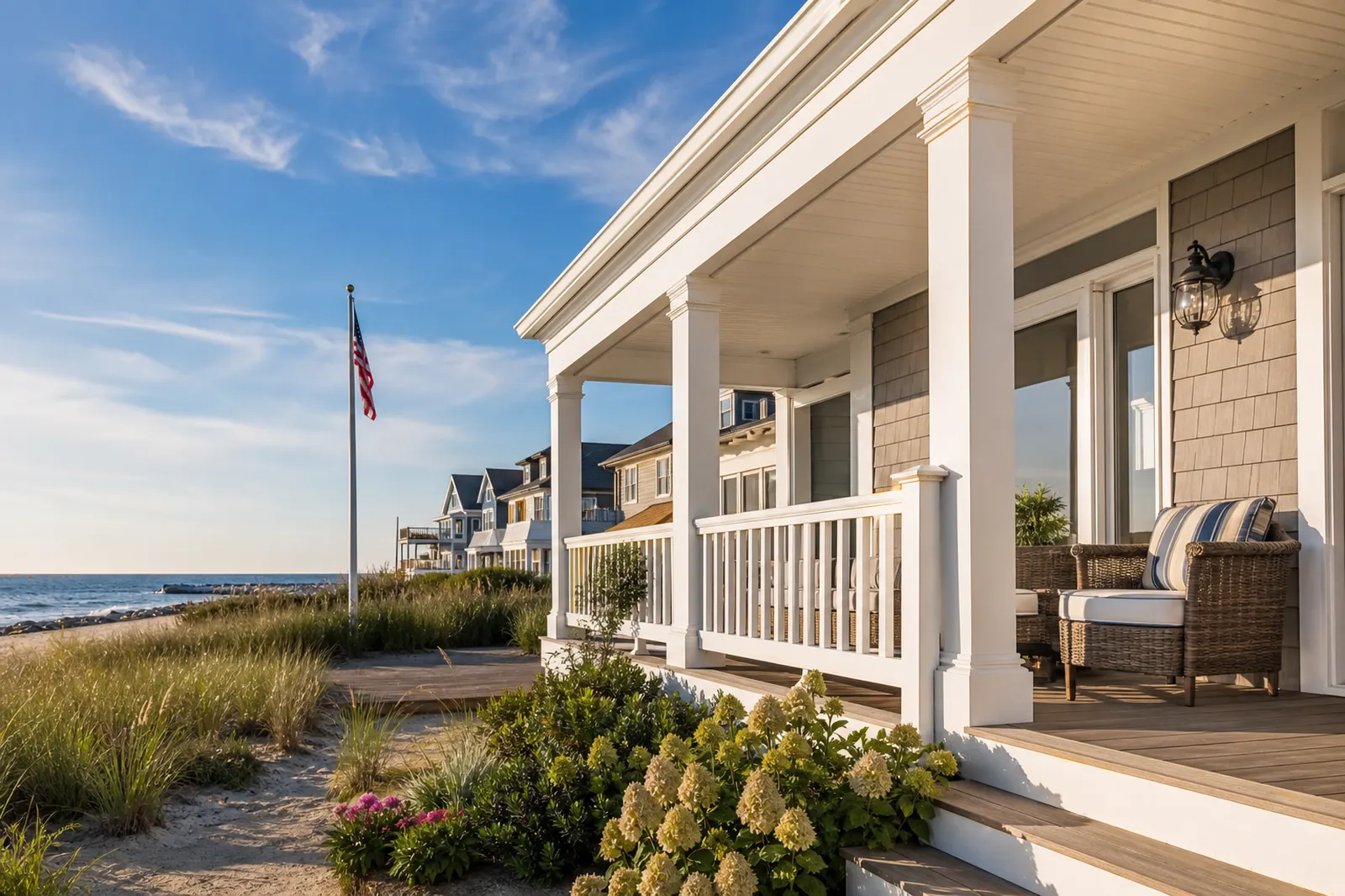
New Jersey short term rental taxation is unusual among state lodging tax systems for one reason: whether you owe the state tax at all depends on how the booking was made and how many units you own. Two identical shore rental property listings on the same block in Wildwood can carry very different tax obligations, and the difference comes down to whether the guest booked through Airbnb or called the owner directly, and whether that owner offers three or more rental units in New Jersey.
That single quirk, created by P.L. 2019, c. 235, trips up more New Jersey hosts than any other rule. Layer on a 6.625% state sales tax, a 5% state occupancy fee that drops to 1% or 3.15% in certain cities, a municipal occupancy tax of up to 3%, a Meadowlands regional assessment in parts of Bergen and Hudson counties, and Cape May County tourism taxes in the Wildwoods, and total tax on a New Jersey short term rental can range from zero to more than 18%.
This guide walks through every layer of the taxes that apply to short term rentals in New Jersey in 2026: which rentals are taxable, the professionally managed unit test, the 90 day exemption, what Airbnb and Vrbo collect for you, which taxes you must remit yourself, registration through Form NJ-REG, filing deadlines for the ST-50 and HM-100 returns, market by market effective rates, and the federal income tax rules that sit on top of all of it.
If you need the licensing, zoning, and permit side of the rules instead, read our companion guide to New Jersey short term rental laws. This article stays focused on taxes.
Does New Jersey Have a Short Term Rental Tax?
Yes, but it does not apply to every rental. New Jersey taxes transient accommodations, which the statute defines as a room, group of rooms, or other living or sleeping space rented to a transient guest for fewer than 90 consecutive days. The two charges imposed at the state level are the 6.625% Sales and Use Tax under N.J.S.A. 54:32B and the 5% State Occupancy Fee under N.J.S.A. 54:32D-1.
The original 2018 law, P.L. 2018, c. 49, applied those charges to essentially all short term rentals. Shore town owners who rented a single family home for a few summer weeks each year objected loudly, and the Legislature responded with P.L. 2019, c. 235, effective August 9, 2019. Since that amendment, the state sales tax and State Occupancy Fee apply to a short term rental only if one of these is true:
- The rental was obtained through a transient space marketplace such as Airbnb, Vrbo, or Booking.com, or
- The rental is a professionally managed unit, meaning the owner offers three or more units for rent in New Jersey during the calendar year.
If neither applies, and the rental is booked directly between owner and guest, the state charges do not apply. That is a meaningful planning point for owners of one or two shore properties who build a repeat guest list, and it is the opposite of how nearly every other state treats direct bookings.
The Professionally Managed Unit Test
The professionally managed unit definition is where most compliance mistakes happen. The count is not per property, it is per unit, and it is measured across all of New Jersey for the calendar year, not per town or per municipality.
A duplex where both halves are offered as separate rentals counts as two units. A single family home with a rentable basement apartment counts as two. An owner with two single family homes and one condo has three units and every direct booking becomes subject to tax, even the ones at the property that was previously exempt. The count includes units offered for rent whether or not they were actually rented, which is why an owner adding a third listing mid season can quietly change the tax treatment of the whole portfolio.
There is also a separate exclusion for rentals executed by a New Jersey licensed real estate broker. If the broker advertises the rental, collects the rent, the property is private residential property, the owner does not provide hotel style services such as maid service, room service, or linen changing, and the guest picks up the keys or access code at the broker's off site office, the rental falls outside the definition of a transient accommodation. This is the traditional shore season rental model, and it remains untaxed at the state level when every element is satisfied.
Because the test turns on facts an auditor can verify from listings and bank deposits, keep a written unit count for each calendar year and note the date any unit was added or removed. Owners who cross the three unit line partway through the year should treat every reservation from that point forward as subject to tax.
Tax Rates for Short Term Rentals in New Jersey, 2026
When a rental is taxable, the charges stack. Here is the full menu of what can apply to a New Jersey short term rental.
State Sales and Use Tax: 6.625%
The New Jersey sales tax rate of 6.625% applies to the rent charged on short term rentals. Rent for this purpose includes mandatory charges the guest cannot avoid, so cleaning fees, pet fees, resort or amenity fees, and extra guest fees are generally subject to tax along with the nightly rate. Refundable security deposits are not rent. Optional add on services a guest can decline are treated separately, so document them as distinct line items rather than folding them into the room charge.
Urban Enterprise Zone reduced sales tax rates do not apply to transient accommodations. The full 6.625% applies statewide.
State Occupancy Fee: 5%, or 1% to 3.15% in Certain Cities
The State Occupancy Fee under N.J.S.A. 54:32D-1 is 5% in most of New Jersey, but it is reduced in municipalities that already levy their own hotel or tourism taxes so guests are not double taxed by the state. The reduced rates are 1% in Newark, Jersey City, Atlantic City, and Elizabeth, and 3.15% in Wildwood, North Wildwood, and Wildwood Crest.
The State Occupancy Fee is a separate charge from sales tax with its own line on the return. It is not a local tax and cannot be waived by a municipality.
Municipal Occupancy Tax: Up to 3%
N.J.S.A. 40:48F-1 through 40:48F-7 lets a municipality adopt an occupancy tax by ordinance at a uniform rate up to 3%. Several hundred New Jersey municipalities have done so, including most of the shore rental markets and many Bergen and Hudson county towns. Newark, Elizabeth, Jersey City, Paterson, Atlantic City, Wildwood, Wildwood Crest, and North Wildwood are carved out of this statute because they levy separate statutory hotel or tourism taxes instead, generally at higher rates. Jersey City and Hoboken, for example, apply a 6% local hotel tax.
The municipal occupancy tax follows the same transient accommodation definition as the state charges, so leases of at least 90 consecutive days, hotel rooms, dormitories, licensed care facilities, campgrounds, and qualifying broker executed rentals are all outside its scope.
Meadowlands Regional Hotel Use Assessment: 3%
Properties inside the Meadowlands district, which covers 14 municipalities across Bergen and Hudson counties, carry an additional 3% Meadowlands Regional Hotel Use Assessment under N.J.S.A. 5:10A. Hosts renting near MetLife Stadium and the American Dream complex should confirm district boundaries with the municipal clerk, because the assessment applies by parcel and not by mailing address.
Cape May County Tourism Taxes
Cape May County imposes a 2% Tourism Sales Tax and a 1.85% Tourism Assessment under the Tourism Improvement and Development District Act. These currently apply only in Wildwood, North Wildwood, and Wildwood Crest. Combined with everything else, the Wildwoods carry one of the heaviest short term rental tax loads in the United States.
Atlantic City Luxury and Promotion Taxes
Atlantic City layers a 9% luxury sales tax on certain categories, a 1% additional luxury tax on room rentals, a tourism promotion fee, and a sports and entertainment district assessment on top of the state charges. Classification matters a great deal here, so a host there taking reservations outside a platform should get the treatment confirmed in writing by the city and by a New Jersey tax professional before setting rates.
Effective Tax Rates in New Jersey's Main Short Term Rental Markets
The table below shows typical combined rates paid on a short term rental booking in 2026. Verify the local layer with the municipal clerk before you publish rates, because municipal ordinances change on their own schedule.
| Market | State Sales Tax | State Occupancy Fee | Local Layers | Typical Combined |
|---|---|---|---|---|
| Town with no local occupancy tax | 6.625% | 5% | None | 11.625% |
| Cape May City | 6.625% | 5% | 3% municipal | 14.625% |
| Long Beach Island towns | 6.625% | 5% | 3% municipal | 14.625% |
| Asbury Park | 6.625% | 5% | 3% municipal | 14.625% |
| Ocean City and Sea Isle City | 6.625% | 5% | Up to 3% municipal | 11.625% to 14.625% |
| Wildwood, North Wildwood, Wildwood Crest | 6.625% | 3.15% | 3% municipal, 2% county tourism sales, 1.85% county tourism assessment | About 16.6% to 18.5% |
| Jersey City and Hoboken | 6.625% | 1% Jersey City, 5% Hoboken | 6% local hotel tax | About 13.6% to 17.6% |
| Newark | 6.625% | 1% | 6% local hotel tax | About 13.6% |
| Meadowlands district towns | 6.625% | 5% | 3% municipal plus 3% Meadowlands assessment | About 17.6% |
| Atlantic City | 6.625% | 1% | Luxury, promotion, and district assessments | About 13% to 18% by classification |
Before you commit to a market, check what those rates do to guest facing pricing and to your net yield. Our free short term rental market data tool shows revenue, occupancy, and average daily rate by market so you can see whether a high tax shore town still pencils after the guest sees the total.
The 90 Day Rule and Other Exemptions
New Jersey's central exemption is duration. A rental to the same occupant for at least 90 consecutive days is not a transient accommodation, so the State Occupancy Fee and the municipal occupancy tax do not apply. This is a much longer threshold than the 30 or 31 day rules used in most states, and it is why many New Jersey owners structure winter and shoulder season stays as single tenant leases of 90 days or more rather than a series of monthly bookings. The 90 days must run consecutively with the same occupant, and a written lease is the cleanest documentation.
The statute also excludes the following from transient accommodations:
- Hotels and hotel rooms, which are taxed under their own rules
- Rooms or spaces used as a place of assembly
- Dormitories and similar school, college, or university residential facilities
- Hospitals, nursing homes, and other licensed care facilities
- Campsites, cabins, lean-tos, and similar campground or camp facilities
- Private residential property rented through a New Jersey licensed real estate broker meeting the off site key handover and no hotel services conditions
Two further points are easy to miss. First, the marketplace and professionally managed unit test is applied before the exemptions, so a direct booking by a one unit owner never reaches the question of duration because it was never taxable. Second, the federal 14 day rule described later has nothing to do with these state exemptions. They are separate systems with separate thresholds.
What Airbnb and Vrbo Collect in New Jersey
Marketplace facilitators are required to collect and remit the state level charges on bookings made through their platforms, which removes most of the burden for hosts who list exclusively on the major platforms.
On an Airbnb tax basis, the platform collects and remits the 6.625% sales tax, the 5% State Occupancy Fee at the applicable rate, the Meadowlands assessment, and the Cape May County tourism taxes, and it collects locally imposed occupancy taxes in most New Jersey municipalities. Vrbo collects the state level charges statewide but handles the municipal layer only in a subset of towns including Asbury Park, Cape May, Elizabeth, Jersey City, and Point Pleasant Beach. If your municipality is not on your platform's list, the local occupancy tax is your responsibility as the property owner even though the state portion was handled for you.
Three practices keep this clean. Pull the tax detail from your platform payout reports each month and confirm which specific taxes were collected rather than assuming full coverage. Do not add a separate tax line to a platform booking that the platform is already collecting, because that double charges the guest and creates a refund problem. And treat direct bookings as a completely separate compliance track, because nothing about the platform's collection carries over to them.
Hosts running a mix of platform and direct bookings are the most exposed group in New Jersey. A professional manager is often worth the fee purely for keeping the two tracks separate and the filings current. Our breakdown of what Airbnb property management costs in 2026 shows how those fees compare against the compliance risk.
Registering With the State of New Jersey
Every person who charges rent for a transient accommodation rent is a seller and must register with the state before doing business. Registration is done on Form NJ-REG through the Division of Revenue and Enterprise Services, and the law requires filing at least 15 business days before you begin renting. Registration is free and produces a Certificate of Authority to collect sales tax.
You do not need to register if either of these is true. All of your sales are made solely through a transient space marketplace that collects and remits on your behalf, or all of your rentals are executed by a licensed New Jersey real estate broker meeting the statutory conditions. In practice, that means the host who takes even one direct booking as a professionally managed unit owner needs to be registered.
Owners already registered for other New Jersey business activity must update the registration to add Sales Tax, the State Occupancy Fee, and where applicable the Meadowlands Regional Hotel Use Assessment. Municipal occupancy tax registration is separate and handled with the town clerk, and shore towns commonly require their own rental license as well. Budget time for both, because a municipal rental license inspection can take several weeks in season.
Filing and Paying New Jersey Short Term Rental Taxes
New Jersey uses a quarterly and monthly hybrid schedule, and the deadlines are strict.
- Form ST-50 is the quarterly Sales and Use Tax return, due the 20th day of the month following the end of each calendar quarter, so April 20, July 20, October 20, and January 20.
- Form ST-51 is a monthly payment voucher required for the first and second months of a quarter when your liability for the prior month exceeds the statutory threshold. Seasonal shore operators frequently cross the threshold in July and August only.
- Form HM-100 is the monthly return for the State Occupancy Fee and the municipal occupancy tax, due on the 20th of the following month.
- Filing and payment are done electronically through the Division of Taxation online services. Returns are required even for months with no rental activity once you are registered, so file zero returns off season rather than skipping them.
Late filing carries a 5% penalty plus 5% per month of the underpayment up to 25%, a $100 per month late filing penalty, and interest at the prime rate plus 3 percentage points. Uncollected tax remains the host's liability, so if you failed to charge the guest you still owe the tax out of your own margin. That is the most expensive version of this mistake and the reason to fix pricing before the season rather than after.
Federal Income Tax on New Jersey Rental Income
Occupancy taxes are collected from guests and passed through, so they are not your income. Income tax on your profit is a separate obligation at both the federal and state level.
The 14 day rule under IRC Section 280A is the first threshold. If you rent the property for 14 or fewer days during the year and personally use it for more than 14 days, the rental income is not reported at all. Cross 14 rental days and all of the income becomes reportable.
Most hosts report on Schedule E as a rental activity, which keeps net income out of self employment tax but subjects losses to the passive activity rules. If you provide substantial hotel style services such as daily housekeeping, meals, or organized activities, the IRS may treat the activity as a business reportable on Schedule C, where net income is subject to self employment tax. Personal use of more than the greater of 14 days or 10% of rental days makes the property a vacation home, which forces expense allocation between rental and personal days and suspends losses.
Two related items matter for New Jersey owners specifically. Average guest stays of seven days or less can take a property out of the passive rental category entirely, which is the basis of the widely discussed short term rental tax loophole and depends on meeting the material participation tests. And New Jersey levies its own gross income tax on net rental profit at graduated rates topping out at 10.75%, with nonresident owners filing Form NJ-1040NR.
Common New Jersey Short Term Rental Tax Mistakes
- Assuming reservations taken outside a platform are always exempt. The exemption disappears the moment you offer a third unit anywhere in New Jersey.
- Assuming the platform handles everything. State charges are usually covered. Municipal occupancy tax often is not, especially on Vrbo.
- Using the wrong State Occupancy Fee rate. Charging 5% in the four cities where the rate is 1%, overcharges guests and creates refund exposure.
- Treating cleaning fees as untaxed. Mandatory fees are part of the rent subject to tax.
- Missing the Meadowlands assessment. Bergen and Hudson county hosts near the sports complex frequently overlook the 3% district charge.
- Counting 90 days loosely. The exemption needs 90 consecutive days with the same occupant, documented by a lease.
- Skipping off season returns. Registered sellers must file zero returns, and the $100 per month late filing penalty accrues regardless of revenue.
- Registering with the state but not the town. Municipal occupancy tax and rental licensing are separate filings with separate deadlines.
How the Jersey Shore Differs From the Cities
Most short term rentals in the state sit in one of two very different worlds. Along the Jersey shore, from Long Beach Island down through Ocean City, Sea Isle City, Avalon, Stone Harbor, Cape May, and the Wildwoods, the business is seasonal, weekly, and family driven. Short term rental operators there often own one or two houses, book many of their summer weeks with returning renters, and rely on a licensed broker or their own website. Those property owners are the ones most likely to fall outside the state charges entirely, and the ones most likely to be surprised when a third unit changes that.
In the Hudson County and Newark corridor the picture flips. Stays are short, weekday heavy, and almost entirely marketplace booked, so taxes apply from the first night. Local rules are also far tighter: the city caps non owner occupied rentals at 60 nights a year and sets insurance requirements of $500,000, and Asbury Park limits rentals to 180 days a year on primary residences only. Those city rules are enforced alongside tax registration, and a city council can amend them with a single ordinance, which is why urban short term rental hosts need to re-check local taxes and local rules every year rather than once at purchase.
The casino market sits in its own category because of the casino era tax structure. The lesson for anyone comparing markets is that the tax stack, not just the nightly rate, decides what a booking is worth. A shore house at 14.625% and a city condo at 17.6% are not the same business even at identical revenue.
How New Jersey Compares to Other States
Compared with other states, New Jersey is unusual in three ways that matter for tax purposes.
- The 90 day threshold. Most states define a transient stay as fewer than 30 or 31 days. New Jersey uses 90, which gives owners a wider window to convert a booking into an exempt lease.
- The marketplace test. Nearly every other state taxes lodging based on the stay itself. New Jersey asks how the booking was obtained, so the same property can be taxable on one booking platform and untaxed on a direct reservation.
- The broker exclusion. The licensed real estate broker carve out has no clean equivalent elsewhere and reflects how the shore rental market operated for decades before Airbnb existed.
The practical effect is that New Jersey is generous to the small owner and demanding of the operator at scale. Portfolios treated the same way in Florida or Texas are treated very differently here, and it is entirely legal for one town to have neighboring houses on opposite sides of that line.
Pricing, Guests, and Who Actually Pays
Occupancy taxes are collected from renters, not from you, but they still affect your revenue because guests shop on the total they see at checkout. In a market where taxes paid at booking add 18% to the subtotal, a $300 nightly rate lands near $354 before cleaning. That changes conversion, and it is a real cost of operating in high tax shore towns even though none of it is your income.
Three habits help. Quote and compare rates on an all in basis when you benchmark against nearby listings, because a competitor in a town with no local occupancy tax looks cheaper than they are. Keep the cleaning fee modest, since it is taxable rent and inflates the total twice over. And model the tax stack before you buy, not after, because it is the one operating cost you can never negotiate down.
Dynamic pricing is where most owners recover that margin. Rates that move with demand across a shore season routinely add double digit percentages to annual revenue, which is more than enough to absorb a 3% municipal layer.
Recordkeeping That Survives an Audit
New Jersey audits of transient accommodations focus on three questions: how many units did the property owner offer, which bookings came through transient space marketplaces, and was the correct local rate applied. Keep documentation that answers each one.
- A calendar year unit list with dates added or removed, so the professionally managed unit test is answerable in one page.
- Monthly platform payout reports showing exactly which applicable taxes each marketplace collected and remitted.
- A separate ledger of direct bookings with the tax charged per stay, or a note of why the stay was exempt.
- Signed leases for any stay claimed as exempt at 90 consecutive days or more.
- Broker agreements and evidence of off site key handover where you rely on the broker exclusion.
- Copies of every ST-50, ST-51, and HM-100 filed, including zero returns.
Hosts who keep this current spend an hour a month on it. Hosts who do not spend weeks reconstructing it later, and they are the ones who end up paying tax they never collected.
A Compliance Checklist for New Jersey Short Term Rental Hosts
Work through this list once before your first booking and once each January. It covers what is legally required at the state and local level and keeps the paperwork short.
- Count your units. Three or more offered anywhere in the state and every reservation is subject to New Jersey sales tax and the State Occupancy Fee, regardless of the booking channel.
- Confirm your location's local taxes. Call the municipal clerk and ask whether the town adopted the 3% occupancy tax, whether the parcel sits in the Meadowlands district, and whether any county tourism tax applies. Only Wildwood, North Wildwood, and Wildwood Crest currently pay the Cape May County tourism tax.
- Register. File Form NJ-REG at least 15 business days out unless every rental runs through transient space marketplaces or a qualifying broker.
- Check platform coverage. Confirm in writing which applicable taxes your booking platform remits for your exact municipality, and which remain your responsibility.
- Set up your filing calendar. ST-50 quarterly, ST-51 monthly payment vouchers when required, HM-100 monthly. Each tax return is due on the 20th.
- Handle licensing. Most towns require a rental license, and some add inspections, insurance requirements, and night caps. State law lets municipalities license rentals under 175 consecutive days.
- Document exemptions. Leases for stays that qualify at 90 days or more, and broker agreements where the broker exclusion applies.
- Review annually. Local rules change by ordinance, and a single city council vote can reset your cost of operating.
Vacation rental hosts who treat compliance as a quarterly routine rather than an annual scramble almost never pay a penalty. Hotels and motels have staff for this. An independent rental property owner has a calendar reminder, and that is usually enough.
New Jersey Short Term Rental Tax FAQ
What is the total short term rental tax in New Jersey?
On short term rentals the minimum is 11.625%, made up of 6.625% state sales tax and the 5% State Occupancy Fee. Most shore markets land at 14.625% once the 3% municipal occupancy tax is added, and the Wildwoods can reach roughly 18.5% with Cape May County tourism taxes included.
Do I have to pay New Jersey sales tax on direct bookings?
Only if you are a professionally managed unit owner, meaning you offer three or more rental units in New Jersey during the calendar year. Owners with one or two units who book directly outside any marketplace are exempt from the state sales tax and the State Occupancy Fee under P.L. 2019, c. 235.
Does Airbnb collect New Jersey occupancy taxes for me?
For Airbnb tax purposes the platform collects and remits the state sales tax, the State Occupancy Fee, the Meadowlands assessment, and Cape May County tourism taxes, and it collects local occupancy taxes in most municipalities. Vrbo covers the state level charges statewide but only a subset of municipalities locally. Check your payout reports and confirm your specific town.
How long is the New Jersey short term rental exemption period?
Ninety consecutive days. A rental to the same occupant for at least 90 consecutive days is not a transient accommodation and is outside the occupancy fee and municipal occupancy tax.
How do I register to collect short term rental tax in New Jersey?
File Form NJ-REG with the Division of Revenue and Enterprise Services at least 15 business days before your first rental. Registration is free and issues a Certificate of Authority. Municipal occupancy tax registration and any local rental license are handled separately with the town.
When are New Jersey short term rental tax returns due?
Form ST-50 for sales tax is due quarterly on the 20th of the month after quarter end, with ST-51 monthly payments when the liability threshold is crossed. Form HM-100 for the State Occupancy Fee and municipal occupancy tax is due monthly on the 20th.
Is the cleaning fee taxable in New Jersey?
Yes. Mandatory charges a renter cannot decline, including cleaning fees, pet fees, and extra guest fees, are part of taxable rent. Refundable security deposits are not.
What is the State Occupancy Fee rate in the reduced rate cities?
One percent. The State Occupancy Fee is reduced to 1% in Newark, Jersey City, Atlantic City, and Elizabeth, and to 3.15% in Wildwood, North Wildwood, and Wildwood Crest, because those cities impose their own hotel or tourism taxes.
What happens if I never collected the tax from guests?
The liability stays with you. New Jersey will assess the uncollected tax plus penalties of up to 25% of the underpayment, a $100 per month late filing penalty, and interest, and you pay it out of your own margin rather than the guest's.
Do I need a rental license in addition to registering for tax?
Usually yes. New Jersey has no statewide short term rental license, but municipalities are authorized to license rentals of fewer than 175 consecutive days, and most shore towns and larger cities do. Jersey City and Asbury Park also impose night caps and primary residence rules.
Getting New Jersey Compliance Right
New Jersey rewards owners who understand the structure. The marketplace and three unit tests mean a small owner with a direct booking channel can legitimately operate outside the state lodging tax entirely, while a growing portfolio crosses into full compliance the moment a third unit is listed. Knowing exactly where you sit on that line, in advance, is worth more than any pricing tweak.
If you would rather not track ST-50 deadlines and municipal ordinances yourself, that is the kind of work a manager should absorb. Surge handles licensing, tax registration and remittance, dynamic pricing, and guest communication for owners across our markets, whether you need full Airbnb management or a lighter Airbnb co-host arrangement.
Start with the numbers. Pull free revenue, occupancy, and rate data for your market from our market data tool, run your address through the Surge Score to see how it grades as a short term rental, then book a free intro call or call us at (888) 616-8149 to talk through your specific property.
Short term rentals are taxed differently in every location, and this guide is general information for 2026 and not tax or legal advice. Rates and ordinances change, and New Jersey's municipal layer changes often. Confirm current rules with the New Jersey Division of Taxation, your municipal clerk, and a qualified tax professional before you file.

Written by
Humberto MarquezFounder, Surge
Founder of Surge and licensed Texas real estate broker. Manages short-term rentals across 12 U.S. markets and invests in STRs himself. Quoted in Martha Stewart, Yahoo Finance, Realtor.com, Bob Vila.
More about Humberto →See what your property could earn with Surge
Full-service short term rental management across 12 markets. Get a free property assessment and revenue estimate, no commitment.