
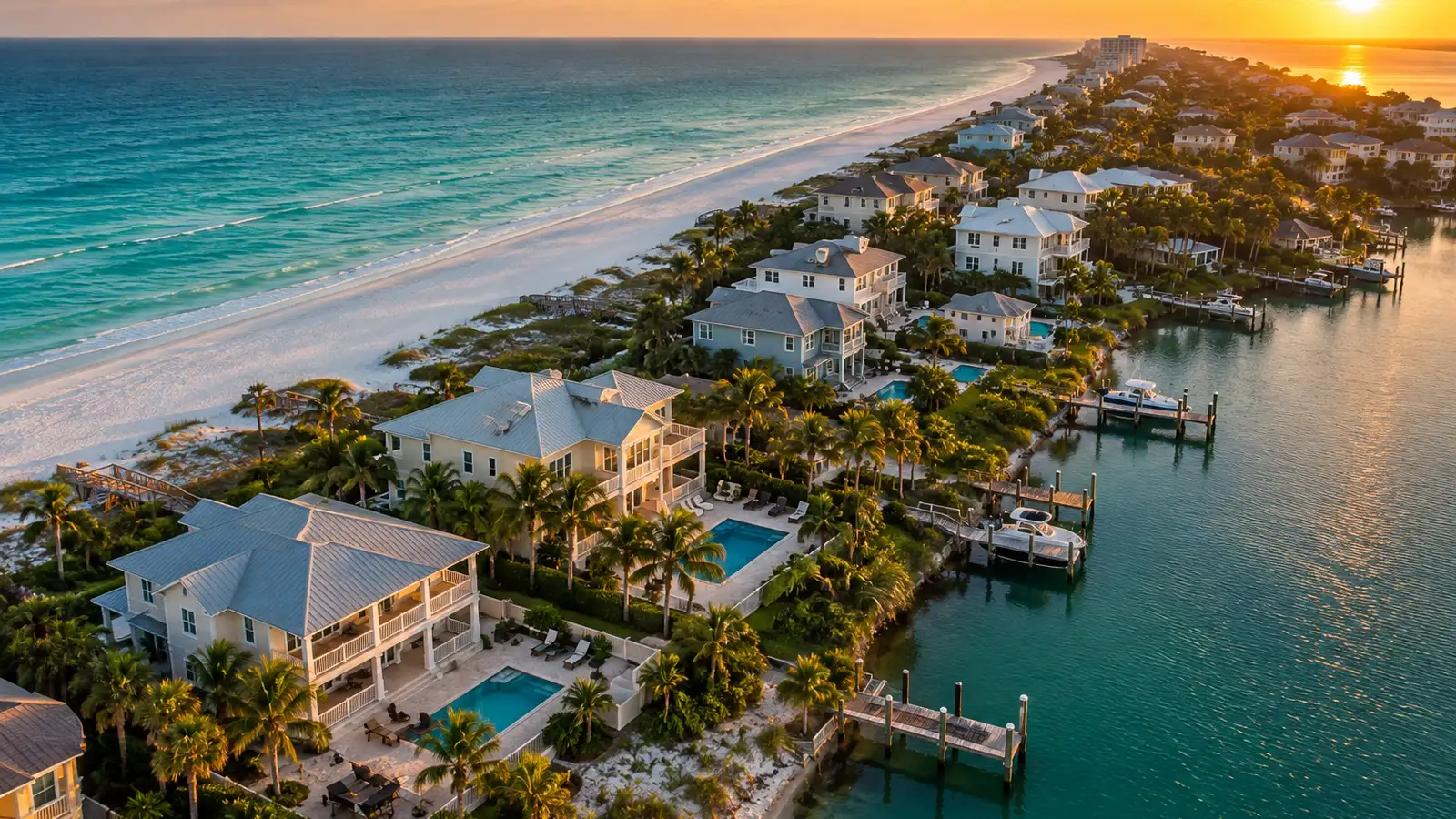
Florida has fifteen distinct short term rental markets tracked by AirDNA, and the revenue gap between the top and the bottom is enormous: a median Key West entire home earns roughly $94,000 a year, a median Tampa entire home earns roughly $36,300. Neither number tells an owner what they actually keep. This guide ranks all fifteen Florida markets by median annual revenue, average daily rate (ADR), occupancy, and revenue per available room (RevPAR), using AirDNA data pulled by Surge in September 2026, entire place listings, trailing twelve months through August 2026. Then it walks through what actually drives profit here, city by city, and what the real cost stack looks like once tax, licensing, and a management fee are subtracted from the top line.
Revenue and profitability are two different questions, and this guide is built to answer both. A market can rank high on revenue and still be a poor place to own if occupancy is falling, the tax stack is heavy, or the licensing and registration cost is higher than a comparable market next door. Read the ranking for where the top-line money is; read the cost and "rising and falling" sections for whether that money is durable and what actually reaches the owner's account each month.
Quick answers
- Which Florida city has the highest Airbnb revenue? Key West, with a median annual revenue near $94,000 for an entire place listing, driven by a $502 average daily rate at 62% occupancy.
- Which Florida market is growing fastest? Sarasota, up 16.4% year over year in revenue, followed by West Palm Beach and Cape Coral/Fort Myers, both up 7.3%.
- Which Florida markets are shrinking? Tampa and Fort Lauderdale, both down 3.0% year over year in revenue; Miami is down 2.2%.
- What does an Airbnb manager cost in Florida? Surge's rate is starting at 15% for full service. The gain over self-management has to come from pricing and occupancy, not a manufactured uplift number.
- Do Florida short term rental taxes come out of the owner's revenue? No. The 11% to 13.5% transient rental tax stack (6% state sales tax, a county surtax, and a county tourist development tax) is charged to the guest on top of the rate, not deducted from the owner's payout.
All 15 Florida markets ranked by revenue
Median annual revenue is the AirDNA trailing twelve month figure for entire place listings, not ADR multiplied by nights; it already reflects each market's real mix of occupancy and seasonality. RevPAR is the trailing twelve month average of the monthly revenue-per-available-room series, a cleaner apples to apples comparison than ADR alone because it factors in how often a listing actually books.
| Rank | Market | Median annual revenue | ADR | Occupancy | RevPAR (T12) | YoY revenue |
|---|---|---|---|---|---|---|
| 1 | Key West | $94,000 | $502 | 62% | $303 | +6.5% |
| 2 | Destin/Ft. Walton Beach | $68,700 | $401 | 61% | $216 | -1.3% |
| 3 | Sarasota | $66,900 | $360 | 62% | $216 | +16.4% |
| 4 | Pensacola | $59,400 | $329 | 62% | $185 | +2.1% |
| 5 | West Palm Beach | $56,900 | $280 | 65% | $178 | +7.3% |
| 6 | Miami | $56,900 | $282 | 62% | $172 | -2.2% |
| 7 | Naples | $56,500 | $337 | 58% | $181 | +5.9% |
| 8 | Panama City | $54,400 | $326 | 59% | $168 | +2.4% |
| 9 | St. Petersburg | $53,600 | $271 | 63% | $167 | -1.6% |
| 10 | Fort Lauderdale | $53,400 | $269 | 62% | $164 | -3.0% |
| 11 | Orlando | $50,600 | $254 | 61% | $154 | +3.0% |
| 12 | Cape Coral/Fort Myers | $49,000 | $288 | 58% | $158 | +7.3% |
| 13 | Jacksonville | $48,600 | $249 | 60% | $148 | +4.4% |
| 14 | Daytona Beach | $40,700 | $237 | 55% | $125 | 0.0% |
| 15 | Tampa | $36,300 | $182 | 60% | $108 | -3.0% |
Tampa's AirDNA market boundary is narrow, a dense urban core rather than the whole bay area, which is most of why it ranks last. Inside that same market, Hyde Park and Apollo Beach post median annual revenue closer to $47,000 to $49,000. Kissimmee and Panama City Beach are not standalone AirDNA markets; Kissimmee is a submarket of Orlando (Downtown Kissimmee $37,100, while ChampionsGate at $60,600 is Orlando's top submarket) and the beach strip itself is a submarket of Panama City ($45,800). If you own or are shopping in either, use the submarket number, not the parent market average.
Two other markets on this list carry the same submarket trap. Miami's citywide median of $56,900 hides a spread from roughly $57,000 to $91,000 in its top waterfront and island submarkets, and Fort Lauderdale's citywide $53,400 sits well under its own top canal-front submarkets. Anywhere the market is large and the inventory is geographically spread out, coastal and waterfront pockets carry most of the revenue, while inland and non-waterfront neighborhoods pull the citywide median down. Before pricing a specific address off a market average, check the submarket table for the neighborhood that actually matches the property.
What actually drives profit in Florida
Two markets can post similar revenue for opposite reasons, and the difference matters for how you price and staff a listing.
ADR versus occupancy
Key West runs a $502 ADR at 62% occupancy: high rate, high demand, a small and largely built-out inventory of entire place homes and cottages that never gets cheap even in the off season. Orlando runs a $254 ADR at 61% occupancy on a much larger, theme-park-driven base: roughly comparable occupancy, less than half the rate. The lesson is that occupancy alone does not separate a profitable market from a mediocre one; Orlando and Key West book at nearly the same rate, and the entire revenue gap between them is rate, driven by what each destination can charge per night, not how full the calendar runs.
Seasonality by region
Florida's short term rental calendar is not one season, it is three, and each region peaks on its own clock.
- Southwest and southeast Florida (Naples, Fort Myers, Fort Lauderdale, West Palm Beach, Miami): snowbird season runs November through April, when northern and Canadian travelers escaping winter push occupancy and rate up together; summer is the shoulder season here, hot and humid with lower demand outside of hurricane-evacuation-adjacent bookings.
- The Panhandle (Destin/Ft. Walton Beach, Panama City, Pensacola): the calendar runs on the opposite cycle, peaking in summer when families drive down for the beach, with spring break as a second smaller spike and a genuine winter lull.
- Orlando and the theme park corridor: demand is closer to year-round because school breaks, conventions, and theme park visits are spread across the calendar, which is part of why Orlando's occupancy stays a steady 61% while its ADR stays modest.
An owner who buys a Panhandle beach house and prices it like a snowbird market, or the reverse, leaves real money on the table twice a year.
Why these Florida markets attract Airbnb investment
Florida keeps drawing Airbnb investment for reasons that show up directly in the ranking above. Easy access from most of the eastern United States, popular tourist attractions from theme parks to beaches to historic downtowns, and Florida's humid climate that keeps the shoulder seasons busier than a comparable market up north all add up to strong demand and seasonal demand patterns that spread revenue across more of the calendar than a single-season destination could manage. Airbnb Florida markets range from vibrant cities with year-round convention and business travelers, like Miami and Orlando, to prime locations built almost entirely around sunny beaches and beach access, like Destin and Santa Rosa Beach, to quieter, high-ADR pockets that behave more like a luxury shopping and dining getaway than a typical beach town.
For airbnb real estate investors comparing the sunshine state against other parts of the country, the appeal is not just the top-line revenue in the ranking table, it is the combination of a large, liquid market for vacation properties, a real estate market with meaningful property appreciation in the strongest coastal submarkets, and a deep enough pool of family homes, condos, and single-family investment property options that most budgets can find a real entry point. That said, none of this is a reason to skip the homework: airbnb investing here means underwriting upfront costs, taxes, licensing and, in some counties, meaningful annual occupancy rate swings between peak and shoulder season, not just chasing the best locations by reputation.
City by city: the top Florida markets for profit
1. Key West
The highest revenue market in the state, and the most supply-constrained: entire home listings are capped by geography and zoning, so rate does almost all of the work. Duck Key ($134,200 median revenue), Key West proper ($132,300), and Stock Island ($121,700) are the top three submarkets by revenue. Occupancy is strong at 68% in the city center. This is a landlord's market for anyone who already owns; it is an expensive one to buy into, and the same zoning constraint that caps supply and props up rate also means new short term rental licenses in the city core are harder to come by than almost anywhere else in the state, worth confirming with the city before assuming a property can be converted to a short term rental at all.
2. Destin/Ft. Walton Beach
A summer-driven Panhandle beach market where Destin itself ($70,000 median revenue, $448 ADR) outperforms the market average, and Okaloosa Island ($54,800) is the next best submarket. Revenue was down slightly year over year (-1.3%), worth watching against 2027 booking pace before assuming the market has topped out.
3. Sarasota
The fastest growing market in the state, up 16.4% in revenue and 12.7% in ADR year over year, a rare case of a market repricing up rather than filling up. Anna Maria ($112,400) and Lido Key ($97,800) lead the submarkets, both barrier island communities with genuine scarcity of entire-home inventory.
4. Pensacola
A steady, less volatile Panhandle market. Pensacola Beach ($75,300) and Navarre Beach ($62,200) are the top submarkets, both beachfront with year over year growth in the low single digits, the kind of market that rewards a buy and hold owner more than a market timer.
5. West Palm Beach
Snowbird-driven and now growing, up 7.3% in revenue year over year. Palm Beach Shores ($69,500) tops the submarket list, with Delray Beach ($60,300) close behind. Occupancy across the market runs a healthy 65%, the highest of any market in the top ten.
6. Miami
Florida's largest and most complex market by listing count, and the one where the submarket spread matters most: North Bay Village ($90,800) and North Miami Beach ($77,000) post revenue far above the market median, while the citywide occupancy figure fell 8.6 points year over year, the steepest occupancy decline of any Florida market tracked. That combination of new supply and softening occupancy is the likely driver of Miami's -2.2% revenue year over year. Miami is also the market with the most local zoning and short term rental permitting variation city to city and even building to building, so a specific address's legal status should be confirmed before any revenue projection is trusted.
7. Naples
A high-ADR, lower-occupancy snowbird market: $337 ADR against 58% occupancy, the lowest occupancy in the top ten. Naples Park ($60,200) and Marco Island ($59,400) are the leading submarkets. Revenue and ADR both grew in 2026 even as occupancy fell, evidence that the market is pricing up faster than it is filling up.
8. Panama City (including Panama City Beach)
A large-inventory Panhandle market where the submarket picture matters enormously: Sunnyside ($63,500) and El Centro Beach ($52,100) beat the market median, while the beach strip itself, the specific submarket most owners mean when they say "PCB," sits at $45,800, below the parent market average. Anyone comparing "Panama City" revenue against a PCB-specific listing is comparing two different things.
9. St. Petersburg
The strongest occupancy story on the Gulf side of the state at 63%, with Seminole ($65,600) and Indian Rocks Beach ($64,800) leading the submarkets. Revenue slipped slightly year over year (-1.6%) even as occupancy held, suggesting rate softness rather than a demand problem.
10. Fort Lauderdale
A Surge market with a wide submarket spread: Nurmi Isles ($130,000, $810 ADR) and Weston ($83,400) sit far above the market median of $53,400, driven by waterfront and canal-front inventory that commands a premium the broader Broward market average does not show. Citywide revenue was down 3.0% year over year and occupancy fell 7.7 points, the second steepest occupancy decline in the state after Miami, worth watching alongside the city's new short term rental certificate enforcement under Ordinance C-26-39.
The cost side: what actually comes out of that revenue
The ranking above is top-line revenue. None of it is profit until the real cost stack is subtracted, and in Florida that stack has more moving pieces than most states.
| Cost line | 2026 figure | Who pays it |
|---|---|---|
| Property management fee | Starting at 15% for full service (Surge's rate) | Owner, as a share of revenue |
| Transient rental tax stack | 11% to 13.5% of the booking, depending on county | Guest, added to the nightly rate |
| DBPR vacation rental license | $230 first year for a single unit ($50 application, $10 HEP fee, $170 license) | Owner, statewide, before the first guest checks in |
| City or county registration certificate | $0 to $880 depending on jurisdiction | Owner, one-time or annual depending on the city |
| Cleaning and turnover cost | Per-turnover, usually billed to the guest as a cleaning fee | Guest at booking, owner if underpriced |
| Insurance and HOA/condo dues | Varies too widely by property to publish a single number | Owner, year-round |
The tax stack is the line most owners misunderstand: it is charged to the guest on top of the nightly rate, the same way a hotel folio adds occupancy tax, and it does not come out of the owner's revenue. It runs 11% in the lowest-tax counties up to 13.5% in Osceola County (6% state sales tax, a 1.5% county discretionary surtax, and Osceola's own 6% tourist development tax). The DBPR vacation rental license, by contrast, is a real out-of-pocket cost every owner pays regardless of county: $230 in the first year for a single unit, covering the $50 application fee, the $10 Hospitality Education Program fee, and the $170 annual license fee, per the Florida DBPR's own vacation rental licensing guide. On top of the state license, city and county registration programs add their own cost: Fort Lauderdale charges $880 to register a property (including the first inspection), Panama City Beach's own registration program and unincorporated Bay County both charge $250 for a first registration, and Osceola County's local business tax receipt runs $30. Insurance and HOA or condo association dues belong on every owner's cost sheet too, but they vary too much property to property, and building to building, to publish a single statewide figure; get a specific quote for the address, not a market average.
License renewal timing also varies by where the property sits, which catches out-of-state owners more than any single fee amount. DBPR vacation rental licenses renew on a district schedule, not a single statewide date: District 2, covering Broward, Martin, and Palm Beach counties, renews December 1; District 4, covering Osceola and the greater Orlando counties, renews April 1; District 6, covering Bay County and the Panhandle, renews June 1; and District 7, covering Collier County, renews December 1. Miss the renewal window and the license lapses along with the legal right to keep taking bookings, regardless of how the property is performing that month.
Rising and falling: which Florida markets are moving
Year over year revenue change separates markets that are compounding from markets that have plateaued or slipped.
- Rising: Sarasota +16.4%, West Palm Beach +7.3%, Cape Coral/Fort Myers +7.3%.
- Falling: Miami -2.2%, Fort Lauderdale -3.0%, Tampa -3.0%.
Sarasota's growth is unusual because it is ADR-led (+12.7% ADR year over year) rather than occupancy-led (occupancy was roughly flat, +0.3 points), meaning the market repriced up on real demand rather than simply filling more nights at the same rate. West Palm Beach grew on a balanced mix, up 3.4% in ADR and 3.5% in occupancy, while Cape Coral/Fort Myers grew mostly on rate, up 6.5% in ADR against a 4.5 point occupancy decline, a market where rising rate more than offset fewer booked nights. On the falling side, Miami and Fort Lauderdale both combine falling revenue with a meaningfully bigger drop in occupancy (-8.6 and -7.7 points respectively), which points to new supply outpacing demand rather than a pricing problem alone; both markets actually grew ADR (+3.9% and +2.8%) even as their revenue fell, meaning owners raised rate and still lost ground on total nights booked. Tampa's decline is different again, a falling ADR (-6.3%) against a small occupancy gain, suggesting rate competition inside a market whose AirDNA boundary is already the narrowest in the state.
For an owner deciding whether to hold, sell, or reposition a property in any of these six markets, the occupancy trend line matters more than the single year over year revenue number. A market losing occupancy while gaining rate, like Miami or Fort Lauderdale, is a market where new competing supply is winning bookings away even as everyone's asking price goes up, which usually means the owners who invest in professional pricing, faster response times, and a stronger listing will separate from the pack rather than all rising together the way they might in a true seller's market like Sarasota.
How a property manager actually changes this math
A management fee is a real cost, and the honest way to evaluate it is to ask what it buys, not to assume a specific revenue lift. Surge's rate, like every fee on this page, is starting at 15% for full service: the gain over self-management, if there is one, has to come from better pricing and higher occupancy than an owner can run alone, from someone who checks the calendar daily against local demand and adjusts rate instead of leaving it static for a season. On a property earning the Fort Lauderdale market median of $53,400, a 15% fee is roughly $8,000 a year; whether that is worth it depends on whether professional pricing, faster guest response, and lower vacancy realistically add more than that back, not on a marketing number. No management company, including Surge, should quote a specific percentage revenue uplift without your property's own before-and-after numbers to back it up; be skeptical of anyone who does.
The math also runs differently depending on where the property is. In a rate-driven market like Sarasota, where rate rather than occupancy drives most of the revenue, a manager's value is mostly in pricing discipline: adjusting rate against demand week to week instead of leaving it flat, and knowing which weeks in the shoulder season are worth discounting for occupancy versus holding rate. In a market like Orlando, with steadier year-round occupancy and a lower ADR ceiling, the manager's value shifts toward guest turnover speed and review quality, since incremental occupancy gains matter more than rate gains when the market is already close to fully booked most of the year. An owner comparing a management quote should ask which lever the manager actually plans to pull for their specific property and market, not just what the headline percentage is.
Key metrics for Florida Airbnb investment
Real estate investors comparing Airbnb markets in Florida should understand a handful of key metrics before treating any single number as the whole picture. Median revenue tells you what a typical entire place listing actually earned, not the asking price of a vacation property or the marketing claims on an investment property listing. Occupancy rate tells you how many nights of the year a listing books; a high occupancy rate with a low average price can still lose to a lower occupancy rate paired with premium rates, which is exactly the Key West versus Orlando comparison above. National average figures for short term rentals sit well below most of Florida's beach and coastal markets, largely because Florida's combination of beach access, theme parks, and year-round international tourism creates stronger and steadier demand than most inland real estate markets in the country.
For airbnb hosts and real estate investors weighing an investment strategy, property prices and expected cash returns need to be evaluated together, not separately. A property in a high-demand tourist attraction corridor near Walt Disney World, Universal Studios, or the Florida Keys can carry a higher upfront cost than a comparable home further inland, and the math only works if the additional revenue, after taxes, licensing, insurance, and management fees, actually clears the higher property prices and financing cost. Airbnb regulations also factor into cash flow and passive income projections: local regulations vary by county and city, market supply of active listings changes how much pricing power any one property has, and an investor who skips the compliance and market-supply homework can end up with a legally compliant but financially underwhelming vacation property.
How to read these florida airbnb investment metrics
This guide is built as a most profitable airbnb cities in florida reference, and the short term rental market here moves fast enough that the ranking is worth rechecking every year rather than treated as permanent. The short term rental properties that hold their value best combine a durable location with a manageable regulatory environment: a business and professional regulation license in good standing, a paid-up county registration, and a management approach that treats compliance as part of the job, not an afterthought.
Among the best airbnb markets and top airbnb markets in this ranking, the ones worth the closest look for new airbnb investors are the ones where revenue, occupancy, and year-over-year growth all point the same direction, not just the ones with the highest single number. A market can look like one of the most profitable cities in the state on revenue alone and still be a mediocre buy if occupancy is falling and new airbnb listings are flooding the same submarket faster than demand can absorb them. Airbnb rentals and airbnb properties in a desired location with limited buildable land, like the Keys' islands or Sarasota's barrier keys, tend to hold pricing power through a supply cycle better than airbnb rentals in a market where family homes and new construction can keep expanding inventory indefinitely.
Frequently asked questions
Which Florida city has the highest Airbnb revenue?
Key West, with a median annual revenue near $94,000 for an entire place listing in the trailing twelve months through August 2026, driven by a $502 ADR at 62% occupancy, per AirDNA data pulled by Surge in September 2026.
Is a high ADR market always more profitable than a high occupancy market?
Not automatically; it depends on what actually gets subtracted from that revenue. A $502 ADR market like Key West and a $254 ADR market like Orlando can post similar occupancy, but the ADR gap is what separates their total revenue, so a rate-driven market only wins if operating costs, taxes, and vacancy do not eat the premium.
What is the Florida transient rental tax rate?
It runs 11% to 13.5% depending on the county: 6% state sales tax, a county discretionary surtax of roughly 0% to 1.5%, and a county tourist development tax of about 5% to 6%. It is charged to the guest on the booking, not deducted from the owner's revenue.
How much does a Florida vacation rental license cost?
A DBPR vacation rental license costs $230 in the first year for a single unit: a $50 application fee, a $10 Hospitality Education Program fee, and a $170 annual license fee. It is required statewide before the first guest checks in, separate from any city or county registration.
Which Florida markets are losing revenue right now?
Miami (-2.2%), Fort Lauderdale (-3.0%), and Tampa (-3.0%) all posted lower revenue year over year through August 2026, per AirDNA data pulled by Surge. Miami and Fort Lauderdale both paired that with a larger drop in occupancy, consistent with new supply growing faster than demand.
Does hiring a property manager guarantee higher revenue?
No. A management fee, starting at 15% for full service at Surge, is a real cost, and any revenue gain has to come from better pricing and occupancy management than an owner can run solo. Treat a specific promised uplift percentage from any manager as a red flag rather than a guarantee.
Why does Panama City Beach show lower revenue than Panama City in this data?
Because it is a submarket, not the parent AirDNA market. The Panama City market average is $54,400, pulled from a wider area that includes higher-revenue submarkets like Sunnyside; the beach strip itself, the specific coastal stretch most owners mean by the name, sits at $45,800. Always compare the submarket figure to the submarket, not to the parent market's average.
Is Sarasota's growth driven by more bookings or higher rates?
Higher rates. Sarasota's occupancy was roughly flat year over year (+0.3 points) while ADR rose 12.7%, so the market's 16.4% revenue growth is almost entirely a repricing story, not a story of the calendar filling up with new demand.
Property type and neighborhood matter as much as the city
Inside every market on this list, property type changes the math more than most owners expect. Luxury villas with a private pool and water access consistently out-earn urban apartments and inland condos in the same city, which is why the submarket detail throughout this guide matters more than the citywide average for anyone actually shopping for a specific address. Waterfront canal homes in Fort Lauderdale, gulf-front condos on Santa Rosa Beach and the wider Destin corridor, and island cottages in the Florida Keys all sit well above their market's median revenue, the same pattern that separates Nurmi Isles from the Fort Lauderdale citywide number and Duck Key from the broader citywide average.
Not every strong Florida submarket makes this list by name. Miami Beach, split across the North Beach and South Beach submarkets inside the Miami market, and other pockets in Broward and Palm Beach counties carry their own supply, regulatory, and pricing dynamics worth checking individually rather than assuming they mirror the parent market. Among Florida short term rentals generally, vacation rentals with direct beach access or a boat dock tend to hold rate better through a soft season than vacation rentals a mile or more inland, even within the same zip code, because guests are paying for the location as much as the square footage.
None of this replaces self management done well, and plenty of Florida owners run profitable vacation rentals on their own. The point of this guide is simply to separate the markets and property types where the revenue is real and durable from the ones where a high headline number hides a shrinking occupancy trend or a tax and licensing stack that eats more of the upside than expected.
The bottom line
Revenue rank and profit rank are not the same list. Key West, Destin, and Sarasota top the state on median revenue, but Sarasota is the only one of the three actually growing, and every market on this page carries the same fixed floor of a $230 DBPR license, a county tax stack the guest pays, and, in Fort Lauderdale and PCB, a city certificate program with real enforcement teeth. Run the numbers for your specific address, not the market average: pull the submarket detail, check what the property manager's fee actually buys, and get every cost line in writing before you close.
For the buy side of this analysis, see our companion guide to the best places to buy an Airbnb in Florida. For the Texas version of this ranking, see the most profitable Airbnb cities in Texas. For compliance details, see our guides to Florida rental tax and the Florida vacation rental license. For management company comparisons, see the best Florida Airbnb management companies. If you own a short term rental in Kissimmee, Fort Lauderdale, Panama City Beach, or Naples and want a straight answer on what your specific address can earn, talk to the Surge team: full service starts at 15%, with market pages for Orlando, Fort Lauderdale, Panama City Beach, and Naples.

Written by
Humberto MarquezFounder, Surge
Founder of Surge and licensed Texas real estate broker. Manages short-term rentals across 12 U.S. markets and invests in STRs himself. Quoted in Martha Stewart, Yahoo Finance, Realtor.com, Bob Vila.
More about Humberto →See what your property could earn with Surge
Full-service short term rental management across Texas and Florida. Get a free property assessment and revenue estimate, no commitment.