
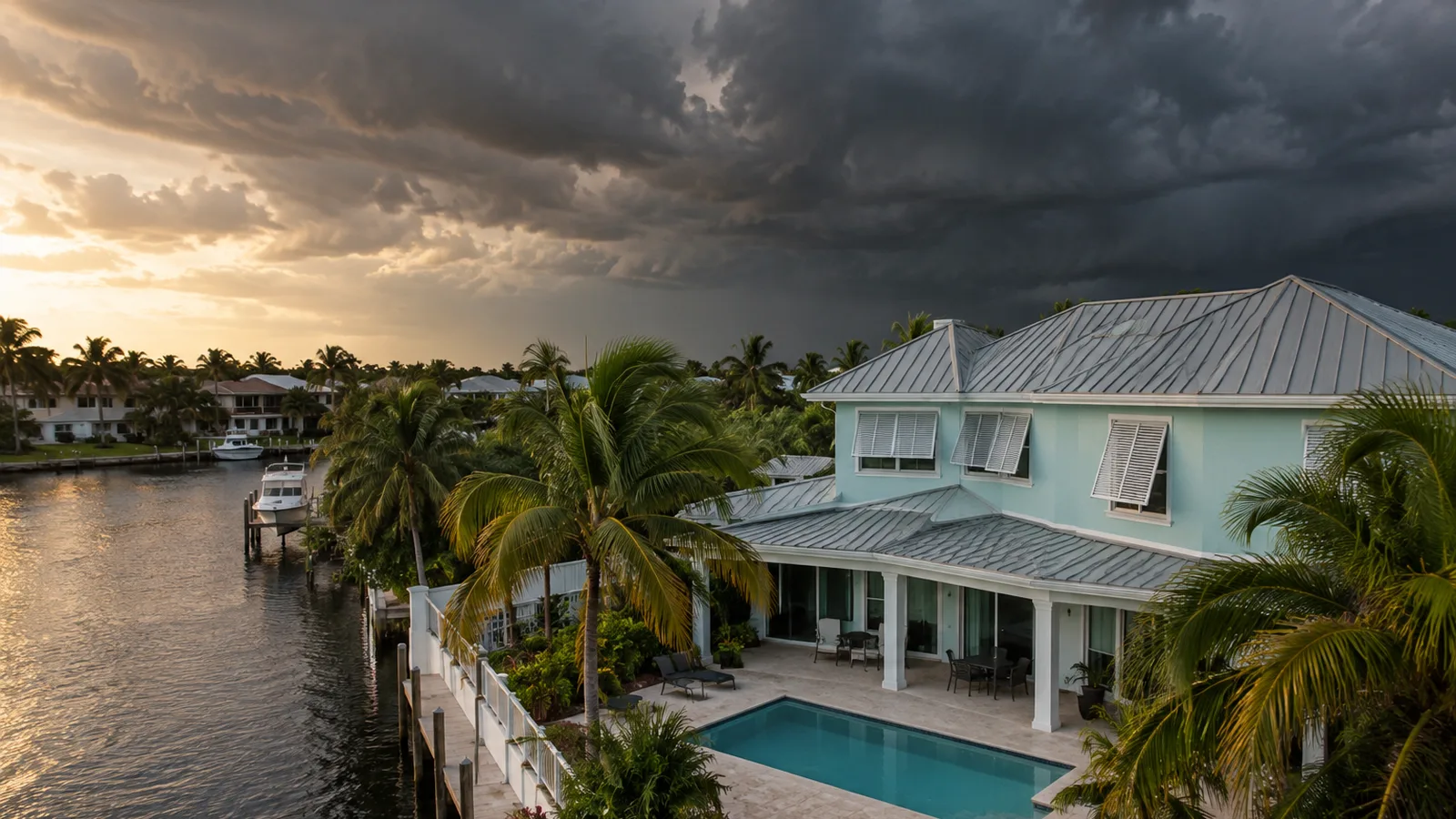
Florida does not have a state law that says an Airbnb owner must carry a specific insurance policy. That surprises a lot of people who search for "Florida Airbnb insurance requirements." The state requires a vacation rental license from the Department of Business and Professional Regulation. It does not require short term rental insurance. The "requirements" you will actually face come from your lender, your HOA or condo association, the booking platforms, and the property manager you hire.
What Florida does have is the hardest property insurance market in the country. Percentage hurricane deductibles, a state-run insurer of last resort with its own rules on vacation rentals and short term rental homes, flood as a completely separate policy, and condo master policies that stop at the drywall. This guide walks through each of those, in plain English, so you can buy the right short term rental insurance the first time, with a deep understanding of what each policy does and hand your property manager a certificate that actually holds up. If you want the national framework first, start with our short term rental insurance guide and come back here for the Florida specifics.
What Florida actually requires (and what it does not)
Under Florida Statute 509.242, a home, condo unit or duplex that is rented to short term rental guests as a transient public lodging establishment is a "vacation rental." That triggers the DBPR license. You can read the licensing process on the DBPR vacation rental page and in our DBPR licensing walkthrough. Nowhere in that process does the state ask for proof of insurance coverage.
Florida also preempts local governments from banning vacation rentals or regulating how often vacation rentals are rented (Statute 509.032, with a carve-out for ordinances adopted before June 2011). Cities and counties still regulate registration, occupancy, parking and noise. Some local registration ordinances ask for an insurance certificate, so check your city. Our Florida short term rental laws guide covers the local layer for every type of rental property.
So who sets the insurance rules for a Florida short term rental? Four parties:
- Your lender. A mortgage requires hazard coverage on the dwelling, and flood coverage if the home sits in a special flood hazard area. Most loan documents also require you to tell the lender if the use of the property changes from primary residence to commercial use.
- Your HOA or condo association. Many Florida associations require unit owners to carry an HO-6 policy and to show a certificate before approving rentals.
- The platforms. Airbnb and Vrbo do not require you to carry your own policy, but their host protection programs are limited and are not a substitute for real insurance protection. More on that below.
- Your property manager. Most management agreements require the owner to hold commercial coverage, usually $1,000,000 per occurrence, and to name the manager as an additional insured. We cover why in our post on additional insured status.
The regulator for all of this is the Florida Office of Insurance Regulation (OIR), which approves policy forms and rates. If a carrier treats you badly on a claim, OIR and the Department of Financial Services consumer helpline are where you complain. Both also publish consumer guides that are worth an hour of any property owner's time before the first claim.
Why your homeowners policy is the wrong policy
A standard home insurance policy (HO-3) is written for a primary residence, and standard policies of that type are priced on the assumption that the property owner lives there. Most policies exclude or sharply limit property damage and guest liability claims tied to business activity, and renting to paying guests more than a few times a year is business use. When a claim comes in and the adjuster finds an Airbnb listing with 80 reviews, you can expect a coverage fight, and the claim may be denied outright. We break down the exclusion language in Airbnb and homeowners insurance.
Landlord insurance (a DP-3 dwelling policy, the standard non owner occupied rental property form for a property owner with a long term tenant) is the next thing owners reach for. It is built for a tenant on a long term basis, not for transient occupancy. A landlord policy typically has no coverage for guest theft, no liability for injuries to short term guests, and loss of rent tied to a lease rather than nightly bookings. Some carriers will endorse landlord insurance for short term use; many will not. And the premium for that endorsement is not typically low.
The right tool is commercial short term rental insurance that treats the home as the small business it is. Proper Insurance is the best known example. According to Proper Insurance's program materials, the policy replaces a homeowners or landlord policy and includes $1,000,000 per occurrence and $2,000,000 aggregate commercial liability coverage, special form (all risk) replacement cost on the building and contents, business income on an actual loss sustained basis with no time limit, guest theft and vandalism with no sublimit, liquor liability, animal liability with no breed exclusions, and coverage for amenities such as pools, hot tubs, bikes and golf carts. It is written as commercial property and liability insurance coverage, which is why lenders and managers accept it. It is underwritten through Lloyd's of London with Concert Specialty as the coverholder, and Proper reports 100,000+ policies written. Details are at proper.insure.
Disclosure: the coverage framework in this article draws on program materials shared with Surge by Proper Insurance. Surge is not currently compensated by Proper, and owners are free to use any insurer that meets the coverage requirements below.
Proper is not the only option. Several admitted and surplus lines carriers write vacation rental insurance in Florida for vacation rentals of every size, and a good independent agent can quote more than one. Vacation rental insurance from any of them beats a homeowners form with a rental endorsement. Our comparison of insurance for Airbnb hosts lists the main players. Whatever you buy, the coverage type and coverage limits on the checklist below are what matter, not the logo on the declarations page. Comprehensive coverage for a rental property means the building, the contents, the liability and the lost rent, all on one insurance policy. If an agent cannot show you all four on the quote, it is not comprehensive coverage.
The hurricane deductible: the number that decides your worst year
This is the piece most out-of-state buyers miss. Florida personal residential policies carry a separate hurricane deductible, and it is a percentage of your dwelling coverage, not a flat dollar amount.
Under Florida Statute 627.701, insurers must offer hurricane deductible options of $500, 2 percent, 5 percent and 10 percent of the dwelling limit. Most Florida policies are written at 2 percent, and many coastal risks are only available at 5 or 10 percent. The deductible applies once per calendar year across all hurricane losses with the same insurer, so two storms in one season do not mean two full deductibles.
The math is simple and painful:
| Dwelling coverage | 2% hurricane deductible | 5% hurricane deductible | 10% hurricane deductible |
|---|---|---|---|
| $400,000 | $8,000 | $20,000 | $40,000 |
| $650,000 | $13,000 | $32,500 | $65,000 |
| $1,000,000 | $20,000 | $50,000 | $100,000 |
When does it apply? Statute 627.4025 defines the hurricane period as starting when the National Hurricane Center issues a hurricane warning for any part of Florida and ending 72 hours after the last watch or warning is lifted. Significant damage from wind inside that window falls under the hurricane deductible, and the claim is adjusted against it. Wind damage from an ordinary summer thunderstorm is still covered, but under your regular all other perils deductible.
Short term rental insurance policies handle wind differently from carrier to carrier. Some use a percentage named storm deductible, some a flat amount, and some exclude wind in coastal counties and require a separate wind policy. Ask the question directly: "What is my wind or named storm deductible in dollars, and does this policy cover wind at all at this address?" Our Airbnb hurricane policy guide covers the guest side of storms: cancellations, refunds and how platforms handle evacuations.
Wind mitigation credits are real money
Florida requires insurers to give premium discounts for construction features that reduce windstorm losses (Statute 627.0629): roof shape, roof-to-wall attachments, roof deck attachment, opening protection such as shutters or impact glass, and secondary water resistance. A wind mitigation inspection costs a few hundred dollars and uses a standard OIR form. On a coastal home in Panama City Beach or Naples, the credits can cut the wind portion of the premium substantially. If you are buying, ask the seller for the existing wind mitigation report and the four-point inspection before you close.
Citizens Property Insurance and short term rentals
Citizens Property Insurance Corporation is Florida's state-created insurer of last resort. It is where property owners end up when no private carrier will write the home, and its rules are set by statute (627.351) rather than by an underwriter's appetite. Two of its rules matter a great deal for vacation rentals.
First, Citizens' multiperil policies are not available for most short term rental properties. Citizens' published eligibility FAQ (Answer ID 1531, updated September 2026) states that a property is not eligible for Personal Residential Multiperil coverage if it is rented to guests more than three times in a calendar year for periods of less than 30 days, or if it is advertised or held out to the public as a place regularly rented to guests. That describes every Airbnb listing and nearly every rental property marketed to vacationers. If the home is in a wind-only eligible area, Citizens may still write a wind-only policy (a DW-2 for a non owner occupied dwelling), and you would pair that with a separate ex-wind policy from a private carrier. You can check Citizens' policy types and wind-only eligibility on citizensfla.com.
Second, Citizens policies with wind coverage now require flood insurance. Under the December 2022 reforms (Senate Bill 2-A, Chapter 2022-271), Citizens personal residential policyholders must carry flood insurance on a phased schedule: all homes in a special flood hazard area now, homes outside the hazard area at $400,000 or more of dwelling coverage as of January 1, 2026, and every policy regardless of value by January 1, 2027. Condo unit owner and wind-excluded policies are exempt. Citizens' flood requirement page lists the schedule and the proof of coverage it accepts.
Citizens also runs a clearinghouse that pushes policies back to the private market. A new applicant is not eligible if a private carrier offers comparable coverage within 20 percent of the Citizens premium, and a renewal is nonrenewed if a private offer comes in at or under 20 percent above. Owners who assume Citizens is a permanent home for the policy are often surprised by a takeout offer. For a short term rental this is mostly academic, since the multiperil rule above already excludes you, but it explains why your neighbor's premium moved and yours did too.
The same December 2022 law eliminated one-way attorney fees in property insurance suits and prohibited assignment of benefits on new policies. Both were aimed at litigation costs that pushed carriers out of Florida. The market has stabilized since, with new carriers entering and rate filings flattening, but Florida premiums are still the highest in the country for comparable homes. Budget for it.
Flood is always a separate policy
No home insurance, landlord insurance or short term rental insurance policy in Florida covers flood. Rising water from storm surge, an overflowing canal or a tropical rain event is not covered, full stop. It is the most common of Florida's natural disasters and the least understood by new hosts. Flood coverage comes from either the National Flood Insurance Program (NFIP) or a private flood carrier.
The NFIP facts every owner should know, from FloodSmart.gov:
- Building coverage maxes out at $250,000 and contents coverage at $100,000 for residential policies. On a $700,000 Fort Lauderdale canal home, that leaves a large gap that only private flood or excess flood fills.
- There is normally a 30 day waiting period before a new NFIP policy takes effect (a loan closing is the main exception). You cannot buy it when a storm is on the forecast cone.
- NFIP does not pay for lost rent or additional living expense. Some private flood policies do; ask.
Your flood zone drives both the requirement and the price. A lender will force flood coverage in any A or V zone. Outside those zones it is optional but often cheap, and Florida has plenty of X-zone homes that flooded in recent storms. Pull the FEMA flood map for the parcel before you make an offer, not after. A cheap X-zone flood policy is usually the best value in the whole premium stack, and it protects the rent as well as the structure if you buy a private form with business income.
Condos and HOAs: the walls-in problem
A large share of Florida vacation rentals and short term rental properties are condo units in Kissimmee resort communities, Panama City Beach towers and Naples golf communities. Condo insurance has a gap that trips up owners constantly.
The association's master policy covers the building structure, common areas and usually the unit down to the unfinished drywall. Everything from the drywall in is yours: flooring, cabinets, countertops, fixtures, appliances, contents, and loss assessment for your share of a master policy deductible. That is what an HO-6 style unit owner policy covers. Citizens describes its HO-6 the same way: it covers certain features of the unit's interior and personal property, and does not cover the exterior of the building.
Three Florida-specific points:
- Master policy hurricane deductibles are huge. A 5 percent deductible on a $40,000,000 building is $2,000,000, and it is split among unit owners as a special assessment. Loss assessment coverage on your unit policy, with a limit sized to your share, is not optional in a coastal tower.
- Most HO-6 forms assume you live there. A unit rented on a short term basis needs the same short term rental insurance coverage as other short term rental properties: commercial liability, guest damages and lost income protection. Vacation rental insurance carriers write condo units, so ask for the unit version of the policy rather than a personal HO-6 with a rental endorsement.
- Read the association's rental rules and insurance requirements together. Many Florida associations require proof of an HO-6 before approving a rental, and some require the association to be listed as an additional interest. Get the exact wording from the manager before you bind.
Sinkholes vs catastrophic ground cover collapse
Central Florida sits on limestone, and sinkholes are one of the natural disasters vacation rentals there face. The risk is real in Polk, Hillsborough, Pasco and Hernando counties, including the Kissimmee and Davenport corridor where so many vacation rentals sit. Florida law splits the coverage in two ways that matter.
Under Statute 627.706, every property insurer in Florida must include coverage for catastrophic ground cover collapse. That sounds broad. It is not. The statutory definition requires all four of: an abrupt collapse of the ground cover, a depression clearly visible to the naked eye, structural damage to the building including the foundation, and the structure being condemned and ordered vacated by a government agency. Cracked slabs and settling do not qualify.
Full sinkhole loss coverage, which pays for the testing and repair when a sinkhole damages the home without condemnation, is an optional endorsement that insurers must offer for an additional premium, often with a separate percentage deductible and an inspection requirement. If your rental property is in a sinkhole-prone county, price the endorsement. A guest-facing home with a foundation problem cannot be rented while it is repaired, which is where your loss of rent protection also earns its keep.
Platform protections are not insurance
Florida hosts on Airbnb get AirCover for Hosts, which includes Host Damage Protection up to $3,000,000 and Host Liability Insurance up to $1,000,000, per Airbnb's Help Center. Vrbo hosts get a comparable program for bookings paid through Vrbo, and Vrbo hosts should read its exclusions the same way. Both are useful protection. Neither is a policy you own, and you are not covered as a named insured under a contract you can enforce.
The gaps that matter in Florida: platform protections apply only to stays booked and paid on that platform, so direct bookings and repeat guests who text you are uncovered. Claims for damage caused by guests run through the platform's process and timelines, and wear and tear, mold and many weather-related losses are excluded. Guest injuries are covered only under the platform's own limits and only for platform bookings. Nothing in AirCover pays for a hurricane, a flood, or lost rent while the home is being repaired. We go deeper in our AirCover breakdown and Host Damage Protection review, and compare it against deposits and waivers in damage waiver vs deposit.
Loss of rental income after a storm
The most expensive part of a Florida hurricane for an owner is often not the roof. It is the twelve to eighteen months of zero bookings while contractors work through a backlog. Business income coverage (also called business revenue protection or loss of rent) replaces that lost revenue while the home is unrentable because of a covered loss.
Look for three things: coverage on an actual loss sustained basis rather than a fixed dollar limit, no 12 month time cap or an extended period of indemnity that lasts until the home is back in service, and a trigger that includes civil authority orders such as mandatory evacuations and bridge closures, so you are paid the rent you would have collected while the home cannot be reached. Note that this coverage only responds to a covered peril. If wind is covered but flood is not, storm surge damage produces no payout unless your flood policy includes it. Our loss of rental income guide runs the numbers.
According to Proper Insurance's program materials, if a covered loss shuts the home, the manager's lost commission can also be paid under a commission income endorsement (form PI PR-400), deducted from the owner's business income payout, but only if the management agreement specifies it. That is a contract detail worth a sentence in your agreement. Have your attorney review any contract language.
What your Florida property manager will ask you for
A professional manager in Florida will not put your home live on their account without proof of coverage. Here is the typical list, and why each item exists:
| Manager requirement | Why they ask |
|---|---|
| Commercial liability of at least $1,000,000 per occurrence | The manager's own business policy usually excludes injuries at premises they manage. Your policy is what responds when a guest is hurt. |
| Manager named as additional insured, with a certificate of insurance | Puts the manager under your policy for claims arising from the home so both parties defend a claim together instead of suing each other. |
| Business use disclosed to the carrier | Prevents a rescission for misrepresentation when the adjuster finds the listing. |
| Flood policy where required, wind confirmed in coastal counties | The manager does not want to explain to you after a storm that the home was never insured for the peril that hit it. |
| Guest damage plan (deposit, waiver or platform program) selected in writing | Defines who pays for the broken TV before it becomes a dispute. |
Sample language from Proper Insurance's program materials reads roughly: the owner maintains commercial liability of at least $1,000,000 per occurrence naming Manager as additional insured and provides a certificate of insurance; if the owner carries business income coverage and a claim is triggered, Manager is entitled to lost commissions if the policy specifies as such. Have your attorney review any contract language before it goes into your agreement. We walk through the full insurance section of a contract in the management agreement insurance clause, and you can compare it to our management agreement template and contract guide.
One more Florida-specific item: know when a guest stops being a guest. A stay that crosses into months can create tenant rights under Chapter 83, and some policies treat tenants differently from transient guests when a claim is filed. Our post on when a guest becomes a tenant explains where the line sits.
What Florida short term rental insurance costs
We are not going to give you a single number, because the honest answer is that the premium depends on the county, distance to the coast, roof age, construction year, wind mitigation features, dwelling value, flood zone and claims history. Two identical vacation rentals, one in Kissimmee and one on the Gulf in Walton County, can carry premiums that differ by a factor of three or more for the same coverage limits. Raising the limits on liability or business income usually moves the premium far less than the wind and flood components do.
What we can tell you is how the bill is structured for a short term rental owner. Florida short term rental owners are usually paying for three separate contracts: the main short term rental insurance policy (the homeowners replacement), a flood policy (NFIP or private), and in some coastal counties a separate wind-only policy. Add optional sinkhole coverage in central Florida. Then add the deductibles you self-insure: the percentage hurricane deductible and the flood deductible. When you underwrite a Florida rental property, put the full premium stack and a realistic hurricane deductible in the model, not just the mortgage. For a comparison with a lower-premium state, see our Texas STR insurance costs post.
Short term rental insurance Florida owners actually need: the checklist
- Commercial short term rental insurance, not standard home insurance or a landlord policy, with the carrier told in writing that the home is rented to transient guests.
- Liability coverage of $1,000,000 per occurrence minimum, $2,000,000 aggregate preferred, extended to your manager as additional insured.
- Building and contents coverage at replacement cost on a special form (all risk) basis, with the dwelling limit set to today's rebuild cost, not purchase price.
- Wind confirmed at the address and the hurricane or named storm deductible stated in dollars.
- Flood policy in place, with building limits above the NFIP $250,000 cap if the home is worth more, and the 30 day waiting period planned for.
- Business income on an actual loss sustained basis with civil authority coverage.
- Guest theft, vandalism and property damage caused by guests covered without a small sublimit, plus a written plan for deposits or a damage waiver. Travel-style damage plans are typically low, often a few thousand dollars, so know your limits.
- Amenity liability for pools, hot tubs, docks, kayaks, bikes and golf carts, all of which are common at Florida vacation rentals.
- For condos: HO-6 style unit coverage with a loss assessment limit sized to the master policy's hurricane deductible.
- Sinkhole loss endorsement priced if the home is in a sinkhole-prone county; catastrophic ground cover collapse is already included by law.
- Wind mitigation inspection on file and every available credit applied.
Quick answers
Is short term rental insurance required in Florida?
Not by state law. Florida requires a DBPR lodging license, not an insurance policy. Insurance requirements come from your lender, your HOA or condo association, and your property management agreement. Some city registration ordinances ask for a certificate of insurance.
Will my homeowners policy cover an Airbnb in Florida?
Almost certainly not for business use. Standard homeowners and landlord insurance policies exclude or limit claims tied to renting the home to paying guests, and Citizens will not write its multiperil homeowners policy on a home rented more than three times a year for stays under 30 days. Buy short term rental insurance designed for vacation rentals.
Does Citizens Property Insurance cover short term rentals?
Citizens' Personal Residential Multiperil policies are not available to homes rented to guests more than three times a calendar year for periods under 30 days or advertised as regularly rented. In wind-only eligible areas Citizens may write a wind-only policy, paired with a private ex-wind policy.
How much is a Florida hurricane deductible?
It is a percentage of your dwelling coverage. Insurers must offer $500, 2 percent, 5 percent and 10 percent options. At 2 percent on a $500,000 dwelling limit you pay the first $10,000 of hurricane damage; at 5 percent, the first $25,000. It applies once per calendar year per insurer.
Is flood covered by short term rental insurance in Florida?
No. Flood is always a separate policy in Florida, through the NFIP or a private flood carrier. NFIP residential building coverage caps at $250,000 and contents at $100,000, with a 30 day waiting period on new policies.
What does the condo master policy leave out?
Typically everything inside the unit from the drywall in, plus your share of any special assessment for the master policy's hurricane deductible. An HO-6 style unit policy with loss assessment coverage fills the gap, and a short term rental unit also needs commercial liability and business income coverage.
Is sinkhole coverage required in Florida?
Insurers must include catastrophic ground cover collapse, which has a narrow four-part definition ending in condemnation of the home. Broader sinkhole loss coverage is an optional endorsement the insurer must offer for an extra premium.
Does Airbnb's AirCover replace insurance in Florida?
No. Host Damage Protection up to $3,000,000 and Host Liability Insurance up to $1,000,000 apply only to Airbnb-booked stays and exclude many losses, and neither covers hurricanes, floods or lost rent during repairs.
What liability limit will a Florida property manager require?
Most managers require at least $1,000,000 per occurrence of commercial liability coverage with the manager named as additional insured, and a current certificate of insurance before the listing goes live.
Get a second set of eyes on your Florida coverage
If you own or are about to buy a vacation rental in Florida, we will read your declarations page and your management agreement side by side and tell you where the gaps are, in plain English, with no obligation. Surge manages homes across the state, from Fort Lauderdale and Naples to Panama City Beach and Kissimmee, with full service starting at 15%. Start on our Florida Airbnb management page, or see how we stack up in our review of Florida Airbnb management companies and the owner's guide to Airbnb management.

Written by
Humberto MarquezFounder, Surge
Founder of Surge and licensed Texas real estate broker. Manages short-term rentals across 12 U.S. markets and invests in STRs himself. Quoted in Martha Stewart, Yahoo Finance, Realtor.com, Bob Vila.
More about Humberto →See what your property could earn with Surge
Full-service short term rental management across Texas and Florida. Get a free property assessment and revenue estimate, no commitment.