
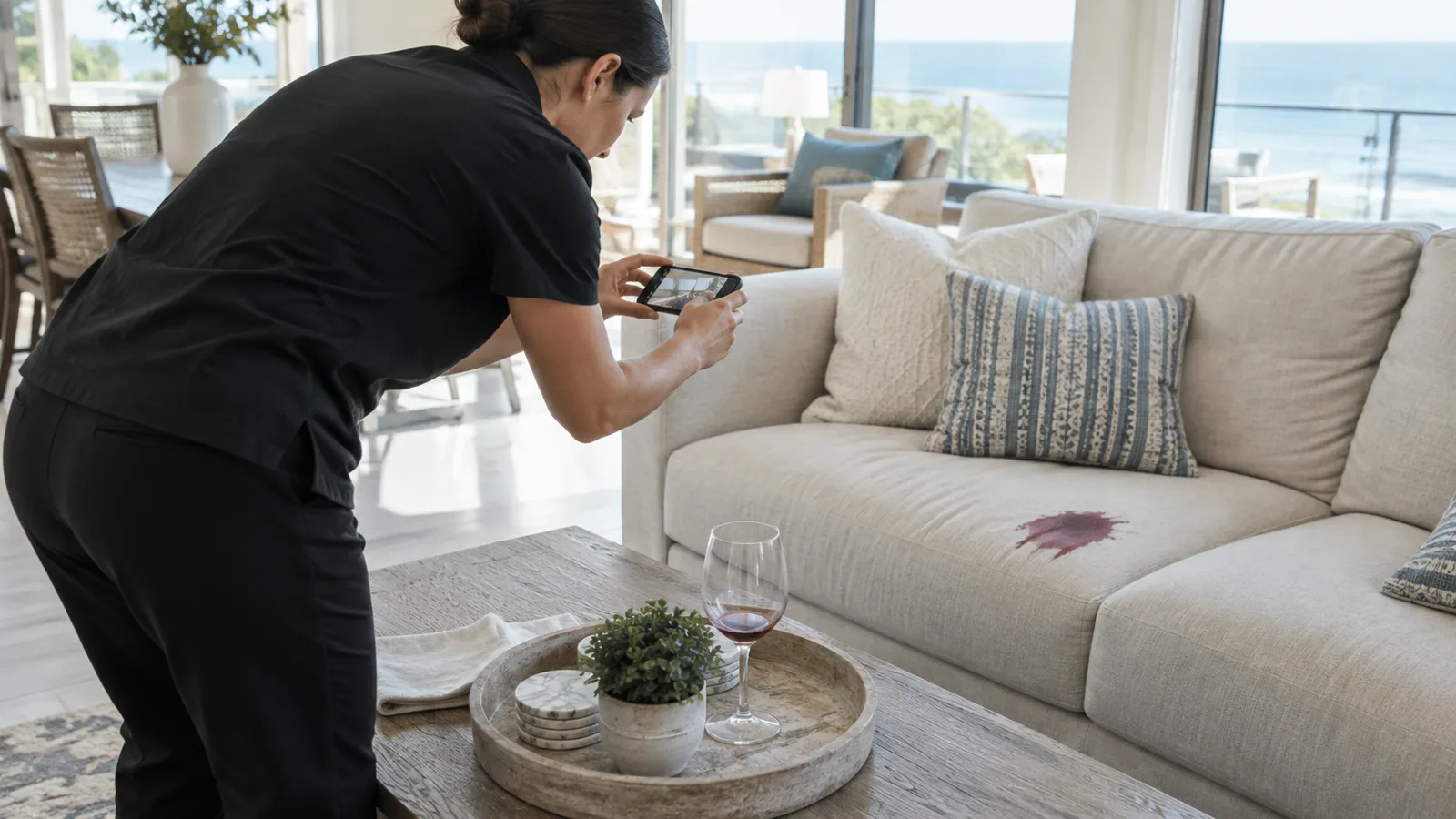
Every owner of vacation rentals eventually gets the photo from the cleaner: a cracked glass cooktop, a red wine stain across a white sofa, a dog-chewed door frame. The question is never whether accidents happen. It is who pays, how fast, and how much of your own time and your guests' goodwill it costs to get reimbursed. That is the whole point of vacation rental damage protection.
There are five common ways to handle guest damage at short term rentals and vacation rentals: a security deposit, Airbnb's Host Damage Protection (part of AirCover), Vrbo's damage protection options, travel style accidental damage plans that the guest buys, and damage waivers that the host pays for per stay. They are not interchangeable. Each type of vacation rental damage protection pays for different things, excludes different things, and puts a different amount of friction between you and your money.
This guide compares all five side by side, explains how each one stacks with the property insurance you already carry, and shares what we see on real turnovers at the vacation rentals we manage. Whether you own a beach house, a lake cabin, or a city apartment, the same five choices apply to all vacation rentals. If you want the bigger picture first, start with our short term rental insurance guide and come back.
Where vacation rental damage protection fits: the three layers
It helps to think about risk at a vacation rental property in three layers. Property owners who understand the layers stop expecting one product to cover everything. Layer 1 is your property manager's own business policy, which covers their operations but, under the standard property manager liability exclusion, does not cover injury or property damage arising from the homes they manage. Layer 2 is your own policy on the rental property: a commercial short term rental policy that replaces a homeowners or landlord form and responds to fire, storms, liability claims, and large losses. Layer 3 is vacation rental damage protection, the topic of this post. According to Proper Insurance's program materials, layer 3 exists because damage caused by guests is usually too small to run through a layer 2 deductible but too frequent to absorb out of pocket.
Disclosure: the coverage framework in this article draws on program materials shared with Surge by Proper Insurance. Surge is not currently compensated by Proper, and owners are free to use any insurer that meets the coverage requirements below.
One point owners often miss: none of the five options below replace layer 2. The Texas Department of Insurance puts it plainly in its home insurance guide: most standard policies will not pay for damages or injuries that occur during short term rentals. Vacation rental damage protection handles the broken lamp or the broken furniture. Your STR property insurance handles the kitchen fire. Liability coverage for an injured guest also lives in layer 2. You need both, and this post is only about the first one.
Why vacation rentals need their own damage protection
Vacation rentals take more wear than hotels and more risk than long term rental property. Guests get full kitchens, more space, private pools, game rooms, and the run of the whole house or apartment, often with pets and kids in tow. Accidents happen at hotels too, but hotels spread that exposure across hundreds of rooms and a housekeeping staff. A property owner renting one vacation home carries that risk alone, and a property owner renting five carries it five times over.
Standard homeowners insurance was not written for property rented to travelers by the night, which is why most carriers exclude it. A commercial STR policy fixes the big picture, but it cannot efficiently cover the $300 accidents that happen every few weeks. Vacation rental damage protection is the financial protection built for that gap: it exists to cover damage that is too small for insurance and too frequent to ignore, and to protect your investment without a claim on your main policy every time a guest breaks something.
A practical way to look at it: your property insurance protects the asset you bought as an investment, and vacation rental damage protection protects your cash flow and your reviews. Owners who run several short term vacation rentals feel this most, because small losses across a portfolio of vacation rentals add up to a real number every year.
The five options compared
Here is the short version of what each type of coverage does. Details, sources, and exceptions follow in the sections below.
| Option | Who pays for it | Typical limit | Intentional damage | Pet damage | Guest involved in claim? | Deductible |
|---|---|---|---|---|---|---|
| Security deposit (damage deposit) | Guest, refundable | Whatever you set; Vrbo charges the card up front above $5,000 | Yes, up to the deposit | Yes, up to the deposit | Yes, and they can dispute | None |
| Airbnb Host Damage Protection (AirCover) | Included with Airbnb bookings | Up to $3 million per stay | Covered if caused by the guest and documented | Yes, including pet accidents and cleaning | Yes, guest gets 24 hours to respond first | None stated, but payouts can be reduced for depreciation and other recoveries |
| Vrbo Property Damage Protection plan | Guest buys at booking ($59, $89 or $119) | $1,500, $3,000 or $5,000 | Accidental damage only | Depends on plan terms | Guest is copied on the claim | None stated |
| Travel style accidental damage plans | Guest buys | Typically $3,000 to $5,000 | No, accidental damage only | Varies, often excluded | Yes, the guest is the policyholder | Varies |
| Damage waiver (Waivo style) | Host pays per stay, can pass through as a fee | $500 to $20,000 | Yes | Yes | No | None |
Option 1: The security deposit
The security deposit is the oldest form of vacation rental damage protection and the one most owners of rental property understand from long term rentals. Guests put a deposit down, you inspect at check out, you refund what is left. It offers financial protection only up to the amount held, so it does not reach damage beyond the deposit.
The catch is that the major rental platforms for short term rentals have moved away from it. Airbnb's security deposit policy says most hosts are not allowed to charge one, on or off the platform. Only select software connected hosts can collect a deposit off platform, and it has to be disclosed in the listing's fee fields. Vrbo still supports a damage deposit: for amounts of $5,000 or below it stores the guest's card on file rather than charging it, and above $5,000 it charges a refundable deposit at booking.
Where a damage deposit still works well is direct bookings and a larger vacation rental property. Where it hurts is conversion. Travelers comparing vacation rentals to hotels see a $1,000 hold and keep scrolling. A deposit also covers only up to the amount you set, and guests who dispute the charge with their bank can tie up a small amount for a long time. For short term rentals that turn over every two or three nights, that friction adds up.
Option 2: Airbnb Host Damage Protection (AirCover for Hosts)
Airbnb's Host Damage Protection reimburses hosts up to $3 million if guests, their invitees, or their pets damage the home or its contents and the guests do not pay. It is included with every Airbnb stay at no cost to the host, which makes it the default vacation rental damage coverage for most Airbnb bookings. Airbnb will also reimburse hosts for damage to parked cars and boats caused by guests, and it pays for extra cleaning to remove stains, pet accidents, and smoke odor, and for booking income lost if you have to cancel confirmed reservations because of guest damage.
What it does not cover, per Airbnb's own help page and program terms:
- Normal wear and tear, and gradual deterioration from age or lack of maintenance
- Acts of nature such as hurricanes, tornadoes, and earthquakes
- Mysterious disappearance or unexplained inventory shortages
- Currency, fine art that cannot be replaced in kind, and several categories of ineligible property
- Cleaning that is part of a normal check out, like dishes, laundry, and trash
- Injury to guests or others (that is a separate liability program)
Two fine print items matter for owners. First, Airbnb states that Host Damage Protection is not insurance. It is a reimbursement guarantee backed by Airbnb, except in Washington state where it is backed by an insurance policy Airbnb purchased. Second, payouts are reduced by anything you already received from a security deposit, the guests, or your own insurance company, and some items are paid at actual cash value with depreciation deducted. We cover the program in depth in our Airbnb Host Damage Protection guide and the broader AirCover for Hosts explainer.
Option 3: Vrbo damage protection options
Vrbo gives owners of vacation rentals and other short term rentals two paths, described on its damage protection help page. The first is a Property Damage Protection plan, an optional insurance the guest can purchase at booking: $59 for $1,500 of coverage, $89 for $3,000, or $119 for $5,000. When accidental damage occurs during the stay, the plan covers your rental property and is administered by Generali Global Assistance. It is, in effect, accidental damage protection insurance that the guests purchase. Claims go through Generali's eClaims portal, and both you and the guest receive the claim email.
The second path is the damage deposit described above, which lets owners cover vacation rentals without asking guests to buy coverage. Whichever coverage level you enable, guests get a choice at booking: buy the plan, or leave the equivalent amount as a damage security deposit. If they choose the deposit and damage occurs, you have 14 days after check out to report it. Vrbo says it will cover valid damage deposit claims up to your deposit amount even if the guest's card is maxed out or expired, and that most claims are processed immediately with funds deposited in 3 to 7 business days.
The weak spot is the same as any guest purchased product: if guests pick the deposit over the plan, your vacation rental damage coverage is capped at the deposit, and the plan itself only covers accidental damage.
Option 4: Travel style accidental damage plans
Outside the two big platforms, a family of products from travel insurance companies does the same job as the Vrbo plan for vacation rentals. Guests purchase a small policy at booking, usually bundled next to trip cancellation and trip interruption coverage, and it reimburses the owner for accidental damage up to a cap.
According to Proper Insurance's program materials, these plans typically cap at $3,000 to $5,000 and cover accidental damage only. That means the guest who breaks a window reaching for a ball is covered. The guest who punches the same window is not. Deliberate damage, and often pet damage and smoking, fall outside the accidental definition, and because guests are the policyholders, guests are part of every claim.
These plans are inexpensive for the traveler to purchase, they are the closest thing to true vacation rental damage insurance sold at checkout, and they are better than nothing, and they do reimburse for the common accidents at vacation rentals, but for an owner of short term rentals they have a structural problem: you do not control whether guests purchase one.
Option 5: Damage waivers
A damage waiver flips the model for a vacation rental property. Instead of the guest buying protection, the host pays a small amount per stay and the waiver provider reimburses the host directly for damage guests cause. Waivo, a sister company of Proper Insurance, is the best known example for vacation rentals. Its plans reimburse the host for guest caused damage through a client portal and never bill the traveler. According to Waivo's published program details and Proper's materials, limits range from $500 to $20,000 per stay, there is no deductible, and the provider does not contact the guest at all. Protection includes accidental and deliberate damage to the building and contents, pet damage, and theft by guests during the stay with a police report. Liability coverage is not included; that stays in layer 2, and you should protect yourself there with a real policy.
The cost is paid by the host per booking and can be passed through to the guest as a line item fee, the same way a cleaning fee is. In our experience a modest vacation rental damage protection fee on a listing converts better than a $1,000 deposit, and it removes the awkward conversation with guests after check out. Since the waiver is not tied to a platform, it will cover vacation rentals the same way on Airbnb, Vrbo, and direct bookings, and it will protect a portfolio of short term rentals with one consistent limit.
What each option pays for, and what it does not
Owners usually ask about four categories of damage at vacation rentals and whether their coverage will cover each one. Here is how the five kinds of vacation rental damage protection treat each one.
Intentional damage
A security deposit pays regardless of intent, up to its amount. Airbnb Host Damage Protection will cover damage caused by guests whether careless or deliberate, subject to documentation. The Vrbo Property Damage Protection plan and travel style plans cover accidental damage only. A Waivo style damage waiver covers it explicitly.
Normal wear and tear
Accidents happen, but wear is not an accident. Nothing on this list pays for wear and tear, and neither does your STR property insurance. Worn carpet, a mattress that sags after three years, a scratched countertop from ordinary use at a vacation rental property: these are operating costs of running a vacation home or any short term rentals, and you should budget for them the way hotels do.
Pet damage
Airbnb explicitly includes pet damage and pet accident cleaning for guests who bring pets, and it applies even when pets were at the home in violation of your house rules. Vrbo plan terms and travel style plans vary, so read the plan document before assuming pets are covered. Damage waivers from Waivo include pet damage. A pet deposit or pet fee covers the expected costs of hosting pets, not unexpected damage, so it does not replace any of these. If you allow pets at your vacation rentals, pet damage is the first thing to check in any vacation rental damage protection you consider, because pets are also the most common source of disputes.
Smoking
Airbnb reimburses smoke odor removal but requires evidence the guest caused it, such as photos, smoke detector readings, a professional assessment, or an admission from the guest, and pays only cleaning costs above your standard cleaning fee. Deposits cover damage from smoking if you can document it inside the filing window. Accidental only plans generally do not treat smoking as an accident.
Claims friction and timing
Coverage limits get the attention, but claims friction is what actually costs owners of vacation rentals the most. A $3 million ceiling does not help if the process takes three weeks and sours a review. Accidents happen on a Saturday; the reimbursement decision should not take until the following month.
- Security deposit: Fast if guests agree, slow if they dispute, and it will only cover up to the amount held. On Vrbo you get 14 days after check out to report, and you get one shot: a deposit cannot be withheld or refunded in two partial amounts.
- Airbnb Host Damage Protection: Document with photos, receipts or estimates, then file in the Resolution Center within 14 days of the responsible guest's check out. Guests have 24 hours to respond. Only if they decline, pay partially, or ignore the request does Airbnb Support review it and reimburse you under the program's coverage. Airbnb notes some requests are reviewed automatically, with human review available if you disagree.
- Vrbo Property Damage Protection plan: File through the Generali eClaims portal after check out for accidental damage the plan will cover. Guests are emailed a copy. Updates arrive by email from Generali.
- Travel style plans: You file with the guests' insurer, which means you depend on their cooperation and the insurer's definition of accidental.
- Damage waiver: You or your manager file directly with the provider through a portal, no guest contact, no deductible, and the provider reimburses you for the covered loss. This is the lowest friction path, which is why professional operators of vacation rentals lean on it to protect their owners.
The 14 day window sounds generous until you run back to back bookings. If your cleaner does not photograph damage at check out and the next guests arrive the same afternoon, you have lost the ability to prove who caused it, and no program will pay for damage you cannot tie to a stay. That is the single biggest reason vacation rental damage claims fail across every option here.
How guest damage protection stacks with your STR property insurance
Vacation rental damage protection is layer 3. It sits on top of, not instead of, your layer 2 property insurance. A well built commercial policy for short term rentals will cover the building and contents of your vacation rentals on a special form basis, carries commercial general liability, and pays business income when a covered loss shuts the home. Guest theft and vandalism at vacation rentals are also included in some programs; according to Proper Insurance's program materials, their policy covers guest theft and vandalism with no sublimit.
So why do you need layer 3 at all? Deductibles and claims history. A typical property insurance deductible for a vacation rental property runs well above the cost of a broken chair or broken furniture, and every claim you file on layer 2 follows you at renewal. Layer 3 handles the frequent small guest caused damage at your vacation rentals so your property insurance stays reserved for fire, wind, water, and liability. That is how the two layers protect each other. The Insurance Information Institute publishes homeowners claim frequency and severity data if you want to see how much of the average claim dollar goes to those big perils.
A few practical rules for stacking coverage across vacation rentals:
- Report damage by guests to layer 3 first. Airbnb reduces its payout by whatever your insurer or deposit already paid, so the order matters.
- If the loss is large enough to exceed the layer 3 limit, a burst pipe left running or a party that trashes the home, that is when you call your insurance company and file on layer 2 for the covered loss. Your business income coverage is what pays for the weeks the home is offline.
- Make sure your management agreement says who files, who documents, and who holds the waiver or deposit funds. Our guides to the insurance clause in a management agreement and naming your manager as additional insured walk through the language. Have your attorney review any contract language.
If you are still on a homeowners or landlord policy for property rented to guests, fix that before worrying about layer 3. Our Airbnb homeowners insurance post explains why the standard form fails at short term rentals and vacation rentals, and best insurance for Airbnb hosts compares the specialty carriers.
What Surge sees on turnovers
We manage short term vacation rentals across Texas and Florida markets like Houston, Galveston, and Panama City Beach, and the pattern of damage at short term rentals is consistent everywhere. A few honest observations from the field:
- Most damage at vacation rentals is small. Broken glassware, a stained duvet, a chipped coffee table, a missing remote, a scorched pan from one of those full kitchens. Individually these fall under any deductible, which is exactly why layer 2 property insurance never sees them and why layer 3 vacation rental damage protection matters for short term rentals.
- Pets and smoking generate the most disputes. Pet damage is rarely denied by guests when there is a photo of what their pets did. Smoking is, because odor is hard to prove. Smoke detector logs and a same day cleaner report make the difference.
- Documentation at check out is the whole game. Our cleaners photograph every room on every turnover, before the next check in. Without that timestamped record, no vacation rental damage protection program on this list will reimburse you.
- Guest contact costs reviews, and lost reviews cost bookings. Asking guests to reimburse you, even when they are clearly at fault, tends to produce a defensive review. Waiver style protection avoids that entirely, which is a large part of its value on a listing that lives on ratings.
- Large events are rare but real. Unauthorized parties and long stay guests who overstay are the two scenarios where damage at vacation rentals climbs past the small stuff and into covered loss territory for your property insurance. The second one also raises the question of when a guest becomes a tenant, which is a legal problem before it is an insurance problem.
Because Surge lists on multiple rental platforms and takes direct bookings, we do not rely on any one platform's program. Airbnb Host Damage Protection stays in place for Airbnb stays, Vrbo's options stay in place for Vrbo, and a per stay damage waiver sits under all of them so every reservation at our owners' vacation rentals has the same floor of vacation rental damage coverage. Owners can see the waiver as a pass through fee on their statements. Our full service management, for owners who treat renting as a business, starts at 15%, and damage handling, documentation, and filing for reimbursement are part of it.
How to choose for your property
Ask three questions about your vacation rentals and how you want to protect them.
Where do your bookings for the rental property come from? If nearly everything comes through Airbnb, Host Damage Protection is already there and you mainly need a documentation process. If you take Vrbo and direct bookings for your vacation rentals, you need something platform independent that will cover every stay, which points to a damage waiver or a deposit.
How much can you absorb per incident? If a $1,500 loss at your rental property would not bother you or threaten the investment, a low limit waiver or the platform programs alone may be enough. If your vacation home has high end furnishings, a $5,000 to $20,000 waiver limit is worth the fee to protect the investment.
How much do you value the guest relationship? Every option that involves guests in the process carries review risk. The two that do not, a waiver you pay for and a deposit you never have to touch, protect your ratings as well as your furniture, and they still cover damage when it happens.
Whatever you pick to protect your vacation rentals, put it in writing with your manager. A good Airbnb management contract states which vacation rental damage protection applies, who files claims, and how reimbursements flow to the owner. If you are drafting one from scratch, start with our short term rental management agreement template. Texas and Florida owners should also read the state specific pieces on Texas STR insurance costs and Florida Airbnb insurance requirements, since wind and flood exposure change how much you lean on layer 2.
Quick answers
Is Airbnb Host Damage Protection the same as vacation rental damage insurance?
No. Airbnb states it is not an insurance policy. It is a reimbursement guarantee from Airbnb for damage by guests at vacation rentals booked on the platform, up to $3 million, with its own exclusions and a 14 day filing window.
Does vacation rental damage protection cover pets?
It depends on the option. Airbnb covers pet damage and pet accident cleaning. Waivo style damage waivers cover pet damage. Accidental only plans and Vrbo's guest purchased plan vary by plan terms, so read them. A security deposit covers pet damage up to the deposit amount.
Does any vacation rental damage protection cover intentional damage?
Security deposits, Airbnb Host Damage Protection, and damage waivers do. Travel style accidental damage plans and the Vrbo Property Damage Protection plan cover accidental damage only, so they will not cover a guest who trashes the place on purpose.
Can I charge a security deposit for vacation rentals on Airbnb?
Most hosts cannot. Airbnb says security deposits are not allowed on or off the platform except for select software connected hosts, and even then the deposit has to be disclosed in the listing fees.
What is the difference between a damage waiver and damage protection insurance the guests buy?
A damage waiver is paid by the host per stay, covers accidental and deliberate damage plus pets and theft, has no deductible, and never involves the guests. Guest purchased damage protection insurance is optional for travelers, usually caps at $3,000 to $5,000, and covers accidental damage only.
Does a damage waiver replace my short term rental insurance?
No. A waiver handles damage by guests up to its limit, usually $500 to $20,000. Fire, storms, liability, and lost rental income are layer 2 items that only a real vacation rental property insurance policy covers. Guest damage waivers are vacation rental damage coverage, not vacation rental damage insurance in the full sense, and they never include liability coverage. Your STR policy still has to be a commercial form, not a homeowners form.
How long do I have to file a vacation rental damage claim?
Airbnb and Vrbo both give hosts of vacation rentals 14 days after guests check out. Damage waiver providers set their own deadlines for vacation rentals, so confirm with the provider whose coverage you purchase. In every case, photograph damage before the next guests arrive, or the coverage will not help you.
Who pays for vacation rental damage protection when property managers handle my short term rentals?
It should be spelled out in the management agreement, along with the coverage limit. Common setups at professionally managed short term rentals are a per stay waiver fee passed through to the guest, or the platform program at no cost with the manager handling documentation and claims. Either way the manager should be able to show you what each stay is covered for and what would count as a covered loss. Ask your manager which one applies to your short term rentals and how they reimburse you when something is damaged.
What does vacation rental damage protection cost?
Airbnb Host Damage Protection is included with Airbnb stays. Vrbo's guest purchased plan runs $59 to $119 per booking depending on the coverage level. Damage waivers are priced per stay by the provider based on the limit selected, and most hosts pass that cost through as a guest fee. Deposits cost nothing but conversion, since travelers comparing vacation rentals see the hold before they book.
Get a human review of your damage protection setup
If you are not sure which of these five options is actually protecting your vacation rentals right now, or whether your manager's process would survive a disputed claim, we are glad to look. Send us your listing and your current coverage. We will look at the risk on your rental property and tell you plainly where the gaps are and what it would take to cover them. Start on our Airbnb management owner's guide, and if you are in Texas or Florida, see the Texas and Florida pages for market specifics.

Written by
Humberto MarquezFounder, Surge
Founder of Surge and licensed Texas real estate broker. Manages short-term rentals across 12 U.S. markets and invests in STRs himself. Quoted in Martha Stewart, Yahoo Finance, Realtor.com, Bob Vila.
More about Humberto →See what your property could earn with Surge
Full-service short term rental management across Texas and Florida. Get a free property assessment and revenue estimate, no commitment.