
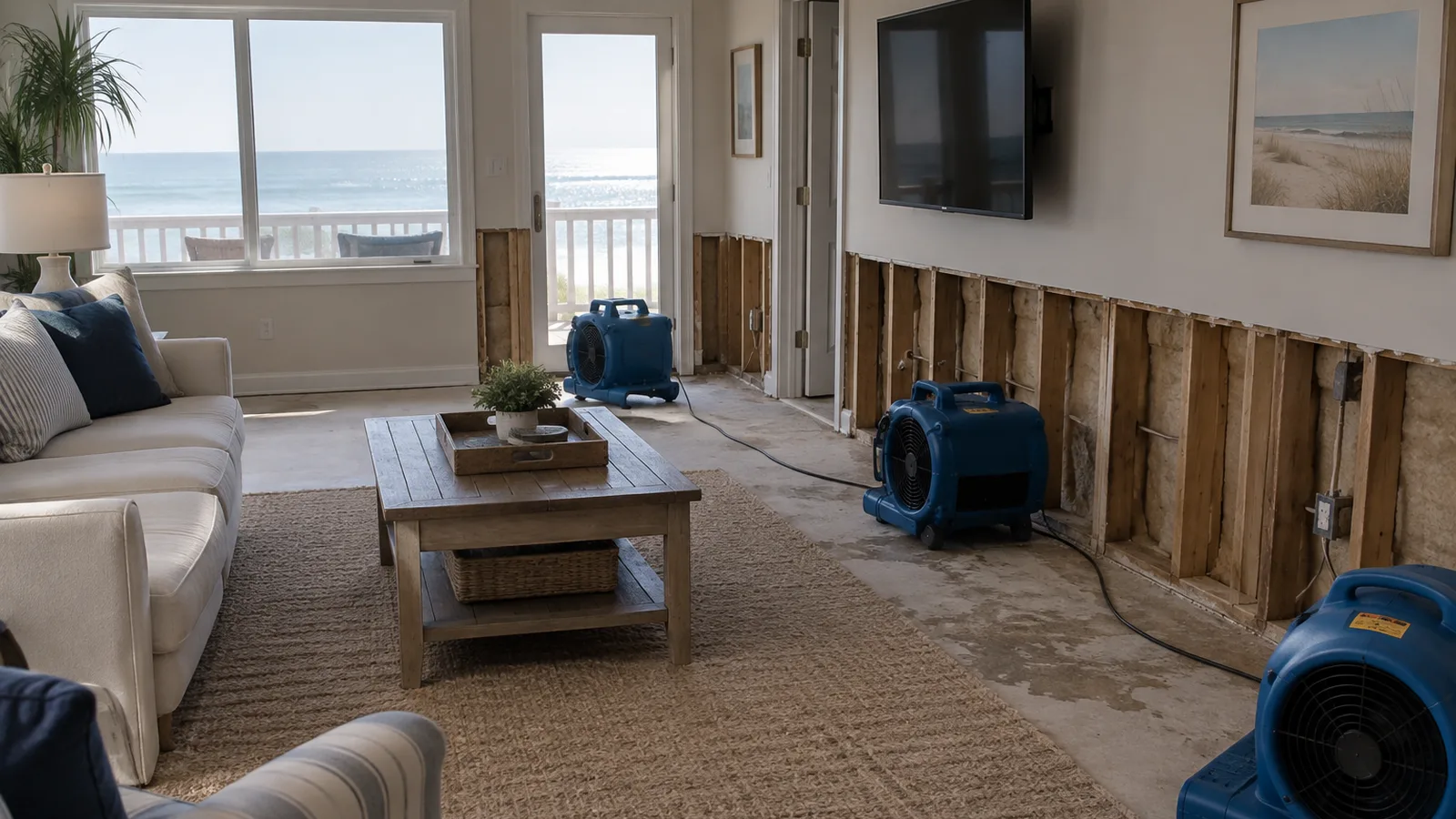
A fire, a burst pipe or a windstorm can take a short term rental offline for months. The repairs get paid by the property side of your policy. The bookings you lose while the home sits empty are a separate problem, and most owners do not find out how their policy handles it until the claim is open. This guide explains how loss of rental income insurance works on landlord insurance and homeowners policies, why short term rental income needs a different form of coverage, how a payout is calculated, and what your property manager is entitled to when the home is shut down.
It is part of our short term rental insurance guide, which covers the three layers of protection every owner should have in place.
What loss of rental income insurance actually is
Loss of rental income insurance replaces the income a rental property would have earned while it cannot be occupied because of a covered loss. Insurers use several names for the same idea: loss of rent coverage, rent loss insurance, fair rental value coverage (the label on most landlord insurance forms), rental income insurance, or business income coverage on commercial forms. The label depends on the policy type, and the policy type is what decides how much you can collect.
The important thing to understand up front: this coverage is not a standalone policy. It is a section inside a homeowners policy, a landlord insurance policy or a commercial short term rental policy, and it only responds when a covered peril damages the property. If the home is fine but the calendar is empty, no version of loss of rent insurance will cover it.
Most of what you read online about loss of rental income insurance is written for landlords with long term tenants. That is where the product started. Landlords buy landlord insurance, tenants pay rent monthly, and when a kitchen fire displaces the tenants the insurer reimburses the landlord for the lost rent until the repairs are done. Short term rental owners are in a different position.
How landlords use loss of rent insurance
For landlords with a lease in place, loss of rent insurance is simple. The lease agreements set the rent payments, so the insurer reimburses the landlord that amount each month the property is temporarily uninhabitable. Landlords use the money to cover mortgage payments, property taxes and other fixed costs while the tenants live elsewhere and the repairs are completed. It is a safety net for cash flow, and for most landlords it is a low cost add on to a landlord insurance policy or included in standard policies.
Rental property owners should also know what loss of rent insurance does not do for landlords. It does not pay when a tenant stops paying rent, when tenants break a lease, or when the property sits vacant between tenants. Those are rent default and vacancy risks, and landlords buy separate products to cover them. Landlords who list a former long term rental on Airbnb should reread their policy with that in mind. Loss of rent coverage applies only after physical damage from a covered peril.
Here is the problem for STR owners, and for landlords who have converted a long term rental to Airbnb. There are no tenants, no lease, and no fixed monthly rent to measure against. Income arrives in nightly bookings that swing with the season. So the landlord version of the coverage, which most landlords are happy with, tends to undervalue an STR badly. That gap is what the rest of this guide deals with.
Loss of use vs loss of rent coverage: how homeowners and landlord policies handle lost rent
Homeowners insurance (HO-3, HO-5)
A standard homeowners policy includes a section called loss of use. The Texas Department of Insurance describes this coverage in plain terms in its home insurance guide: it pays additional living expenses, meaning rent, food and other costs you would not have if you were still living in the home while it is repaired. Some homeowners policies also include a rental value provision for a room or a unit you rent to others, and a short civil authority provision if officials block access after a covered event nearby.
Two problems for short term rental owners. First, the limit is usually modest, expressed as a percentage of dwelling coverage or as a 12 month cap, and it was designed to cover a family's temporary housing, not a business's revenue. Second, homeowners insurance is built around the business use exclusion. Renting to paying guests night after night is a business activity in the eyes of most insurers. TDI says it directly on its home sharing page: homeowners insurance probably will not cover the costs if someone else gets hurt or causes damage when you rent out your home. If the insurer denies the property damage claim on business use grounds, there is no loss of use payout either, because the second depends on the first.
We cover the full exclusion problem in does homeowners insurance cover Airbnb.
Landlord insurance (DP-3)
A DP-3 dwelling policy is the rental property insurance most landlords carry on a long term rental property. It includes rental value coverage, usually labeled loss of rent coverage or rental property insurance with a loss of rent add on, which reimburses landlords for the rent payments tenants would have made while the home is uninhabitable after a covered loss. It is real insurance coverage and it is a good fit for landlords with a long term rental property and a lease.
The limits are where short term rental owners run into trouble:
- Time caps. Most policies pay loss of rent for the shortest time needed to make the repairs, often with a 12 month outside limit. Some landlord insurance forms cap it at a set number of months regardless of how long repairs take.
- Dollar caps. Many landlord insurance policies set the loss of rent limit as a percentage of the dwelling coverage, or as a flat monthly figure based on the lease. Neither has any relationship to what a well run Airbnb earns in peak season. Property owners often discover this only when the rent insurance claim is settled.
- Lease based valuation. The rental value is measured against what the property could rent for on a lease. The carrier looks at comparable long term rents in the area, not your nightly rate. A Galveston beach house that grosses $9,000 in July but would lease for $2,800 a month gets valued at $2,800.
- Occupancy assumptions. TDI notes that landlord insurance is mainly for traditional long term leases and may not be appropriate for short term rentals. Some carriers will not write rental property insurance on a home listed on Airbnb at all, and some that do have a vacancy clause that suspends coverage after 30 or 60 days without an occupant, which a seasonal rental can trip in the off season.
Our post on the best insurance for Airbnb hosts compares landlord insurance to purpose built short term rental policies in more detail, including how each handles personal property, meaning the furniture and contents that a furnished rental property carries and a bare landlord insurance policy often does not cover.
Why short term rental income needs "actual loss sustained" with no time limit
Commercial short term rental policies handle lost income under a business income section rather than a loss of rent section. The difference is not cosmetic. Business income coverage on an actual loss sustained basis means the insurer pays what the property actually would have earned, based on your booking history, for as long as the period of restoration runs, with no preset dollar limit and, on the better forms, no 12 month cutoff.
Proper Insurance's program, which is written specifically for short term rental property owners and underwritten through Lloyd's of London, includes business income coverage on an actual loss sustained basis with no time limit, according to Proper Insurance's program materials. The same policy replaces the homeowners or landlord policy entirely rather than sitting on top of it, so there is no business use exclusion to argue about when the claim is filed. Its liability coverage extends to the property manager as an additional insured, which matters for the commission question later in this guide.
Disclosure: the coverage framework in this article draws on program materials shared with Surge by Proper Insurance. Surge is not currently compensated by Proper, and owners are free to use any insurer that meets the coverage requirements below.
Why does the time limit matter so much? Because short term rental repairs take longer than people expect. A furnished home has contents to replace, a permit process to clear, a contractor schedule to wait for, and then photography, listing updates and a booking ramp before the calendar refills. Twelve months of insurance coverage sounds generous until you are in month ten of a total loss rebuild in a coastal Florida county with a backed up permitting office. A 12 month cap on a landlord policy ends the checks while the mortgage payments continue. A landlord with tenants can usually re-lease quickly once repairs finish. An STR owner cannot, because the booking pipeline has to be rebuilt.
There is also a valuation difference. A commercial form measures revenue the way you earn it, with seasonality. A landlord form measures it the way tenants pay rent, flat and monthly. For a property that earns 45 percent of its annual revenue in three months, that difference can be the entire summer.
How the payout is calculated from trailing bookings
On an actual loss sustained basis, the insurer reconstructs what the property would have earned during the shutdown. The adjuster typically looks at:
- Trailing 12 to 24 months of booking revenue from your channel exports and owner statements, broken out by month so seasonality is visible.
- Bookings already on the calendar for the restoration period that had to be cancelled or relocated.
- Forward pacing, meaning how far ahead the property was booked compared with the same point last year.
- Market conditions, if the shutdown overlaps with an event, a hurricane recovery period, or a broad demand shift, since the policy pays what you would have earned, not what you earned in a different year.
- Continuing fixed costs that do not stop when the home closes, such as mortgage payments, tax bills, insurance and HOA dues, which most business income forms include in the calculation.
Cleaning fees, platform commissions, utilities in some cases and other expenses that stop when guests stop coming are deducted, because the coverage is meant to put you where you would have been, not ahead of it.
Other factors come into play too, such as whether you had blocked dates for personal use or planned renovations during the restoration period. The quality of your records decides how smoothly this goes. A property with clean monthly owner statements from its manager and a channel export showing two years of paid reservations gets a straightforward calculation. A property with a shoebox of Venmo screenshots gets a fight.
What triggers the coverage, and what does not
Loss of rental income coverage, in any form, only applies when a covered peril causes direct physical damage that makes the property uninhabitable or unrentable. That is the trigger. Everything else falls under policy exclusions, and the same is true for landlords and short term rental owners alike. A financial loss with no property damage behind it is not a covered event.
| Usually triggers a payout | Does not trigger a payout |
|---|---|
| Fire or smoke damage that closes the home | A pandemic or travel restriction with no physical damage |
| Burst pipe or sudden plumbing failure (not gradual leaks) | A wave of cancellations after bad reviews or a market slowdown |
| Windstorm, hail or hurricane wind damage | A city ordinance or HOA rule that bans short term rentals |
| Vandalism or guest damage that forces repairs | Platform delisting or account suspension |
| Civil authority order after a covered event nearby (limited period, often 2 to 4 weeks) | Flood, unless you carry a separate flood policy (see FloodSmart) |
| Utility failure, only if the policy includes an off premises utility endorsement | Wear and tear, mold from long term neglect, or deferred maintenance (standard policies do not cover damage that builds up over time) |
Two details owners miss. First, most business income forms have a waiting period, often 48 or 72 hours, before the income clock starts. Second, the period of restoration ends when the property is repaired and ready to rent, not when it is fully booked again. Some commercial forms add an extended period of indemnity of 30 to 60 days to cover the booking ramp; ask whether yours does.
Guest caused damage is a special case. Airbnb's Host damage protection, part of AirCover for Hosts, states on its help page that it reimburses income lost if you need to cancel confirmed Airbnb bookings due to damage caused by a guest. It also states that it does not cover loss due to acts of nature such as earthquakes and hurricanes. So the platform program can help cover the guest who floods the bathroom, but it does nothing for the windstorm, and it is not a substitute for insurance coverage from an insurance company. We break this down in Airbnb Host Damage Protection explained and in our comparison of damage waivers vs deposits vs AirCover. For hurricane specific cancellation rules, see the Airbnb hurricane policy.
The property manager commission endorsement
Here is the part most owner guides skip. When a covered loss shuts your home for four months, your manager loses four months of commission on a property they are still coordinating: meeting adjusters, letting contractors in, handling relocations for the guests who were already booked. Under a standard policy, that lost commission is not anyone's covered loss and is not something an insurance company will pay unprompted. The owner's business income payout covers the owner's revenue, and the manager's own business insurance excludes earnings from properties they manage.
Proper Insurance addresses this with a commission income endorsement, form PI PR-400. According to Proper Insurance's program materials, when a covered loss triggers the owner's business income coverage, the manager's lost commission can be paid, but it is deducted from the owner's business income payout, and it is paid only if the management agreement specifies that the manager is entitled to it. There is no separate pot of money. The policy pays the property's total lost revenue once and splits it the way the contract says.
For owners, that has three practical consequences:
- If your management agreement is silent on lost commissions, the full business income payout goes to you, and your manager absorbs the loss. Some managers will accept that. Others will charge a fee for claim coordination or push to end the agreement.
- If the agreement does specify it, you are agreeing to share the payout in the same ratio as normal operations. On a 15 percent full service agreement, that is 15 percent of the lost revenue going to the manager, the same as it would have if the guests had actually stayed.
- Either way, the coverage limit is the same. The endorsement changes who receives the money, not how much the policy pays.
Proper's sample contract language reads, in part: "In the event owner carries business income coverage and a claim is triggered, Manager is entitled to lost commissions if the policy specifies as such." Have your attorney review any contract language before you sign it. We walk through the full insurance section of a management contract, including this clause, in the insurance clause in your STR management agreement, and there is a starting point in our short term rental management agreement template.
Related: the same owner policy that carries business income coverage should also name your manager as additional insured on liability coverage. That is covered in why your manager needs to be an additional insured.
Worked example: a Texas rental property offline for 4 months
A four bedroom home near Galveston's west end grosses $84,000 a year, with $38,000 of that earned from June through August. On June 3 a supply line fails behind the washer and floods the first floor overnight. Drying, flooring, drywall, cabinet replacement and permits take the home offline until October 5, roughly four months.
| Landlord insurance policy (DP-3, loss of rent) | Commercial STR policy (business income, actual loss sustained) | |
|---|---|---|
| Basis | Comparable long term rent, about $3,200/month | Trailing bookings for June through September |
| June to Sept. revenue that would have been earned | Not considered | $38,000 (summer) + $7,500 (September) = $45,500 |
| Less expenses that stopped (cleaning, platform fees, roughly 12%) | Not applicable | ($5,460) |
| Deductible period | None typical | 72 hours, roughly ($1,100) |
| Payout | About $12,800 | About $38,900 |
| Manager commission (15%, if the agreement specifies it) | Not addressed | About $5,800, deducted from the owner's payout |
| Owner receives | About $12,800 | About $33,100 |
In this example the gap is about $26,000 on a single claim, before counting the loan payments and tax bills that continued through the shutdown, which the commercial form also considers and the loss of rent form does not. The numbers above are illustrative. Your adjuster will work from your actual records and your actual policy wording, and every insurance company applies its own form.
The same math applies to a Panama City Beach or Fort Lauderdale rental with hurricane wind damage, with one added wrinkle: after a named storm, contractor and permit backlogs routinely push restoration past 12 months in the hardest hit counties. A landlord policy with a 12 month cap on loss of rent stops paying while the roof is still open. See our guides to Texas STR insurance costs and Florida Airbnb insurance requirements, and if you own in these markets, our local pages for Galveston, Panama City Beach and Fort Lauderdale.
What documents an owner should keep
An actual loss sustained claim is a documentation exercise. Landlords can hand an adjuster a lease. Short term rental property owners have to prove income another way. If your records are in order, the adjuster's job is arithmetic. If they are not, every month of lost income becomes a negotiation. Keep the following current and stored somewhere outside the property:
- Booking exports. Download the reservation history from Airbnb, Vrbo and your direct booking site at least quarterly. Include paid, cancelled and pending reservations with payout amounts.
- Monthly owner statements. If a manager runs the property, their statements show gross revenue, fees, costs and net payout by month. These are the cleanest evidence of earnings an adjuster will see.
- Prior year tax returns with the Schedule E or Schedule C for the property.
- Your management agreement, so the adjuster can see the commission rate and whether the lost commission clause applies.
- The policy and declarations page, showing the business income or loss of rent limit, waiting period and any extended period of indemnity.
- Fixed cost records: mortgage statements, tax bills, HOA dues, insurance premiums and utility bills, which document the ongoing expenses the coverage is meant to carry. Keep receipts for extra expenses too, such as storage for salvaged furniture, since some forms reimburse them.
- Photos and a contents inventory of the furnished home, updated after any significant purchase.
Ask your manager whether owner statements and booking data are exportable on demand. If they are not, that is worth fixing before you need them.
Questions to ask your insurance agent
Whether you are shopping for new insurance coverage or reviewing the policy you have, get written answers to these:
- Is lost income covered as loss of rent, rental value, or business income? On what basis is it valued?
- Is there a time limit on the loss of rental income coverage? Is there a dollar limit?
- What is the waiting period, and is there an extended period of indemnity after repairs finish?
- Does the policy have a vacancy clause or occupancy restriction that could suspend coverage in the off season?
- Does the property policy acknowledge short term rental use in writing? If not, the loss of rent claim will fail with the property claim.
- Can the manager's lost commission be included, and what does the management agreement need to say?
- Does the policy cover flood? Does it cover wind, or is wind subject to a separate deductible? Both are common on the Texas and Florida coasts.
Florida owners can find plain English coverage overviews through the Florida Department of Financial Services, and Texas owners can use the TDI guides linked above.
Quick answers
Does landlord insurance cover lost rental income for an Airbnb?
Sometimes, with limits. A landlord insurance policy built for landlords includes loss of rent coverage, but it values the rental income loss at long term lease rates and usually caps it at 12 months or a set dollar amount. Many landlord insurance carriers also restrict or exclude short term rental use, which can void the claim entirely.
Does homeowners insurance cover lost rent on a short term rental?
Standard homeowners insurance covers loss of use, meaning your own temporary housing costs, and sometimes rental value for a rented room. It generally excludes business use, so an active short term rental is at risk of a full denial rather than a small payout.
What is the difference between loss of rent coverage and business income coverage?
Loss of rent coverage on a landlord or homeowners policy, the version most landlords carry, pays a lease based amount for a capped period. Business income coverage on a commercial short term rental policy pays actual loss sustained from your booking history, on the better forms with no time limit.
Does loss of rent insurance pay if a tenant stops paying rent or a guest cancels?
No. Loss of rental income insurance responds only to a covered loss that physically damages the property. If a tenant simply stops paying, that is a rent default risk, sometimes sold as a separate rent guarantee product. Cancellations, pandemics, regulations and market drops are not covered events, and neither loss of rent insurance nor commercial property coverage responds to them.
How long does loss of rental income coverage last?
On landlord insurance, typically for the shortest reasonable repair period up to 12 months. On a commercial STR policy with actual loss sustained coverage, for the full period of restoration, with no time limit on some forms. Always check your declarations page.
Can my property manager collect from my loss of rental income claim?
Only if two things line up: your policy carries a commission income endorsement such as Proper's PI PR-400, and your management agreement says the manager is entitled to lost commissions. The commission is deducted from your business income payout, not paid on top of it.
How soon does a rent insurance claim start paying?
Many business income forms start paying only after a set period, commonly 48 to 72 hours after the damage. Loss of rent coverage on landlord insurance often has no waiting period but a shorter overall duration.
Do I need loss of rental income insurance if I have AirCover?
Yes. AirCover's Host damage protection reimburses lost booking income only when guest caused damage forces a cancellation, and it excludes acts of nature. It does not cover fire, windstorm or plumbing failures the way insurance does. See our AirCover for hosts guide.
Is rent loss insurance the same as renters insurance?
No. Renters insurance is bought by tenants to cover their own personal property and liability. Rent loss insurance, or loss of rent coverage, is bought by landlords and property owners to replace rental income after a covered loss. A building owner carries the second; the tenants carry the first.
Is loss of rental income insurance worth it for a short term rental?
For most STR owners, yes. It is valuable protection against the most likely large financial loss you face: a home that cannot generate income for months while the mortgage and property taxes continue. On a commercial STR policy it is usually included rather than sold as additional coverage, so the question is less whether to buy it and more whether the form you have values lost rental income the way you earn it.
What if the insurer refuses to pay a valid rent insurance claim?
Start by requesting the denial in writing with the policy language cited. Then file a complaint with your state insurance department. Texas and Florida both handle consumer complaints and can compel a response. If an insurer knowingly delays or underpays a clear claim, state law may allow an insurance bad faith action, which is a conversation for an attorney, not a blog post.
Does a guest who stays 30 days change my coverage?
It can. Long stays may shift the relationship from guest to tenant under state law, which changes the removal process and can affect how the carrier views the occupancy. See when does a guest become a tenant.
Next step
If you own a short term rental in Texas or Florida and are not sure how your current policy would handle four months of lost bookings, we will look at your declarations page and your management agreement together and tell you plainly where the gaps are, including whether a lost rental income claim would even be paid under your current form. Surge's full service management starts at 15 percent, and the insurance review is part of onboarding, not an upsell. Start with our owner's guide to Airbnb management, or go straight to the Texas or Florida pages.

Written by
Humberto MarquezFounder, Surge
Founder of Surge and licensed Texas real estate broker. Manages short-term rentals across 12 U.S. markets and invests in STRs himself. Quoted in Martha Stewart, Yahoo Finance, Realtor.com, Bob Vila.
More about Humberto →See what your property could earn with Surge
Full-service short term rental management across Texas and Florida. Get a free property assessment and revenue estimate, no commitment.