
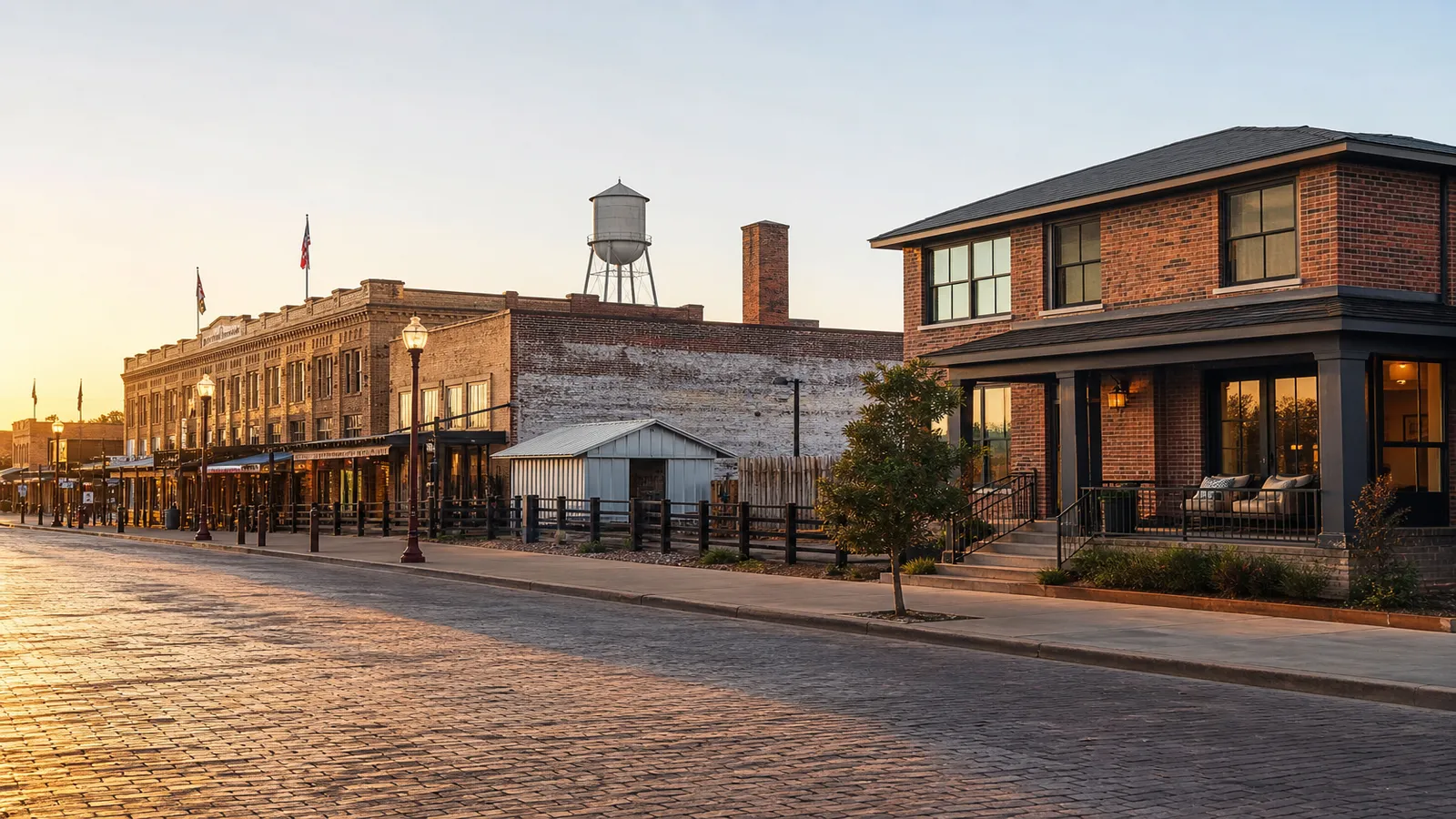
Fort Worth is the one big Texas market where the revenue question has a zoning question attached to it. The short term rental numbers here are healthy, occupancy is among the strongest in the state, and the metro added listings again this year. But the City of Fort Worth does not allow short term rentals in residential zoning districts, and in 2026 an appeals court upheld that rule. So the honest answer to how much can you make on Airbnb in Fort Worth depends first on where the property sits.
Search how much can you make on Airbnb Fort Worth and you get national averages that ignore the map. The honest version of the answer starts with zoning. This guide uses a fresh Surge market pull for the Fort Worth market (August 31, 2026) covering 8,450 active short term rentals across 31 submarkets, plus the current city registration and hotel occupancy tax rules verified against the city's own short term rental page. Every revenue figure for Airbnb in Fort Worth below is a trailing twelve month figure, not a peak month projection.
How much can you make on Airbnb in Fort Worth: the headline numbers
Short answer: the average Fort Worth Airbnb earns about $35,693 a year, roughly $2,975 in average monthly revenue, at a 58.2% occupancy rate. What they clear after costs depends on zoning, property size and management, and all three are covered below.
Across all active short term rentals in Fort Worth, the typical annual revenue is $35,693 over the last twelve months, up 3.6% year over year. Filter to entire place Airbnb listings, which is what most property owners operate, and it rises to $38,754.
| Segment | Annual revenue | Average daily rate ADR | Occupancy |
|---|---|---|---|
| All listings | $35,693 | $186.21 | 58.2% |
| Entire place | $38,754 | $204.54 | 57.7% |
| Houses | $43,402 | $234.58 | 56.5% |
| Apartments and condos | $28,780 | $139.30 | 62.5% |
Two things stand out. First, occupancy of 58.2% is high for Texas, ahead of Austin, San Antonio and Houston, and second only to Dallas among the big markets we track. Fort Worth vacation rentals fill up, and a high occupancy rate is the engine behind rental income here. Second, the average daily rate grew 5.8% year over year while revenue grew 3.6%, which tells you supply absorbed part of the rate gain. More short term rentals in Fort Worth are splitting a growing pie, so market conditions reward operators who price well.
The average daily rate tells only half the story. The average booking runs 4.87 nights with a 38 day booking lead time. That is a leisure and event driven pattern, not a business travel pattern, and it means your calendar and your pricing strategy need to be set well ahead of demand rather than reacting to it.
The zoning rule that decides whether you can operate at all
Before any revenue math, confirm the address. Short term rentals in Fort Worth are legal only in the right zoning. Short term rentals are allowed in Fort Worth's mixed use districts and in most form based, commercial and industrial districts. They are not allowed in residential districts: A-#, AR, B, R1, R2, CR, C, D and UR. That is the city's own language on its short term rentals page, and it covers the great majority of single family housing inside the city limits.
Owners challenged the prohibition in court. In Modern Builders LLC v. City of Fort Worth, the Fort Worth Court of Appeals upheld the city's ordinance prohibiting short term rentals in single family residential districts, as summarized by the Texas Municipal League in July 2026. Anyone telling you the ban on short term rentals in residential areas is about to disappear is guessing. Treat the current rule as the rule for short term rentals inside the city.
This is the opposite of the Dallas situation, where the residential ban was enjoined and the case is still working through the Texas Supreme Court, so short term rentals remain legal today. If you are choosing between the two halves of the metroplex, read our Dallas revenue breakdown next, and our Fort Worth Airbnb laws guide for the full ordinance detail.
Registration, hotel occupancy tax and the real operating expenses
If the property is in an allowed district, registration is straightforward and cheap compared with Austin. The first time application fee is $150, with a $100 annual renewal. Registration is not transferable, you must upload a zoning confirmation showing a success result as part of the application, and the current registration confirmation has to be displayed inside the property. Register before the property is listed, not after.
On taxes, the City of Fort Worth lodging tax is 9% of room receipts, made up of a 7% hotel tax and a 2% hotel convention tax. Add the 6% Texas state lodging tax and the guest pays 15% on top of the nightly rate. City filings run monthly through the Localgov portal, payment is due on the first and is late after the 25th of the following month, and zero dollar filings are still required for every period. Miss a filing and the penalty is 15% of tax owed plus 10% annual interest, which is a painfully expensive way to learn a calendar rule.
Here is what the rest of the cost stack looks like on a typical entire place house at $43,402 in gross annual revenue:
| Line item | Typical annual cost | Notes |
|---|---|---|
| Platform fee | $6,510 | Airbnb host only fee, 15% of the booking |
| Cleaning fees | Pass through | Guest paid, but underpricing it eats your margin |
| Property management | $8,680 | Management fees at 20% of revenue |
| Utilities, internet, supplies | $4,200 to $5,400 | Higher in summer with Texas cooling loads |
| Insurance | $2,000 to $3,500 | Short term rental policy, not a standard homeowner policy |
| Repairs, maintenance and turnover wear | $2,500 to $4,000 | Rises with occupancy, and Fort Worth occupancy is high |
| Registration and compliance | $100 to $150 | Plus monthly tax filings |
That leaves roughly $19,000 to $23,000 before mortgage and property taxes on a typical managed house. Tarrant County property taxes are the line most owners underestimate. Run your break even at a 50% occupancy rate assumption rather than the 56.5% market average, because your first year rarely gets the market's review count or its ranking.
Fort Worth submarket revenue: all 31 areas ranked
The Fort Worth market is a metro, not the city limits, so this table includes surrounding cities such as Keller, Grapevine, Mansfield, Euless, Granbury and Weatherford. Each of those has its own short term rental rules, and several of them are friendlier to residential vacation rentals than Fort Worth itself. That is exactly why the top of this table matters to investors.
| Submarket | Annual revenue | ADR | Occupancy |
|---|---|---|---|
| North Richland Hills | $43,322 | $219 | 61.2% |
| Far Greater Northside Historical | $42,255 | $232 | 56.8% |
| Eagle Mountain Lake | $37,993 | $224 | 54.0% |
| Granbury | $37,873 | $267 | 47.1% |
| Ridglea | $37,521 | $188 | 62.5% |
| Keller | $37,517 | $193 | 66.2% |
| Bedford | $35,696 | $198 | 61.6% |
| Mansfield | $35,425 | $185 | 59.1% |
| Westside | $35,376 | $172 | 66.5% |
| Lake Worth | $35,005 | $203 | 55.8% |
| Oakhurst | $34,584 | $172 | 62.8% |
| Downtown Fort Worth | $33,866 | $158 | 68.0% |
| Grapevine | $33,150 | $182 | 73.2% |
| Alexandra Meadows | $32,683 | $146 | 72.7% |
| Euless | $32,667 | $171 | 60.1% |
| Decatur | $32,080 | $190 | 51.4% |
| Weatherford | $31,607 | $191 | 55.1% |
| Park Glen | $31,510 | $144 | 69.4% |
| Historic Southside | $31,490 | $160 | 65.0% |
| Arlington | $30,343 | $184 | 54.8% |
| Garden Acres | $30,078 | $160 | 61.4% |
| Rosemont | $30,059 | $167 | 62.6% |
| Cleburne | $28,608 | $165 | 54.3% |
| University | $28,320 | $170 | 61.1% |
| South Hills | $26,037 | $134 | 65.4% |
| Overon South | $25,618 | $117 | 72.9% |
| East Fort Worth | $25,454 | $144 | 57.0% |
| South Fort Worth | $24,797 | $136 | 57.2% |
| River Trails | $24,323 | $124 | 65.2% |
| Springtown | $22,472 | $159 | 46.4% |
| Bridgeport | $22,369 | $223 | 34.1% |
North Richland Hills leads at $43,322 on a $219 rate and 61.2% occupancy, a rare combination of strong rate and strong fill. Far Greater Northside Historical is the best performing area inside Fort Worth proper at $42,255, driven by the Stockyards and the Cultural District crowd, and much of that inventory sits in mixed use and commercial zoning where short term rental use is allowed.
Granbury earns a high $267 nightly rate but only 47.1% occupancy, the classic lake market shape: excellent summer weekends, quiet winters. Grapevine posts the highest occupancy in the metro at 73.2% thanks to DFW Airport, Great Wolf Lodge and Main Street. The bottom of the table is instructive too. Bridgeport clears $22,369 despite a $223 rate because occupancy is only 34.1%, which is what happens when demand is seasonal and thin.
Averages hide property level differences. Two Airbnb properties on the same street can be $15,000 apart on Airbnb revenue based on photos, amenities and pricing discipline. If you want to see how a specific address sits relative to nearby demand drivers, our free Airbnb map maker plots an Airbnb property against the attractions guests actually search for.
Peak season and seasonality: plan for a 1.6x swing
Fort Worth revenue peaked at $3,858 per listing in June 2026 and bottomed at $2,348 in January 2026. Peak season here is late spring through summer. That is a 1.64x swing, milder than Galveston or Austin but real enough to wreck a cash flow plan built on summer numbers.
The demand calendar is event heavy. The Fort Worth Stock Show and Rodeo fills January and February, which is why the winter trough is shallower here than in most Texas markets. Spring brings the Main Street Arts Festival and the Fort Worth Invitational, summer runs on the Stockyards and family travel, and fall picks up with TCU home games. Dynamic pricing that anticipates those windows is worth more in Fort Worth than in flatter markets, because the peaks are concentrated in identifiable weekends rather than spread across a season.
Property type and size: what actually earns here
Houses out earn apartments and condos by $14,622 a year on average, and the gap is entirely rate driven: $234.58 versus $139.30 per night. Condos hold higher occupancy at 62.5%, so they are not a bad asset, they are simply a lower ceiling one. For most property owners the right Fort Worth vacation rental is a three or four bedroom house that sleeps eight to ten in an allowed zoning district near the Stockyards, the Cultural District, downtown or the medical district.
Amenities that move the needle in this market, in rough order of return on cost: a pool for summer rate lift, a genuine work setup for the medical and corporate stays that fill weekdays, a covered patio and grill, blackout curtains and quality mattresses, and enough parking for two vehicles. Guests booking a Fort Worth vacation rental skew families and groups, so bunk configurations, a second living space and a stocked kitchen convert better here than in a downtown Dallas condo.
What the numbers mean for a Fort Worth property owner
Three practical takeaways for anyone weighing a purchase or a switch to short term rental use:
- Zoning first, revenue second. Pull the zoning confirmation before you write an offer. A property that cannot be registered has zero short term rental revenue, no matter what a comparable listing two miles away earns.
- The suburbs are doing the heavy lifting. Occupancy rate and rate both hold up outside the city limits. Six of the ten highest earning submarkets are outside the Fort Worth city limits. If your goal is a residential single family vacation rental, the surrounding cities deserve a serious look, with their own ordinances checked one at a time.
- A high occupancy rate is a management problem, not just a good headline. At 58% occupancy you are turning a property roughly 70 times a year. Cleaning quality, linen inventory, restocking and maintenance response are what separate a $43,000 house from a $30,000 house in the same submarket.
What a Fort Worth property management company should be doing
Full service short term rental property management in this market typically costs 18% to 25% of revenue. What you should expect in return for those management fees, beyond the day to day operations:
- Dynamic pricing rebuilt around Fort Worth's event calendar rather than a generic national model
- Registration, zoning confirmation and monthly Localgov hotel occupancy tax filings handled for you, including zero dollar periods
- Professional photography and a listing built for the searches guests actually run
- Vetted cleaning and maintenance with real turnover capacity on high occupancy weekends
- Direct bookings and repeat guest capture so you are not entirely dependent on one platform
- Transparent monthly owner statements with no hidden fees
Ask any property management company for their average occupancy rates and average daily rate on comparable Fort Worth properties, not a portfolio wide average that blends in lake houses and downtown condos. Ask what happens when a guest cancels a Stock Show weekend. Ask for written exit terms before you sign, in writing, whatever the listing account arrangement is.
Surge handles short term rental management for property owners across our Texas markets, including Fort Worth and the wider metroplex. If you want a revenue estimate for a specific address, including whether the zoning allows short term rental use at all, start here or compare options in our roundup of the best Airbnb management companies in Fort Worth.
Frequently asked questions
How much can you make on Airbnb in Fort Worth?
The typical Fort Worth listing earns $35,693 a year, and the typical entire place vacation rental earns $38,754. A well run entire place house averages $43,402 at a $234.58 average daily rate and 56.5% occupancy [Surge market data, August 2026].
Is Airbnb legal in Fort Worth?
Yes, but only in permitted zoning. Short term rentals are allowed in mixed use and most form based, commercial and industrial districts, and prohibited in residential districts including A-#, AR, B, R1, R2, CR, C, D and UR. An appeals court upheld that prohibition in 2026.
What taxes do short term rentals in Fort Worth pay?
A 9% city lodging tax, 7% hotel plus 2% convention, and the 6% Texas state rate, for 15% total. City filings are monthly through Localgov and zero dollar filings are still required.
What does it cost to register a short term rental in Fort Worth?
$150 for the first application and $100 for each annual renewal. Registration is not transferable and requires a zoning confirmation.
How many Airbnbs are in Fort Worth, and which area earns the most?
The Fort Worth market has 8,450 active Airbnb listings. North Richland Hills leads at $43,322 a year, followed by Far Greater Northside Historical near the Stockyards at $42,255. Grapevine has the highest occupancy at 73.2%.
Quick answers
- Typical annual revenue across Fort Worth short term rentals: $35,693, up 3.6% year over year
- Entire place: $38,754 | Houses: $43,402 | Apartments and condos: $28,780
- Average daily rate: $186.21 all listings, $234.58 for houses
- Occupancy: 58.2%, average stay 4.87 nights, 38 day booking lead time
- Market size: 8,450 active Airbnb listings across 31 submarkets
- Total guest tax: 15% (9% city plus 6% state)
- Registration: $150 first year, $100 renewal, allowed zoning only
Market data: Surge market data, Fort Worth market, trailing twelve months to July 2026, pulled August 31, 2026. Regulatory details verified against the City of Fort Worth short term rental page and the Texas Comptroller, August 31, 2026. Rules change, so confirm current requirements before you list.
Where Fort Worth Airbnb demand comes from
Revenue follows demand drivers, and Fort Worth has an unusually broad set of them. The Historic Stockyards anchor leisure travel year round, with twice daily cattle drives, rodeo events and a hotel and restaurant district that keeps guests booking multi night stays. The Fort Worth Convention Center sits a short drive from both. The Cultural District carries the Kimbell Art Museum, the Modern Art Museum of Fort Worth and the Amon Carter, a cluster of cultural attractions that no other Texas city matches at that density.
The Fort Worth Convention Center reopened its expanded footprint and pulls group business into downtown, and the medical district plus the corporate campuses across the metro produce steady weekday demand from business travelers, and business travelers book longer stays than leisure guests. Major employers including American Airlines, Lockheed Martin, BNSF Railway and Texas Health Resources create contractor and relocation stays that fill the Sunday through Thursday gaps that break most leisure only calendars. That tourism infrastructure is the reason average occupancy rates here beat Austin and Houston, and average occupancy rates are the number investors should compare first despite a lower average daily rate.
Local events matter more than a national model expects. The short term rental market rewards operators who plan ahead. Short term rental operators who price the Stock Show, the Main Street Arts Festival, TCU home games and the major events on the convention center calendar as separate demand spikes capture rate the rest of the Fort Worth Airbnb market leaves on the table.
How the Fort Worth Airbnb market compares to other Texas cities
Set the revenue data side by side with the other major cities we track and the shape of this short term rental market gets clear.
| Market | Annual revenue, all listings | ADR | Occupancy rate | Active listings |
|---|---|---|---|---|
| Galveston | $45,175 | $317.95 | 45.1% | 9,415 |
| Austin | $41,291 | $215.76 | 57.8% | 24,368 |
| Dallas | $35,499 | $178.82 | 60.4% | 20,751 |
| Fort Worth | $35,693 | $186.21 | 58.2% | 8,450 |
| San Antonio | $34,819 | $188.14 | 55.4% | 14,812 |
| Houston | $30,619 | $164.05 | 56.4% | ~9,000 |
Fort Worth sits mid pack on revenue and near the top on occupancy rate, with roughly a third of the Airbnb listings that Dallas carries. Over the past year supply grew without the rapid expansion Austin went through, which is part of why rate held up. For an Airbnb investment thesis, that combination, real demand and constrained legal supply of short term rentals in Fort Worth, is more attractive than a raw revenue ranking suggests. Compare the neighboring market in our Austin revenue guide if you are deciding between Texas Airbnb markets.
What actually drives revenue per Airbnb property
Market averages tell you the ceiling. These factors decide where your Airbnb property lands inside it, and they are what separates a strong Airbnb investment from a mediocre one.
- Property size and bedroom count. Property size drives everything here, and every additional bedroom that adds real sleeping capacity moves gross revenue more than any decor change. Four bedroom houses that sleep ten are the strongest performing property type in this market.
- Outdoor space. A pool, a shaded patio or a yard converts Texas summer searches. Airbnb properties in Fort Worth without outdoor space discount to compete from June through September.
- High quality photos. The first three images decide the click. Professional photography is the cheapest revenue lever available to Airbnb hosts, and most hosts still skip it. Airbnb properties with professional images hold higher click through and higher occupancy and the one most owners skip.
- High speed wi fi and a work setup. Required to attract guests from the business travel and extended stay segment that fills weekdays.
- Management quality. Review scores for short term rentals in Fort Worth, response time and turnover reliability drive placement, and placement drives occupancy. Two comparable properties with different management can be $12,000 apart on gross revenue.
- Occupancy rate discipline. Track your occupancy rate weekly against the submarket, not monthly.
- Competitive positioning. Price against your true comparable properties, same submarket, same bedroom count, same amenity tier, not against the market average.
Careful property selection at purchase is worth more than years of optimization afterwards. Buy in an allowed district, with the right property size and property type, near a demand driver, and the rest of the work compounds.
Is a Fort Worth Airbnb a good short term rental investment?
Compared with traditional real estate, a legal short term rental in Fort Worth roughly doubles to triples the gross rental income of a long term lease on the same house, and it carries higher operating costs, more management fees and far more variance. As an Airbnb investment it is a good market for owners who buy correctly and run the short term rental business seriously, and a poor one for owners who buy in the wrong zoning and hope. Average monthly revenue across the market runs about $2,975, peaking near $3,858 in June and dropping to $2,348 in January, so how much do Airbnbs return in cash flow depends heavily on whether your debt service assumes the peak or the trough.
How many Airbnbs are here matters too: 8,450 active listings across the metro, a third of Dallas's count, in a market with comparable demand. Airbnb revenue per property has held up better than in oversupplied Texas markets because the city limits the legal supply. If market conditions tighten, the properties that suffer first are the ones with weak photos, thin amenities and static pricing, not the ones in good submarkets with real management behind them.
Compliance checklist for Fort Worth short term rental properties
The local regulations that govern short term rentals in Fort Worth are specific, and most enforcement problems start with an owner who assumed the state rules were the only rules.
- Zoning. Confirm the address is not in a residential district. Airbnb in Fort Worth is prohibited in residential neighborhoods inside the city limits, and residential areas are where most owners look first. Commercial, mixed use and industrial zoning districts are where legal inventory lives.
- Registration. $150 first application, $100 renewal, annual, not transferable, confirmation displayed on site.
- Tax obligations. Monthly Localgov filings for the city lodging tax, including zero dollar periods, plus state remittance. Platforms may collect some of it, but the filing duty stays with you.
- Occupancy limits, parking regulations and noise. The short term rental regulations set guest limits and parking expectations, and neighbor complaints are the most common trigger for a city inspection. Write the rules into your house manual.
- Insurance and property damage. A standard homeowner policy will not respond to a guest claim. Carry a short term rental policy and document condition between stays.
Local STR regulations across the surrounding cities differ from Fort Worth's, sometimes dramatically, so verify each one individually rather than assuming metro wide rules.

Written by
Humberto MarquezFounder, Surge
Founder of Surge and licensed Texas real estate broker. Manages short-term rentals across 12 U.S. markets and invests in STRs himself. Quoted in Martha Stewart, Yahoo Finance, Realtor.com, Bob Vila.
More about Humberto →See what your property could earn with Surge
Full-service short term rental management across Texas and Florida. Get a free property assessment and revenue estimate, no commitment.