
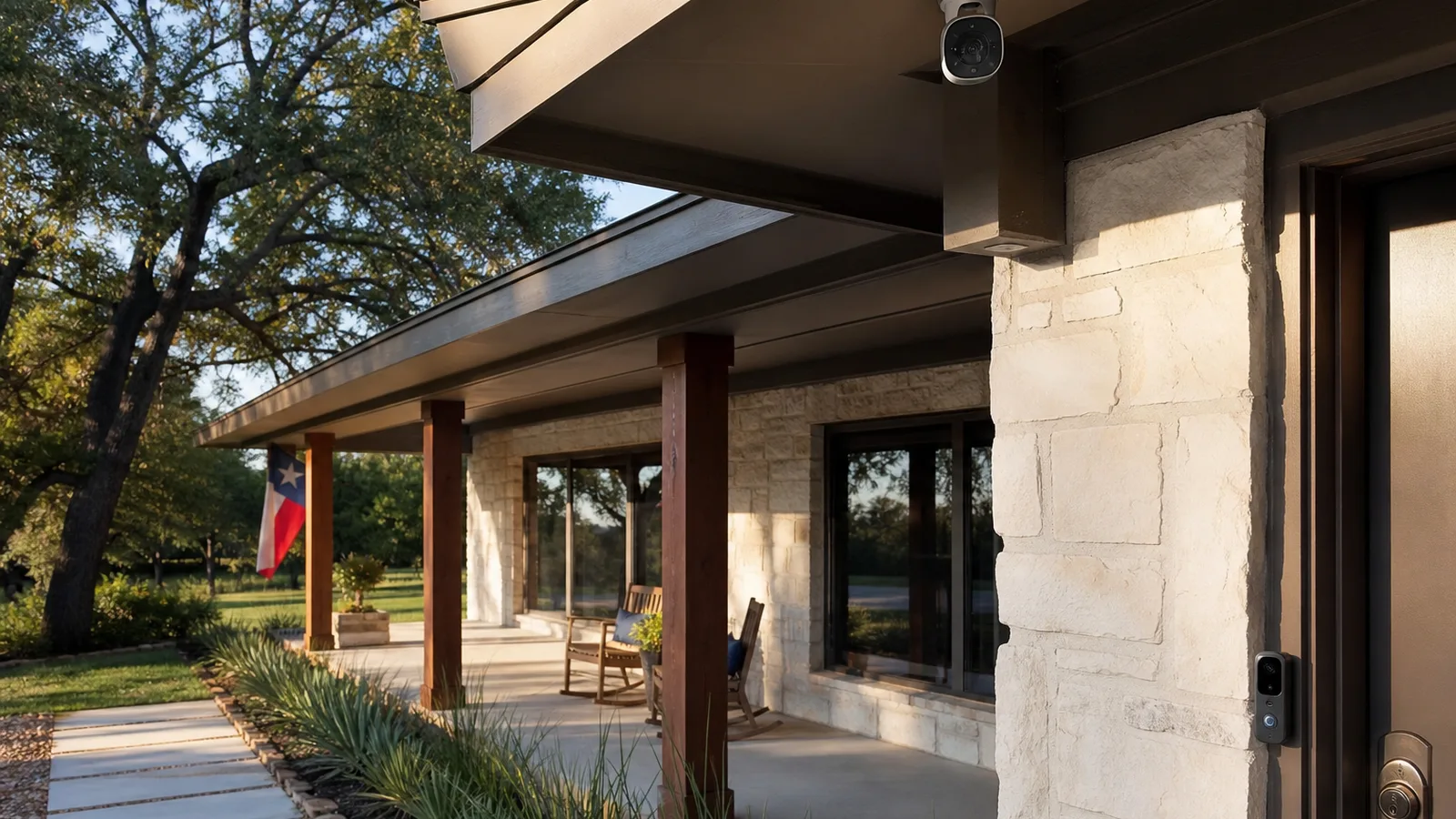
Airbnb's rules on security cameras are not a gray area anymore. Indoor security cameras and indoor recording devices are banned in every listing, worldwide, even when they are switched off or unplugged from the wall. Outdoor cameras and doorbell cameras are still allowed on Airbnb, but only if you disclose them and only if they are not pointed anywhere guests expect privacy. Get that wrong in Texas and you are not just risking a delisting. You are risking a state jail felony charge under the Texas invasive visual recording statute.
This guide covers what the current Airbnb security camera policy actually says, where outdoor cameras allowed under that policy can go, how to disclose those devices correctly, what Texas recording law allows, and how professional managers use the allowed devices to catch parties and verify turnovers. We manage short term rentals for owners across our markets in Houston, Galveston, Austin, Dallas, Fort Worth, and San Antonio, so every recommendation here reflects setups we run day to day.
What Airbnb's security camera policy says in 2026
The governing document is Airbnb's community policy on restrictions on security cameras and other devices in homes. The rules took effect on April 30, 2024, and they still stand today. Three lines matter most:
- Hosts are not allowed to have security cameras or recording devices that monitor any part of a home's interior, including hallways, bedrooms, bathrooms, living rooms, and guest houses, even if the device is turned off or disconnected.
- Hidden security cameras are strictly prohibited. That has always been true and it did not change.
- Exterior security cameras are allowed, and hosts are required to disclose their location in the listing description.
Airbnb defines security cameras and recording devices broadly: any device that records or transmits video, images, or audio. A baby monitor counts. A doorbell camera counts. So do the surveillance cameras built into a smart display you left on the kitchen counter. If it captures or transmits, treat it as regulated hardware.
The indoor ban applies to private room listings too. If you rent a bedroom in your own home, the shared living room is still a home's interior under the policy, so the camera in the corner has to come out.
There is one narrow carve out and it does not help Texas hosts. For certain homes in Japan operating under a Hotel Business License, local law can require a camera monitoring the interior entryway only. That exception is written into the policy for those specific properties, not as a general workaround.
Smart home devices are treated separately
Smart devices such as smart speakers and thermostats are allowed. Smart devices connect and interact with other devices or networks, and Airbnb permits them in listings. Airbnb encourages, but does not require, hosts to disclose them, and encourages hosts to let guests unplug or disable them. That is a lower bar than cameras. Even so, we disclose voice assistants on every listing we run, because a guest who finds an Alexa they did not expect starts wondering what else is listening, and that suspicion shows up in reviews.
Noise decibel monitors: allowed indoors, with conditions
Airbnb's disclosure guidance treats these devices differently from cameras, and this is the part most hosts get backwards. Noise monitors are not banned. Airbnb defines them as devices that assess sound levels and their duration but do not record audio. Under the policy, hosts may have noise decibel monitors inside the home as long as two conditions hold: the host discloses their presence, and the devices are not located in bedrooms bathrooms or sleeping areas.
One helpful detail from the policy: hosts are not required to disclose where noise monitors are located, only that they exist. Outdoor security cameras are the opposite. For exterior cameras you must state the location, and Airbnb's own examples are blunt: "I have a camera in my front yard," "I have a camera over my patio," "I have a doorbell camera monitoring my front door."
A decibel monitor in the main living area is the single highest value device you can add to a Texas short term rental. It will not tell you what guests are saying. It will tell you that sound levels crossed your threshold at 11:40 p.m. on a Saturday and stayed there, which is exactly when a twelve person "family trip" turns into a hundred person event. Pair it with a firm quiet hours clause in your house rules and you have something enforceable rather than aspirational.
Where outdoor cameras are allowed, and where hosts get burned
Exterior security cameras are permitted. The failure mode is almost always angle, not location.
Placements that work: driveway and parking pad, front entry and doorbell, side gate, garage exterior, and the outer fence line of a yard. Those cover the things you actually need to know: how many cars arrived, how many people walked in, and whether anyone is moving furniture out at 2 a.m.
Placements that get listings suspended:
- Any camera whose frame reaches through a window or an open door into interior spaces. A doorbell camera that sees the living room every time the door swings is monitoring a home's interior in practice.
- Cameras covering an enclosed outdoor shower or a sauna. Airbnb names these outdoor areas as places where users have a greater expectation of privacy, and they are off limits.
- Pool and hot tub coverage. Airbnb's disclosure examples do include a camera over a pool, so it is not automatically banned, but people change clothes and lounge at pools. In Texas, a pool camera also runs straight into the invasive visual recording statute discussed below. We do not install them.
- An indoor camera left mounted on the wall with the lens taped over. Still a violation of the indoor cameras ban. Turned off and disconnected are explicitly not defenses.
Practical rule we use during onboarding: if a camera can see skin or sleeping areas, it comes down. If it can only see cars, doors, and driveways, it stays and gets disclosed. Owners who are still self managing across several properties should run this audit property by property, not from memory.
Quick reference: banned versus allowed
Banned anywhere on the property: hidden cameras of any kind, including devices disguised as smoke detectors or chargers. Hidden cameras are strictly prohibited and always have been.
Banned indoors: security cameras and recording devices that monitor indoor spaces. That covers the living room, kitchen, hallway, bedrooms, bathrooms, a detached guest house, and the indoor common spaces and shared spaces of private room listings. Interior cameras are banned in Airbnb listings globally, on or off.
Allowed with prior disclosure: exterior security cameras, doorbell cameras, and noise decibel monitors. Allowed without required disclosure: smart home devices, though Airbnb encourages hosts to disclose them and to let guests disable them.
Airbnb's rules sit on top of applicable laws, not instead of them. Where applicable laws are stricter than the platform, the law wins. That matters for audio recording devices in particular.
Privacy friendly security measures that replace indoor surveillance
Losing indoor surveillance does not mean losing control of the property. It means changing what you monitor. Video surveillance of interior rooms was never the strongest layer anyway. These security measures are.
Smart locks. Per reservation codes, timestamped guest access logs, and codes that expire at checkout. Smart locks are not cameras or recording devices, so they sit outside the policy entirely, and they solve the problem indoor cameras were supposed to solve: knowing who is inside and when. Airbnb hosts who switch to smart locks usually stop missing key handoffs too.
Noise decibel monitors in indoor common spaces. Volume data with no audio recording and no video surveillance. This is the only compliant way to monitor areas inside the home for unauthorized parties, and it protects guest privacy while doing it.
Guest verification and screening. Airbnb's guest verification, reservation requirements, and a short pre booking question about the purpose of the stay filter out the bookings that create problems. Screening is cheaper than enforcement.
Locked owner storage. One locked closet for valuables removes the reason most hosts wanted cameras inside in the first place.
Security deposits are a weaker tool than most owners expect. Airbnb does not hold a traditional cash security deposit on most reservations, and damage recovery runs through AirCover and the Resolution Center instead, so your evidence trail matters more than a deposit line in the listing. Approved monitoring devices, disclosed properly, are what enhance guest privacy and protect the property at the same time.
Texas recording law: two statutes that decide the question
The Airbnb camera policy is a contract term. Texas law is a criminal statute. You have to satisfy both, and the state law is the one with jail attached.
Video in private areas: Texas Penal Code 21.15
Texas Penal Code Section 21.15, invasive visual recording, makes it an offense to photograph, record, broadcast, or transmit a visual image of another person in a place in which a person has a reasonable expectation of privacy, without that person's consent and with intent to invade their privacy. The statute defines that phrase to include a bathroom, bedroom, and changing room. An offense under the section is a state jail felony.
One subsection deserves special attention from hosts who think signage solves the problem. Under subsection (e), a posted sign indicating that a person is being photographed or recorded is not sufficient to establish consent for recording in a place with a reasonable expectation of privacy. A sticker on the door does not make a bedroom camera legal.
Audio: Texas is a one party consent state
Texas Penal Code Section 16.02 governs unlawful interception of wire, oral, or electronic communications. It is an affirmative defense to prosecution when a person is a party to the communication, or when one of the parties has given prior consent to the interception. That is the standard one party consent framework, and it is why Texas is often described as a one party consent state.
Here is the operator's reading of that. One party consent protects you when you are on the call. It does nothing for a microphone sitting on a fence line recording a private conversation between two guests you are not part of. That is interception of an oral communication with no party consenting. So the Texas rule is not a license to run always on audio outdoors.
Our standard: audio disabled on every exterior camera, on every property, in every market. There is no revenue upside to recording guest conversations, and the downside is a criminal statute plus an Airbnb violation if the mic reaches indoors. If you want the legal reasoning in one line, tell your camera installer that video of cars is evidence and audio of people is liability.
How to disclose cameras correctly on your listing
Disclosure is a booking condition, not a courtesy. Airbnb requires the presence and general location of each device to be stated before guests book, and the Guest safety panel is where that presence and general location gets recorded. Airbnb's guidance on informing guests about security devices walks through the setting, and the steps on desktop are short:
- Open Listings and select the listing.
- Under Listing editor, click Your space, then Guest safety.
- Click Safety devices and check the box for exterior security cameras present or noise decibel monitor present.
- Describe each device, its location, and whether it will be switched on or off.
- Save.
Then do the part most hosts skip. Repeat the same disclosure in plain language inside the listing text and again in your pre arrival message. Guests do not read the safety devices panel. They read the message you send two days before check in. A guest who was told about the driveway camera three separate times does not file a privacy complaint when they notice it. A guest who discovers it on arrival sometimes does, and that complaint lands in Airbnb's queue as an undisclosed recording device, which is a far worse conversation.
Keep dated screenshots of the disclosure. If a claim ever goes to Airbnb support or to your insurer, the evidence trail is what settles it. Owners on our owner portal get the device inventory and disclosure record stored per property, so the documentation exists before anyone needs it.
A camera setup that works for a Texas short term rental
The hardware list is short because the compliant surface area is small.
- Doorbell camera at the front door. This is your headcount device. It tells you whether four guests became twenty four, and it timestamps arrivals and departures. Angle it down and out, never through the doorway.
- One driveway or street facing camera. Vehicle counts are the earliest reliable party signal. Six cars at a two bedroom in the Heights is a problem before the noise monitor ever trips.
- One rear or side yard camera on the fence line. Covers the entry point most break ins and unauthorized guests use, especially on Galveston beach houses with ground level access.
- A noise decibel monitor in the main living space. Disclosed, out of bedrooms and bathrooms, threshold set for local quiet hours.
- A smart lock with per reservation codes. Not a recording device at all, so it sits outside the policy entirely, and the access log gives you time stamped entry data that a camera cannot.
Total cost is usually a few hundred dollars per property. Compare that against the exposure. Hotel occupancy tax alone runs 17% in Houston and Austin, 16.75% in San Antonio, and 15% in Dallas, Fort Worth, and Galveston, so a suspended listing costs you gross revenue you have already priced against a heavy tax load. Surge's August 2026 market data put Galveston's median annual revenue at $45,175, with Austin at $41,291, Dallas at $39,947, Fort Worth at $35,693, San Antonio at $34,819, and Houston at $30,619. A month offline in Galveston is roughly $3,700 of median revenue, gone, over a camera you could have unscrewed in ten minutes.
How managers actually use these devices
Cameras in Airbnb rentals are not surveillance theater when they are wired into an operating process. Four uses carry almost all the value.
Turnover verification. A doorbell camera confirms that the cleaner arrived at 11:05 and left at 13:40, and that nobody else entered before the next check in. When a guest reports a dirty property, we can tell within a minute whether the clean happened or the schedule slipped. That single capability resolves most cleaning disputes without a refund.
Party prevention. Vehicle counts plus decibel thresholds catch escalation while it is still fixable. The intervention is a phone call, not a police report. Guests who get a polite call at the first decibel spike usually shut it down, and that beats discovering the damage at checkout.
Occupancy disputes. If your listing sleeps six and twelve people walk through the front door, you have documentation for an extra guest fee or a cancellation. This ties directly to guest screening. Screening filters the booking, cameras verify what actually showed up.
Claims documentation. Damage claims move faster with timestamped exterior footage establishing who was on the property and when. Your policy still does the heavy lifting, and choosing the right short term rental insurance matters more than any camera, but adjusters respond to evidence.
There is a fifth situation nobody plans for. When a guest refuses to leave, entry and exit footage becomes part of the record for establishing occupancy timelines. Texas has real thresholds around when a guest becomes a tenant, and the process for removing a squatter from a short term rental is slow and expensive. Documentation from day one shortens it.
What this looks like when a manager runs it
Compliance at one property is a Saturday task. Compliance across a portfolio is an operations problem, and it is the point at which most owners start weighing a property manager. Full service management runs 15% to 25% of revenue in Texas, half service around 10%, so the math has to clear a real bar.
Here is the honest version of that math. Surge's August 2026 market data shows professionally managed listings earning more per available night than self managed ones in most Texas markets: about 20% more in San Antonio, 18% in Houston, and 12% in Galveston. In Dallas the gap is roughly zero. If you are running a Dallas property well already, a management fee is a cost, not an arbitrage. Anyone who tells you otherwise is selling.
Two more numbers worth having in your model. Airbnb's host only fee has been 15.5% since July 7, 2026, dropping to 15% for hosts connected through a property management system, and the older split fee model retires on September 15, 2026 for non EEA hosts. That is a structural change to your net, and it hits self managed and managed listings alike.
On listing ownership, both models are common. Some managers list your property under your Airbnb account, and some, including us, list under the manager account. Manager account launches typically start stronger, because the account carries existing review history and performance signals that a brand new listing does not. What matters is not which model you pick. It is that your agreement spells out in writing what happens at exit: who keeps the listing, what data and reviews transfer, and how long the transition takes. Insist on written exit terms before you sign anything, and if you are still deciding, the signs you have outgrown self managing are usually operational before they are financial.
Free market data and a Surge Score analysis for your property
If you want to know what your specific address should be earning, we will pull the market data and run a Surge Score analysis on it at no cost. That includes comparable revenue, seasonality, and the operational gaps we see on properties like yours, including device and disclosure risk.
Book a call at cal.com/surge/intro-surge-property-management or call us at (888) 616-8149. If your setup already looks clean, we will tell you that and you can go back to running it yourself with a tighter set of house rules.
Frequently Asked Questions
Are indoor security cameras allowed on Airbnb?
No. Airbnb does not allow security cameras or recording devices that monitor any part of a home's interior, including hallways, living rooms, bedrooms, bathrooms, and guest houses. The prohibition applies even if the device is turned off or disconnected, and it applies to the shared spaces of private room listings. These rules took effect on April 30, 2024.
Can I keep my Ring doorbell camera?
Yes, if it is disclosed and aimed correctly. A doorbell camera is one of the exterior security cameras Airbnb permits, and Airbnb requires that you disclose its general location in the listing text. The problem is angle. If the camera captures the interior of the home through the open door, it is monitoring indoor space and it violates the policy. Reposition it so the frame ends at the threshold.
Do noise monitors violate Airbnb's rules?
No. Noise decibel monitors assess sound levels and duration without recording audio, and hosts are allowed to have them inside the home. Two conditions apply: you must disclose their presence, and they cannot be located in bedrooms bathrooms or sleeping areas. Airbnb does not require you to disclose exactly where a noise monitor sits.
Is it legal to record video at a rental property in Texas?
Exterior video of driveways, yards, and entrances is generally fine. Recording private spaces where a person has a reasonable expectation of privacy is not. Texas Penal Code Section 21.15 makes invasive visual recording a state jail felony and defines that phrase to include bathrooms, bedrooms, and changing rooms. The statute also says a posted sign is not enough to establish consent. This is general information and not legal advice, so confirm your specific setup with a Texas attorney.
Does one party consent mean I can record audio outdoors in Texas?
Not the way most hosts assume. Texas Penal Code Section 16.02 provides an affirmative defense when a person is a party to the communication or when one party has given prior consent. A camera microphone recording a conversation between two guests has no consenting party, so it falls outside that protection. We disable audio on all exterior cameras as standard practice.
What happens if a guest finds an undisclosed camera?
Expect an immediate escalation. Airbnb can refund the guest, relocate them, suspend the listing, or remove the account, and an undisclosed indoor device in a private area can also draw a criminal complaint under state law. The fix is preventive: physically remove interior surveillance devices, disclose every exterior camera by location, keep dated screenshots of those disclosures, and re audit after any hardware change.
Related: Airbnb host damage protection explains what the platform guarantee pays for guest damage, and where your own policy has to take over.

Written by
Humberto MarquezFounder, Surge
Founder of Surge and licensed Texas real estate broker. Manages short-term rentals across 12 U.S. markets and invests in STRs himself. Quoted in Martha Stewart, Yahoo Finance, Realtor.com, Bob Vila.
More about Humberto →See what your property could earn with Surge
Full-service short term rental management across Texas and Florida. Get a free property assessment and revenue estimate, no commitment.