Every short-term rental in Texas needs a turnover between guests, and almost none of those turnovers are done by the owner. That is the whole opportunity behind an airbnb cleaning business. We run short-term rental management for owners across our markets in Houston, Galveston, Austin, Dallas, Fort Worth, and San Antonio, which means we hire, vet, and fire airbnb cleaning services constantly. This guide is the version we wish every applicant read first: how to start an airbnb cleaning business in Texas, what the legal setup for an airbnb cleaning business actually costs, how to price so you keep money, and what a property manager checks before handing you a route of properties.
If you are on the other side of this and you need someone to clean your rental, read our guide to hiring an airbnb cleaning company instead. This post is for the person building the cleaning business.
Why Airbnb Cleaning Is a Real Business, Not a Side Gig
Residential house cleaning is a monthly or biweekly relationship. Vacation rental cleaning is an operations job tied to a booking calendar. Airbnb guests check out at 11 a.m., the next arrivals land at 4 p.m., and the property has to be photo-ready in between. That five hour window is the entire product. Speed, proof, and consistency are what airbnb cleaning services sell.
Demand in the cleaning industry around short-term rentals is structural rather than seasonal hype. Airbnb hosts are graded on cleanliness in every review, and cleanliness is the fastest star to lose. The cleaning fee is a one-off charge set by the host and included in the guest total price, per Airbnb's own help documentation on cleaning fees, so hosts have a budget line already carved out for you. They are not deciding whether to pay for cleaning. They are deciding who gets the work.
Market size in Texas is easy to sanity check with revenue data. Surge's August 2026 metro medians for annual short-term rental revenue run $45,175 in Galveston, $41,291 in Austin, $39,947 in Dallas, $35,693 in Fort Worth, $34,819 in San Antonio, and $30,619 in Houston. A property generating $40,000 a year is turning over often, and each of those turnovers is a job. Constant demand in this niche comes from booking volume, not from marketing budgets.
One more thing worth knowing before you start: professionally managed listings out-earn self-managed ones per available night in most Texas metros. Surge market data put that gap at roughly 18 percent in Houston, 20 percent in San Antonio, 12 percent in Galveston, and about zero in Dallas as of August 2026. Managed properties book more nights. More nights means more cleaning jobs per door, which is why chasing property management companies beats chasing individual owners.
What Airbnb Cleaning Services Include
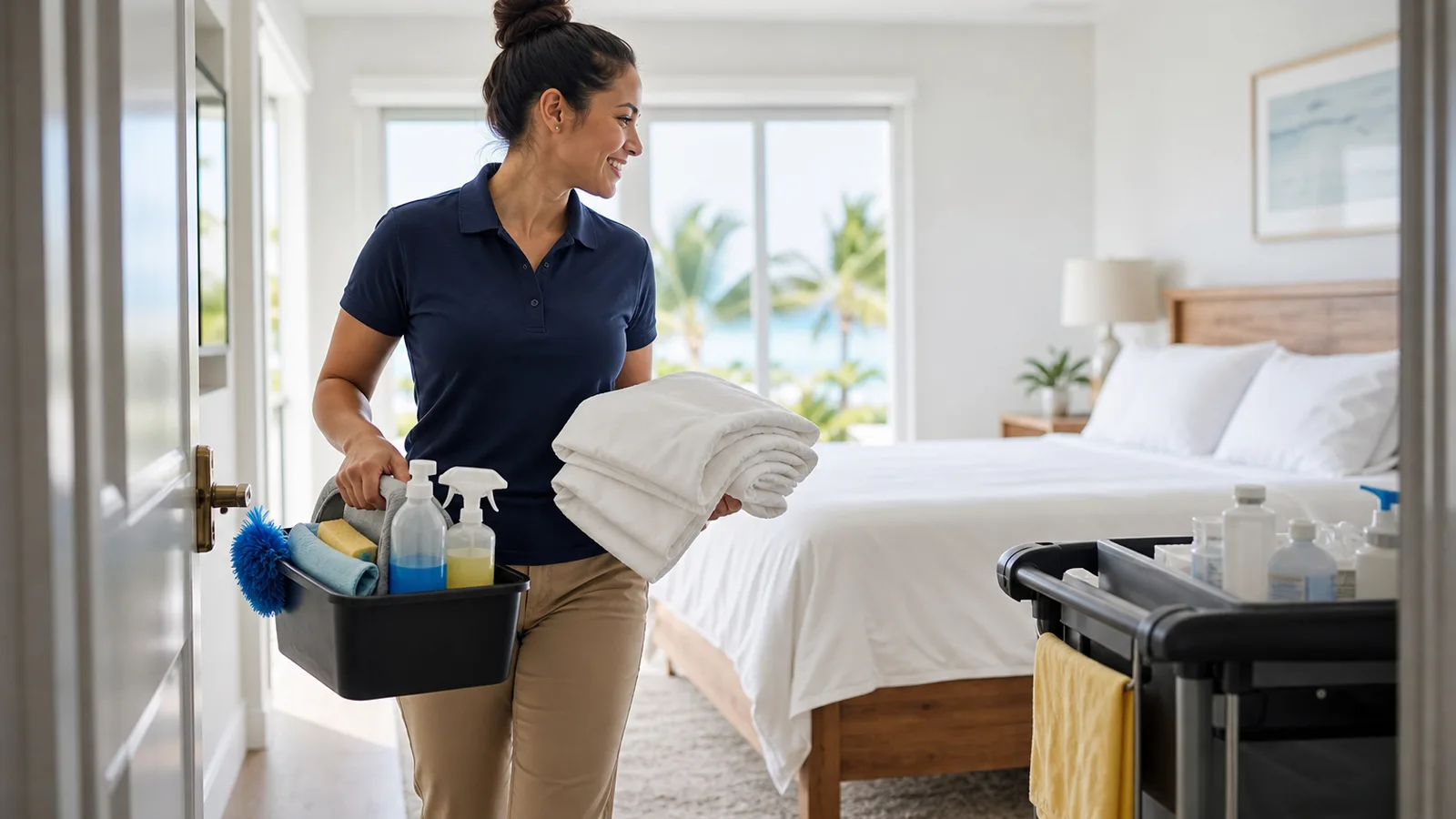
Before you price anything, get precise about the product. Airbnb cleaning services are a bundle, and the bundle is wider than most new cleaning services expect. A standard turnover covers surfaces, floors, bathrooms, and the kitchen. Vacation rental cleaning adds the hospitality layer: staging, linens, restocking, and a written report. Sell those vacation rental cleaning services as one package and you avoid the endless scope arguments that drain small operators.
Core airbnb cleaning services to offer from day one:
- Turnover cleaning between every stay at short term rental properties
- Laundry and linen service for bed sheets and towels
- Bathroom and kitchen sanitizing with commercial-grade cleaning products
- Trash removal and bed making, with rooms staged to match the listing photos
- Restocking paper towels, toilet paper, soap, and coffee
- A photo report and a damage note filed the same day
Add-on cleaning services that raise revenue per property: quarterly deep cleaning, pre-season refreshes for beach and lake homes, inventory counts, and emergency same-day cleaning jobs when a booking lands back to back. Professional cleaning services priced as tiers give vacation rental owners an easy yes, and they let you grow an account without finding new customers.
One warning about cleaning products. Vacation rental cleaners work in homes where a guest arrives within hours, so strong solvents and heavy fragrance create complaints. Use products that flash off fast, ventilate, and keep labels on hand. Guests with allergies do write reviews about it.
The other half of the job is communication. Airbnb hosts are running a hospitality business on a phone, and the cleaning company that answers fast becomes the default choice. That single habit separates a professional cleaning company from an individual cleaner with a bucket.
Step 1: Decide What Kind of Airbnb Cleaning Business You Are Building
A vacation rental cleaning business takes one of three shapes, and picking one early keeps your pricing honest.
- Solo operator. You clean. Low startup cost, full quality control, hard ceiling on capacity. A realistic day is three to five turnovers depending on property size and drive time.
- Small cleaning team. You clean part time and run a cleaning crew the rest of the time. This is where most cleaning business owners plateau, because scheduling becomes the job.
- Professional cleaning company. You do not clean. You dispatch, inspect, and sell. This is the model that wins contracts with property management companies, because a manager needs coverage when one person calls out.
Adjacent revenue lines matter too. Laundry and linen service, quarterly deep cleaning, restocking, and inventory checks are all billable. Do not treat them as favors. If you want to see how owners think about the tradeoff between hiring a cleaner and hiring a manager, our breakdown of property manager vs airbnb cleaner lays out both sides of that decision.
Step 2: Register the Business and Get Legal in Texas
This is where most new cleaning services cut corners on the boring paperwork, and it is the exact thing that disqualifies them from the contracts worth having. The Texas setup is short and cheap.
Registering properly is what lets you operate legally, bid on portfolio work, and open a bank account under your business name. Every cleaning business owner we contract with cleared these four items before the first job.
Form an LLC
Most airbnb cleaning business owners choose an LLC over a sole proprietorship for liability protection. If you damage a host's floors or a guest trips over your equipment, a sole proprietorship puts your personal assets in the line of fire. In Texas you file a certificate of formation with the Secretary of State using Form 205, and the filing fee is $300. That is the number on the form itself. No lawyer required for a single member cleaning company, though one is cheap insurance if you are taking on partners.
Get a sales tax permit and charge tax correctly
Cleaning is taxable in Texas. The Comptroller's publication on Cleaning and Janitorial Services is explicit: tax is due on the charge to clean a home, office, or any other building, including cleaning and straightening, washing windows, floors, walls, and ceilings, and picking up trash indoors or outdoors. That is a turnover, line for line. The state rate is 6.25 percent with local jurisdictions adding up to 2 percent, for a maximum combined 8.25 percent. Apply for your permit through the Texas Comptroller sales tax permit page before you invoice your first job, and quote your prices plus tax so you are not eating it later.
There is a narrow exemption for a self-employed person doing traditional household work as an employee of the household, but a maid service or a subcontractor working for a third party does not qualify. If you are running a cleaning business with clients, assume you collect tax.
Franchise tax
Texas has no personal income tax, and the state franchise tax has a no tax due threshold of $2,650,000 in total revenue for the 2026 report year, per the Comptroller's franchise tax page. A new cleaning business will not owe franchise tax. You still have a filing obligation, so calendar it.
Check your local government
City and county rules vary. Some Texas cities require a general business registration or a home occupation permit if you run the operation out of your house. Call your local government before you assume you are clear. This takes one phone call and it is the cheapest step in the whole process.
Step 3: Buy Insurance Before Your First Job
Business insurance for a cleaning business is not optional in this trade. Missing commercial insurance is the single most common reason we decline a new vendor, and for a small business the premium is usually smaller than one lost account. Three coverages matter.
- General liability insurance. Covers property damage and bodily injury at a client's rental property, whether you clean one home or fifty. Every serious host and every management company will ask for a certificate. No certificate, no work.
- Commercial auto insurance. Personal auto insurance generally excludes business use. If you are driving between properties with supplies and linens in the back, personal auto insurance is the policy that quietly does not pay. Business auto coverage is the one that does.
- A janitorial bond. Protects the client against theft by your staff. Once you have a cleaning team working unsupervised inside occupied homes, a bond turns a trust problem into a paperwork problem.
Add workers compensation once you hire employees rather than subcontractors. Get real quotes for business insurance and commercial insurance in your city instead of trusting a national average, because rates swing hard by county, vehicle count, and coverage limits. Ask your agent to name your largest clients as additional insured. It costs little and it closes deals.
Step 4: Understand What a Turnover Actually Requires
The gap between residential cleaning and short term rental cleaning is where new operators lose money. Residential cleaning services have a tolerance for good enough. A turnover does not, because the next guest photographs everything.
A complete turnover includes the standard clean plus staging to match listing photos, laundering and swapping sheets and towels, restocking consumables like toilet paper, paper towels, soap, and coffee, checking the property for damage, and reporting anything missing before the next check-in. Glass cleaner on the mirrors and shower door is not a detail. It is the first thing a guest sees.
Our full airbnb turnover cleaning checklist is the same structure we hold vendors to, and it is worth building your own cleaning checklist from something like it rather than from memory. A written cleaning checklist per room is also what makes hiring possible. You cannot train a new cleaner into your standards if the standards live in your head.
Two more operational realities. First, damage reporting is part of the service. If you find a broken lamp or a stain and you do not photograph it before the next guest arrives, the host has no claim and you own the blame. Second, deep cleaning is a separate product on a separate schedule, typically quarterly, covering oven interiors, grout, baseboards, window tracks, and under furniture. Do not bury deep cleaning inside your turnover rate.
If you want the guest-facing view of what good looks like, read airbnb cleaning standards for 5-star reviews and what to expect from professional airbnb cleaning. Both describe the standard your clients are being graded against, and both are what a rental property owner compares your work to.
Step 5: Price for Profit, Not for the Job
The dominant pricing structure in vacation rental cleaning is a flat fee per turnover, sized by bedroom and bathroom count. Airbnb hosts and vacation rental owners prefer it because their cleaning fee is a fixed line item in the listing, and open-ended hourly bills are impossible to pass through to a guest.
Rather than repeat national averages for airbnb cleaning services that mean nothing in your zip code, use local market data. We publish current Texas cleaning cost ranges by market: airbnb cleaning cost in Houston, airbnb cleaning cost in Austin, and airbnb cleaning cost in Dallas. Those are the numbers hosts in those cities are already paying, which makes them the numbers you are competing against. Our overview of airbnb cleaning fees in 2026 covers how hosts set the guest-facing fee, which tells you exactly how much room they have.
Build your price from the bottom up:
- Labor hours times your fully loaded hourly cost, including payroll tax if you have staff
- Laundry, either on-site machine time or off-site processing plus transport
- Cleaning supplies and consumables you provide
- Drive time and fuel, plus parking in dense areas like downtown Austin or the Houston Medical Center
- Your margin, stated as a number and defended
Then run the honest math. Say you charge $135 for a two-bedroom turnover and it takes one cleaner two and a half hours. At $22 an hour that is $55 in labor, plus roughly $12 in supplies and laundry and $8 in fuel. You are left with about $60 before sales tax, overhead, and insurance. Fifteen turnovers a week at that margin is roughly $900 a week in gross profit, or $46,800 a year before you pay yourself for the dispatching, invoicing, and driving. That is a real small business, and it grows because add-on work makes you more money per door. It is not passive, and anyone selling you a six-figure first year is selling a course.
Where the model gets good is add-ons and density. Linen service, restocking, mid-stay cleans, and quarterly deep cleaning raise revenue per property without new customer acquisition. Density lowers drive time, which is pure margin. Every account is repeat business, so a property you win in March still pays you in December, and that is where the real money in vacation rental cleaning jobs sits. Ten properties in one neighborhood beats twenty scattered across a metro every single time. Review your pricing strategy annually against supply costs and wages, and put a peak season surcharge on holiday weekends.
Step 6: Write a Business Plan You Will Actually Use
Everyone asking how to start an airbnb cleaning business wants a template. The good news is that a business plan for a cleaning company does not need to be forty pages, and you can start an airbnb cleaning operation off a single page. It needs six answers: which neighborhoods you serve, which services offered at which prices, your cost per turnover, how many properties you need to break even, how you will find them, and what you do when your best cleaner quits.
Break-even is the number that matters. Add your fixed monthly costs, meaning insurance, software, phone, and vehicle payment, then divide by your gross profit per turnover. That is how many jobs you need before you earn a dollar. Most new operators discover they need fewer properties than they feared and better routing than they expected.
Step 7: Set Up Tools That Prove the Work Happened
Proof is the product. A property manager cannot stand in every home, so what we buy is documentation. Your tech stack should cover four things:
- Calendar sync. Jobs should auto-create from the booking calendar so nobody texts you a checkout time at 10 p.m. Turno, Breezeway, and Properly all connect to common property management systems.
- Photo verification. Before and after photos per room, timestamped, attached to the job. This ends nine out of ten quality disputes on the spot.
- Damage and supply reporting. A one-tap way for a cleaner to flag a broken item or a low supply, routed to the host or manager the same hour.
- Invoicing. Per-property line items, sales tax calculated, monthly statements. Managers pay fast when the invoice is easy to reconcile.
Whatever software you pick, the cleaning process has to survive a phone with a dead battery. Keep a printed cleaning checklist in every supply caddy.
Step 8: Win Contracts With Property Managers
Individual airbnb hosts are one door each and they churn when they sell. Management firms are ten to fifty doors with one point of contact and one invoice. This is the highest-leverage marketing strategy available to a new vacation rental cleaning business, and almost nobody executes it well.
Here is what we actually check before we route work to a cleaning partner:
- Certificate of insurance, current. General liability insurance coverage at minimum, business auto coverage if your crew drives. This is a hard gate.
- Same-day turn capacity. Checkout at 11, check-in at 4, no exceptions. If you cannot commit to that window, you are a backup vendor, not a primary. Our piece on same-day airbnb turnover cleaning explains why that window drives everything.
- Photo verification on every job. Not on request. Every job.
- Restocking with a documented par level. You track consumables, you flag what is low, you never let a guest arrive to an empty toilet paper roll.
- Damage reporting within the hour. With photos, before the next guest arrives, because that is the only window where a claim is provable.
- Depth on the bench. Who cleans when your lead is sick on Memorial Day weekend? A single-person operation cannot answer this, and it is the reason solo cleaners lose portfolio contracts.
- Response time. If you do not answer a text within thirty minutes on a checkout day, the relationship is already over.
When you pitch, skip the brochure. Send a one-page rate sheet by property size, your certificate of insurance, a link to your cleaning checklist, and two sample photo reports. That packet gets read. A generic introduction email does not.
Other channels that work
Browse airbnb listings in your city to see which airbnb properties look professionally run and which do not, then reach out to the hosts who host properties that clearly need help. Build a simple business website naming your city and the services offered, because most hosts search by city name plus service. Claim a Google Business Profile so you show up when potential customers search for airbnb cleaners near me. Join local airbnb hosts Facebook groups and answer questions instead of posting ads; the referrals in those Facebook groups are worth more than paid ads for a new business. Ask for a Google review after every fifth clean, because potential customers read them before they call. Referrals from happy vacation rental hosts bring in more business than any ad you can buy. Individual cleaners selling the same cleaning services who never build a review profile stay invisible, and reviews are what convince a host to hand a stranger a door code.
Paid ads can work for a professional cleaning company with capacity to fill, but organic search and referrals produce better clients. A local paper ad still pulls in some Texas beach and lake markets where the host community skews older. Test cheap, measure, and drop what does not produce.
Step 9: Hire and Keep a Cleaning Team
You need a second cleaner well before you feel ready, because the first time you get sick with six turnovers scheduled you will lose a client permanently. Hire for reliability and a hospitality mindset over raw cleaning experience, because an airbnb cleaner is preparing a guest stay, not scrubbing an office. Speed can be trained into any cleaner. Showing up cannot.
Onboard every new cleaner the same way: two shadowed properties, then one supervised solo clean with a photo review, then live. Cross-train so no property depends on one person. Keep one floater available on Fridays and Sundays, which are the heaviest turnover days in every Texas market we operate in. Track on-time completion rate and complaints per hundred jobs, and act on both.
Pay above the local house cleaning rate. Turnover work is harder, the hours are worse, and the standard is higher. Underpaying produces churn, and churn produces the inconsistent quality that gets a cleaning company fired.
Mistakes That Sink New Cleaning Businesses
We have watched a lot of vacation rental cleaning businesses start and stop. The failure patterns repeat.
- Pricing off a competitor instead of a cost sheet. If you do not know your cost per job, a busy calendar can still lose money.
- Skipping insurance to save a small monthly premium. It disqualifies you from every account worth having, and one broken television ends the business.
- Accepting scattered properties. Drive time is unbilled labor. Cluster or decline.
- No backup cleaner. A missed turnover costs a host a booking, and hosts do not give second chances on that.
- Treating restocking and laundry as free. They are billable services, and giving them away trains clients to expect it.
- No written scope. Put what is included in writing so nobody debates whether the oven was your job.
Plan ahead for the seasonal shape of the work too. Galveston peaks in summer, Austin spikes around large events, and Dallas and Houston hold steadier year-round demand. Knowing which airbnb rentals in your area are seasonal keeps you from hiring into a peak you cannot sustain in February.
Step 10: Know the Numbers Around Your Clients
You sell better when you understand your client's P&L. A Texas short-term rental owner is paying a full-service manager 15 to 25 percent of revenue, or around 10 percent for half-service. Airbnb takes a host-only service fee of 15.5 percent as of July 7, 2026, dropping to 15 percent for hosts connected through a property management system, with the old split-fee model retiring September 15, 2026 for non-EEA hosts. On top of that, hotel occupancy tax runs 17 percent in Houston and Austin, 16.75 percent in San Antonio, and 15 percent in Dallas, Fort Worth, and Galveston.
Read that stack again and you can see the owner's problem. Between platform fees, taxes, and management, margins are thin, so your rate gets scrutinized. It also means the argument that wins is never lowest price. It is fewer complaints, fewer refunds, and better cleanliness scores. A single one-star cleanliness review costs a host more than a year of paying you $15 more per turnover.
Scaling Without Breaking
The cleaning industry rewards operators who can add volume without dropping quality, and the vacation rental industry punishes anyone who cannot. An airbnb cleaner who runs six flawless properties earns more per hour than an airbnb cleaner juggling twenty sloppy ones, because rework and refunds eat the difference.
The growing pains are predictable. Quality slips when you onboard too many cleaners at once. Long-distance jobs quietly lose money. The owner burns out doing sales, dispatch, and quality control alone. A key cleaner leaves and there is no trained backup.
Before adding a market or a van, confirm three things: your margin per turnover is stable and measured, demand in your current territory is steady rather than one seasonal spike, and your legal and insurance foundation is current. Growing on top of a shaky foundation just makes the eventual problem more expensive.
Partnering with short-term rental management companies is the most stable path we see. One manager can supply a route of properties in a tight geographic cluster with predictable volume, consistent standards, and one payer. That is worth accepting a slightly lower per-job rate for, because your unbilled hours drop to near zero.
Work With Surge
If you run an airbnb cleaning business in Houston, Galveston, Austin, Dallas, Fort Worth, or San Antonio and you can meet the standards above for an airbnb cleaner, we want to know you. A cleaning business owner who documents the work is rare, and we keep those numbers on speed dial. And if you landed here as an owner instead, we will run your numbers for free: current market data for your address plus a Surge Score analysis of how your property should perform against comparable listings, with no obligation.
Book a call at cal.com/surge/intro-surge-property-management or call us at (888) 616-8149. Owners can also see how we report performance and turnovers inside the owner portal.
Frequently Asked Questions
How much does it cost to start an airbnb cleaning business in Texas?
Starting a new business here is cheap. The legal piece is small and fixed: $300 for the LLC certificate of formation with the Texas Secretary of State, plus a sales tax permit, which is free to apply for. The variable costs are equipment, cleaning supplies, and your first insurance premium. Get real quotes for business insurance in your county, covering general liability and commercial auto, rather than relying on a national average, because they are your largest recurring startup line.
Do I have to charge sales tax on Airbnb cleaning in Texas?
Yes, in almost every case. The Texas Comptroller classifies building cleaning as a taxable real property service, so a cleaning business or airbnb cleaning company billing a host or a property manager collects the 6.25 percent state rate plus local tax, up to 8.25 percent combined. The narrow exemption for a self-employed household employee does not cover a maid service or a subcontractor working for a third party. Quote your rate plus tax from day one.
How many properties do I need to make this full time?
Work backward from your own numbers instead of a headline figure. Take your gross profit per turnover after labor, supplies, and drive costs, then divide your target income by it. A property that books at a typical Texas metro rate turns over several times a month, so a tight cluster of properties in one neighborhood produces far more billable jobs than a scattered list of the same size.
What do property managers look for in a cleaning partner?
Current proof of insurance, same-day turnover capacity between an 11 a.m. checkout and a 4 p.m. check-in, photo verification on every job, restocking against a documented par level, damage reporting within the hour, and a bench deep enough to cover a sick cleaner on a holiday weekend. Fast replies on checkout days matter more than price.
Is airbnb cleaning different from regular house cleaning?
Substantially. Short term rental cleaning is scheduled by the booking calendar, not by the week, and it includes staging rooms to match listing photos, laundering bed sheets and towels, restocking consumables, and documenting damage. The clean also has to be complete inside a fixed window, because a guest is arriving whether you finished or not.
Should I work with individual hosts or property management companies?
Both, but weight your effort toward managers. Individual airbnb hosts are easier to land and useful for building reviews early. Management firms deliver volume, geographic density, and one reliable payer, which is what turns a cleaning business into something you can staff and forecast.

Written by
Humberto MarquezFounder, Surge
Founder of Surge and licensed Texas real estate broker. Manages short-term rentals across 12 U.S. markets and invests in STRs himself. Quoted in Martha Stewart, Yahoo Finance, Realtor.com, Bob Vila.
More about Humberto →See what your property could earn with Surge
Full-service short term rental management across Texas and Florida. Get a free property assessment and revenue estimate, no commitment.