
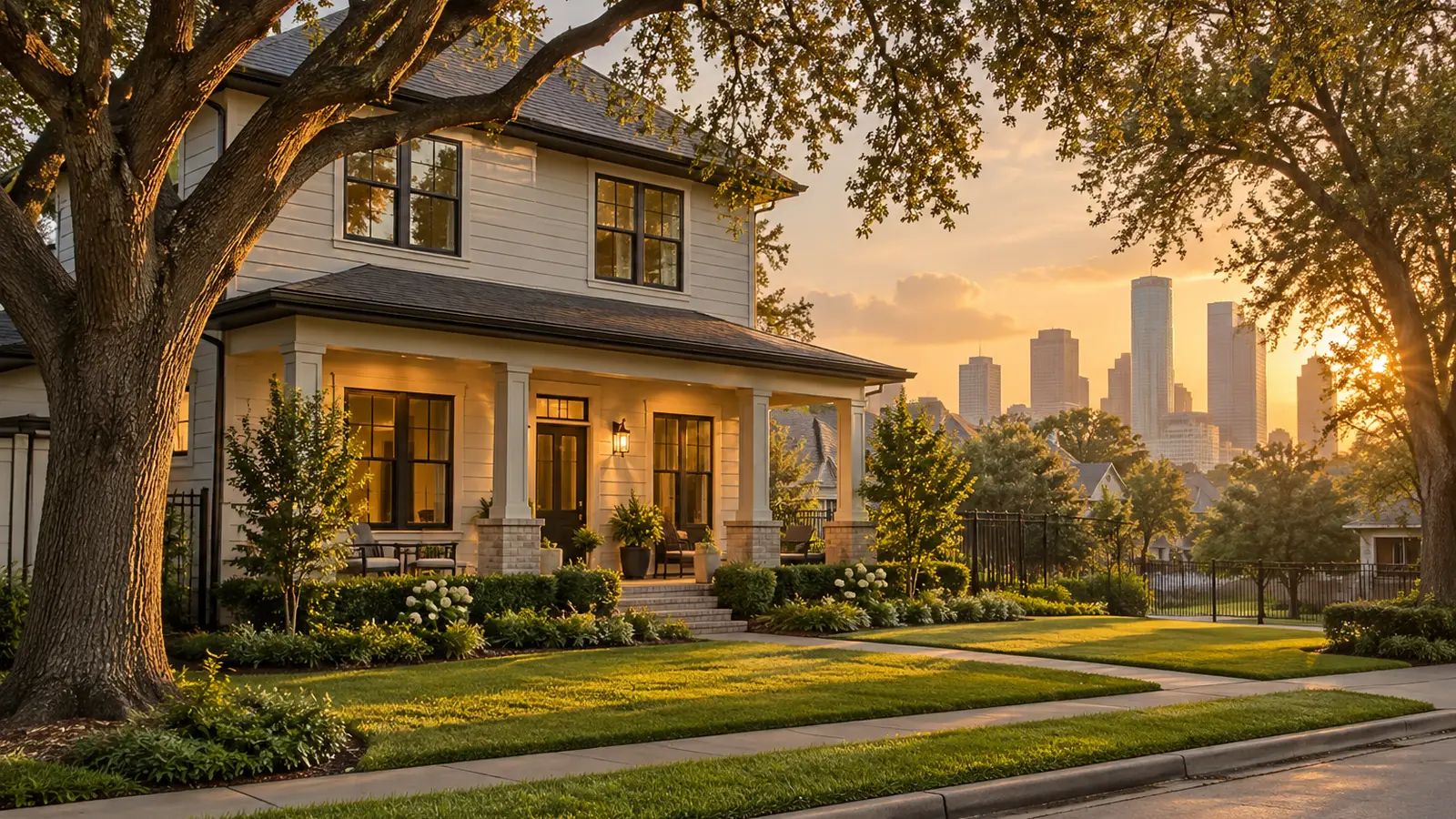
Short answer: yes, Houston can be a good short term rental market in 2026, but only for buyers who underwrite it honestly. Surge market data shows the typical area listing grossed about $30,600 over the last twelve months (entire-place listings about $34,300), at a $164 average daily rate and 56.4% occupancy, with revenue up roughly 8% year over year. Those are solid numbers for a big Texas metro, but they are lower than Austin, Dallas, or Galveston, and the median deal bought with a mortgage at today's prices does not cash flow on its own. The buyers who win here pick the right submarket, buy the right size home, and run it like a business.
This guide covers what a Houston short term rental investment really looks like right now: the market numbers, the top submarkets, the city's registration ordinance, the 17% hotel tax, the demand drivers that keep guests coming, how DSCR financing works, and a worked example with every assumption labeled so you can swap in your own.
Houston STR Investment at a Glance (2026)
| Item | Houston figure | Source |
|---|---|---|
| Average annual revenue, all listings | about $30,600 | Surge market data, Aug 2026 |
| Entire-place listings | about $34,300 | Surge market data |
| Houses / apartments and condos | about $33,200 / $26,500 | Surge market data |
| Average daily rate | $164 all, $187 entire homes, $193 professionally managed | Surge market data |
| Occupancy | 56.4% | Surge market data |
| Year-over-year revenue | about +8% | Surge market data |
| City registration | $275 per property per year | City of Houston, Code Sec. 28-731(a) |
| Platform delisting of unregistered listings | notices begin January 1, 2027 | houstontx.gov |
| Hotel occupancy tax | 17% (6% state, 7% city, 2% Harris County, 2% sports authority) | Texas Comptroller |
One caveat before you use any of these numbers: the market data covers the Houston metro, not only the city limits. It blends a Montrose bungalow, a Clear Lake ranch home, and a Lake Conroe vacation rental. The submarket table below breaks the area apart.
Is Houston a Good Market for a Short Term Rental in 2026?
The honest answer is "it depends on the deal." Here is how Houston stacks up against the other big Texas markets on the same data pull:
| Market | Median revenue | ADR | Occupancy | YoY |
|---|---|---|---|---|
| Galveston | $45,175 | $318 | 45.1% | +6.2% |
| Austin | $41,291 | $216 | 57.8% | +0.3% |
| Dallas | $39,947 | $203 | 60.2% | +9.1% |
| Fort Worth | $35,693 | $186 | 58.2% | +3.6% |
| San Antonio | $34,819 | $188 | 55.4% | +1.6% |
| Houston | $30,619 | $164 | 56.4% | +7.9% |
It has the lowest average revenue of the six, but also one of the fastest growth rates and occupancy in line with the rest of the state. What the table does not show is cost: home prices here are generally lower than Austin's, so a smaller revenue number can still produce a better return on the cash you put in. Revenue only means something next to the price you pay.
Three things make this market attractive to investors:
- Demand that is not purely seasonal. Medical travel, energy work, conventions, and stadium events spread reservations across the year instead of concentrating them in one summer peak.
- Clear, legal path to operate. Unlike Fort Worth, which bans STRs in most residential districts, or Dallas, whose rules are tied up in court, the city allows short term rentals everywhere with a simple registration.
- Lower entry prices than Austin. That keeps the math within reach for buyers using a DSCR loan.
And three things work against it: lower nightly rates than other big Texas cities, a large and growing supply of listings, and hurricane and flood exposure that pushes insurance costs up. If you want a deeper look at income by property size, read our guide on how much you can make on Airbnb in Houston.
Houston Market Data: Revenue, ADR and Occupancy
Four numbers drive every projection.
Average daily rate
The average daily rate is what listings actually book at. Across the metro it is $164.05 for all listings and $186.86 for entire homes. Professionally managed listings book at $193.12, which is the clearest sign that pricing and presentation move the number.
Occupancy
Metro occupancy is 56.4%, meaning a typical listing books a little more than half of its available nights. Do not underwrite a new listing at 75% because a seller's spreadsheet says so. If a home has no booking history, start near the submarket average and treat anything above it as upside.
Annual revenue by home type
Houses earn about $33,200 a year and apartments and condos about $26,500. Revenue grows with bedrooms and sleeping capacity much faster than the nightly rate does, which is why groups, families, and work crews favor larger homes.
Seasonality
The local calendar is flatter than a beach or ski market, but it still moves. Summer travel, the spring rodeo season, and big conventions lift demand; winter and late summer can soften. Plan cash reserves for the slow months instead of cutting rates to the bone.
Best Houston Neighborhoods and Submarkets for STR Investors
Surge market data splits the metro into 53 submarkets. Here are the top ten by average annual revenue (August 2026):
| Submarket | Annual revenue | ADR | Occupancy |
|---|---|---|---|
| Angleton | $39,210 | $122 | 56% |
| The Woodlands | $36,131 | $205 | 60% |
| Seabrook | $35,790 | $209 | 58% |
| La Porte | $34,057 | $167 | 63% |
| Rice Military | $33,766 | $182 | 59% |
| Greater OST | $33,239 | $201 | 54% |
| Clear Lake City | $32,774 | $162 | 61% |
| Sheldon | $32,718 | $200 | 51% |
| Lake Conroe | $32,610 | $231 | 46% |
| Tomball | $32,535 | $195 | 56% |
At the bottom, Missouri City ($19,959), Rosharon ($19,384), and Kashmere Gardens ($18,268) earn about half as much. Neighborhoods a few miles apart behave like different markets.
Two lessons for buyers:
- The top of the list is not the tourist core. Bay-area towns like Seabrook and La Porte, and suburbs like The Woodlands, beat the inner loop on revenue. Several of these sit outside the city boundary, so the city ordinance may not apply, but county rules, HOA rules, and other city codes might. Check each one.
- High ADR and high occupancy rarely live in the same area. Lake Conroe books at $231 a night but fills only 46% of nights; La Porte books at $167 and fills 63%. Both can work. What fails is buying in a high-rate area and assuming high occupancy too.
Demand Drivers: TMC, NRG, Downtown and the Galleria
A good short term rental needs a steady reason for people to come. This metro has several.
Texas Medical Center
The Texas Medical Center describes itself as the largest medical complex in the world, with about 10 million patient encounters a year and the world's largest children's and cancer hospitals. That creates demand from patients in extended treatment, their families, travel nurses, and visiting doctors. These guests book longer stays and value a full kitchen, laundry, parking, and a quiet street. Homes within a short drive of TMC that offer those things often fill weekdays that leisure guests leave empty.
NRG Park
NRG Park, just south of the medical center, hosts stadium games, concerts, and large events throughout the year. Event weekends are short, sharp spikes in demand. A good pricing system raises rates for those dates months ahead instead of selling them at the normal rate.
Downtown and the convention district
The George R. Brown Convention Center anchors downtown's convention business, and the city is reworking the convention district to connect it with the East End. Conventions bring business guests and groups who want walkable, central stays. EaDo, Midtown, and the East End sit close by.
The Galleria and Uptown
The Galleria and Uptown area mixes shopping, offices, and hotels west of the loop, so it sees both corporate and weekend travel. Expect more competition from hotels here, so a short term rental needs something a hotel room lacks: space, a kitchen, parking, or room for a group.
Energy, aerospace, and the port
The Energy Corridor, the industrial east side, and the Clear Lake area near NASA bring project crews and contractors who stay weeks at a time. That helps explain why La Porte, Seabrook, and Clear Lake City rank so high in the submarket table.
Houston Short Term Rental Rules: The City Ordinance
The city adopted its short term rental ordinance (Ordinance 2025-322) in 2025, and a certificate is required for each home. It does not ban STRs or cap them by neighborhood. It requires every operator to register. The City of Houston Administration and Regulatory Affairs department is the appropriate city department; its site holds the registration portal and guides. The city defines a short term rental as a dwelling unit, or any portion of a dwelling unit, rented for less than 30 consecutive days.
Key rules, current as of October 2026:
- Registration certificates: each property operating within the city limits needs a certificate of registration. The fee is $275 per property per year (Code Sec. 28-731(a), City-Wide Fee Schedule). The portal may add a small city administrative charge per application.
- Listing numbers: once you register, you must give your city registration number to every listing platform, and listings must show the registration number and maximum occupancy.
- Delisting starts January 1, 2027: on that date the city will begin asking platforms to remove listings without a certificate. If you applied but never received an approval email and certificate, the city treats your property as non-compliant.
- Emergency contact: a person or call center authorized to respond to emergencies within one hour of being notified, posted inside the home.
- Human trafficking awareness training for the registrant.
- HOT proof: listings only on Airbnb do not need proof of hotel tax payment; listings on other platforms or direct booking sites must show proof of HOT remittance or registration.
- Operating rules: no stays shorter than one night, no advertising or allowing special events like bachelor parties or receptions, and compliance with city noise, trash, building, and fire codes. Post the certificate inside the front entrance.
The ordinance does not override HOA covenants or deed restrictions, which are common in local subdivisions. Many buyers in a suburban subdivision learn too late that the HOA bans rentals under 30 days. Read the deed restrictions and HOA rules before you buy, and ask your real estate agent to request them during the option period. For the full legal breakdown, see our Houston short term rental laws guide and the statewide Texas Airbnb laws guide.
This article is general information, not legal or tax advice. Rules change; confirm with the city and a qualified professional before you buy.
Hotel Occupancy Tax: 17% in Houston
Guests here pay a combined 17% hotel occupancy tax. The Texas Comptroller breaks it down: 6% state, 7% city of Houston, 2% Harris County, and 2% Harris County-Houston Sports Authority. The tax is paid by the guest, but the owner or operator is responsible for making sure it is collected and remitted. Airbnb collects and remits many Texas hotel taxes for its listings; other platforms and direct reservations may leave filing to you. Our Texas short term rental taxes guide walks through who collects what.
For underwriting, the important point is that HOT is added on top of your nightly rate. A $187 night becomes about $219 to the guest before cleaning and platform fees, so price with the full guest total in mind.
Financing a Houston STR: How DSCR Loans Work
Many investors finance short term rentals with a DSCR (debt service coverage ratio) loan. Instead of qualifying mainly on your personal income, the lender looks at whether the property's income covers its debt payment.
The ratio is simple: DSCR = net operating income / annual debt service. A ratio of 1.0 means the home's income exactly covers the mortgage payment; above 1.0 means it covers it with room to spare. Each lender sets its own minimum ratio, down payment, rate, and rules for how it counts short term rental income (some use market reports, some use a history of reservations, some use long-term rent). Ask each lender for its written terms; we do not recommend specific lenders.
Two practical points:
- Run the DSCR math yourself before you make an offer, using the submarket average, not a best-case projection.
- Gulf Coast insurance can be expensive, especially in flood-prone areas. Get a real quote, including flood coverage, during your option period. It changes the ratio.
Worked Example: Does a Typical Houston STR Cash Flow?
Here is a simple example. Every input is labeled. Surge market data provides the revenue; everything marked "assumption" is a placeholder you should replace with your own quotes.
| Line | Amount | Basis |
|---|---|---|
| Purchase price | $300,000 | Assumption |
| Down payment (25%) | $75,000 | Assumption |
| Loan, 30 years at 7.5% | $225,000 | Assumption (rate) |
| Gross booking revenue | $34,328 | Surge market data, entire-place average |
| Platform fees (about 15%) | -$5,149 | Airbnb host-only fee range |
| Management (15%) | -$5,149 | Full-service rate |
| Property tax (2.2%) | -$6,600 | Assumption |
| Insurance | -$3,000 | Assumption |
| Utilities and internet | -$4,200 | Assumption |
| Repairs and supplies | -$3,000 | Assumption |
| City registration | -$275 | City of Houston |
| Net operating income | $6,955 | |
| Annual mortgage payment | -$18,879 | Calculated |
| Annual cash flow | -$11,924 | |
| DSCR | 0.37 | NOI / debt service |
Cleaning is treated as passed through to guests, and hotel tax is excluded because the guest pays it. Even so, the average entire-place listing at these assumptions loses money with a mortgage attached. That is the honest picture.
What would it take to break even? With the same costs, the home would need about $51,400 in gross revenue a year. That is roughly 1.5 times the market average: realistic for a well-run, larger home in a strong submarket, unrealistic for an average two-bedroom. The other levers are a lower purchase price, a bigger down payment, or a lower rate.
The takeaway is not "don't invest in Houston." It is: buy on numbers that work at average performance, and treat strong management as upside rather than the plan.
STR Laws, Permits and Regulations: What Changed for Operators
Before 2025, operators in Houston TX could list a home with no city permit at all. That changed with the ordinance. The registration process now means every STR operator must apply, provide documents, and comply with operating rules, and the city can request removal of listings that lack a certificate. For investors, the change is mostly good news: the law sets clear standards instead of a ban, and it gives the city a tool against problem properties that create noise and safety concerns for the community.
What the regulations ask of operators in practice:
- Have your documents ready before you start: registrant details, property address, emergency contact, platform links, HOT proof where required, and owner authorization if you are not the owner. The portal does not let you save and return; an unfinished application must start over after one hour.
- Follow the posted requirements inside the home, including the certificate and an emergency contact for emergencies.
- Expect enforcement to begin in earnest in 2027. Operators found violating the ordinance risk losing their listings, which is a bigger financial hit than most fines.
If you are new to STR permits in Texas, the city's question line (832-394-8802) and str@houstontx.gov can answer specific questions. Search the city site for the latest guides, since the process has changed since launch.
STR Profitability: Insight From the Data
Profitability in this market comes down to three questions. First, what is the realistic revenue potential for this exact home type in this exact submarket? Second, what does it cost to own and operate, including insurance, taxes, and management? Third, what did you pay? A map of comparable listings and their calendars gives more insight than any citywide average. In addition, consider your options if the STR plan underperforms: a furnished mid-term rental to medical travelers near TMC, or a standard lease. Homes that work under more than one plan carry less risk.
Step-by-Step Due Diligence Before You Buy
- Confirm location: is the home inside the city boundary? If so, the ordinance applies. If not, check the other city or county rules.
- Check HOA covenants and deed restrictions for minimum rental periods.
- Pull submarket data for comparable homes with the same bedroom count, not the city average.
- Get insurance and flood quotes during your option period.
- Run the DSCR and cash flow math at average occupancy.
- Budget setup costs: furniture, linens, smart lock, photos, and the $275 registration.
- Register before you list, and add the number to every listing.
- Set up hotel tax filing if you will take reservations outside Airbnb.
Our guide to the cost of running an Airbnb in Texas covers operating expenses in more detail, and Airbnb cleaning costs in Houston breaks down turnover pricing.
Managing Your Houston STR: Self-Manage or Hire Help
The gap between average and top performers comes from pricing, photos, response time, reviews, and clean turnovers. You can do all of that yourself if you live nearby and have the time. Many out-of-town operators hire a manager instead. If you do, compare full-service fees, what is included, and the exit terms in writing. Our roundup of the best Houston Airbnb management companies compares local options.
Frequently Asked Questions
Is Houston a good place to invest in short term rentals?
It can be. Houston has steady year-round demand, a legal registration path, and lower prices than Austin, but nightly rates are lower than most big Texas markets. The deal works when the purchase price fits the submarket's real revenue.
How much does an Airbnb make in Houston?
About $30,600 a year across all listings and about $34,300 for entire-place listings, based on Surge market data for the past twelve months. Top submarkets average $32,000 to $39,000.
Do I need a permit for a short term rental in Houston?
Yes. Properties within the city limits need a certificate of registration from the city, which costs $275 per year. Starting January 1, 2027, the city will ask platforms to remove unregistered listings.
What is the hotel tax on Airbnb in Houston?
17%: 6% state, 7% city, 2% Harris County, and 2% sports authority.
Can I use a DSCR loan for a Houston Airbnb?
Many investors do. A DSCR loan qualifies the property based on its income versus its debt payment. Terms vary by lender, so get written terms and run the ratio at average performance.
Which Houston neighborhoods earn the most?
In Surge market data, Angleton, The Woodlands, Seabrook, La Porte, and Rice Military lead on average annual revenue. Inside the loop, homes near the Texas Medical Center and downtown benefit from weekday demand.
Thinking About a Houston Short Term Rental?
Surge manages short term rentals for owners in Texas and Florida, with Houston management starting at 15% for full service. We handle pricing, guest messaging, cleaning, compliance, and registration so your home earns what the data says it can. See our Houston Airbnb management page for a free revenue estimate.

Written by
Humberto MarquezFounder, Surge
Founder of Surge and licensed Texas real estate broker. Manages short-term rentals across 12 U.S. markets and invests in STRs himself. Quoted in Martha Stewart, Yahoo Finance, Realtor.com, Bob Vila.
More about Humberto →See what your property could earn with Surge
Full-service short term rental management across Texas and Florida. Get a free property assessment and revenue estimate, no commitment.